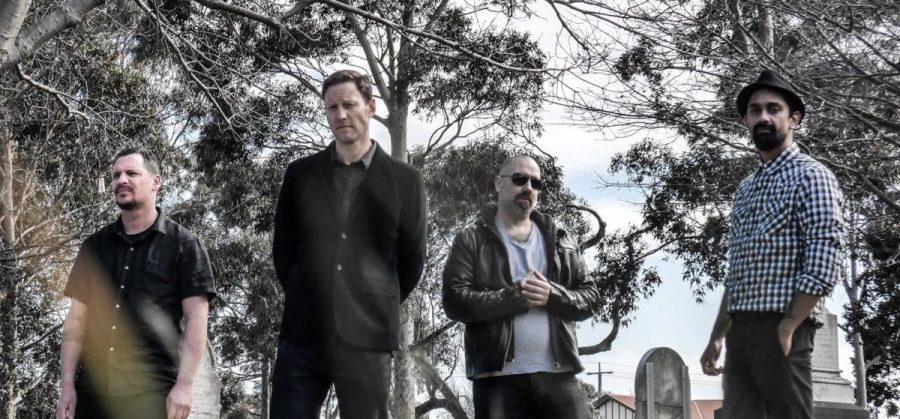
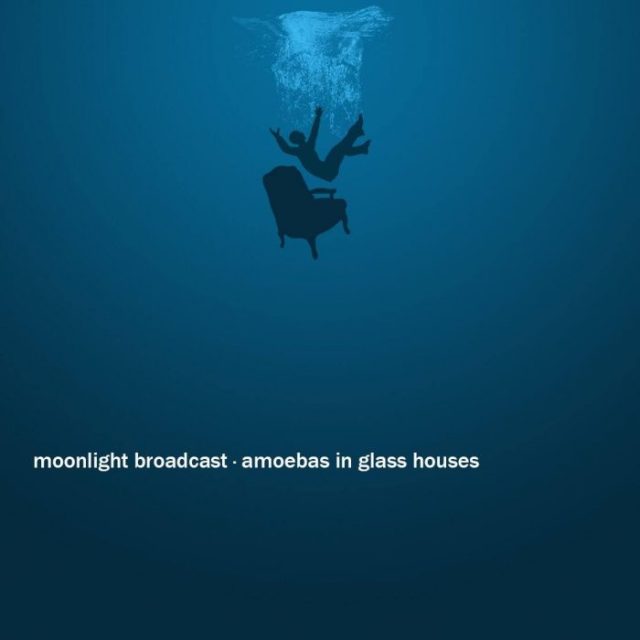
Moonlight Broadcast is an alternative rock band hailing from beautiful Melbourne, Australia. Influenced by such greats as Crowded House, The National and Death Cab for Cutie, they write songs with memorable guitar-driven melodies and poignant lyrics about (in their own words) “the winding, bumpy road we’re all travelling on.” The band is comprised of Cameron (lead vocals), Adi (guitar), Craig (bass, backing vocals) and Ash (drums & mojo). They released their excellent debut EP A Cynic’s Guide to Dying Happy in February 2018 (you can read my review here), and after a two and a half year break, the guys are back at last with a terrific new single “Amoebas in Glass Houses“.
The song has a bouncy melody and lively mix of jangly guitars, humming bass and punchy drumbeats, creating a pleasing, upbeat vibe that contrasts with the rather depressing and brutally honest lyrics. Cameron says the song is basically about procrastination and living in a prison of one’s own making, not moving forward or achieving anything. The lyrics speak to turning inward and wanting to hide away from the world and just be left alone, yet something’s missing and you’re still feeling restless and unhappy as outside pressures build: “I’m floating around the lounge room, red-eyed and my cock in my hand / another Friday night and the walls are closing in / Cracks creeping up my window / I can’t stay here and I can’t go.”
Feelings of inadequacy and worthlessness are further compounded by seeing a beautiful and unattainable young starlett on TV: “Her physical beauty makes me want to curl up and die where I sit.” All these negative feelings have him pondering suicide as the only possible way out, though he doesn’t really want that: “There’s a tree I can see from my lounge room / limbs spread like an invitation late on Friday night and I probably need a friend.“
“Amoebas in Glass Houses” is a great song, and I’m so glad Moonlight Broadcast have graced our ears with new music.
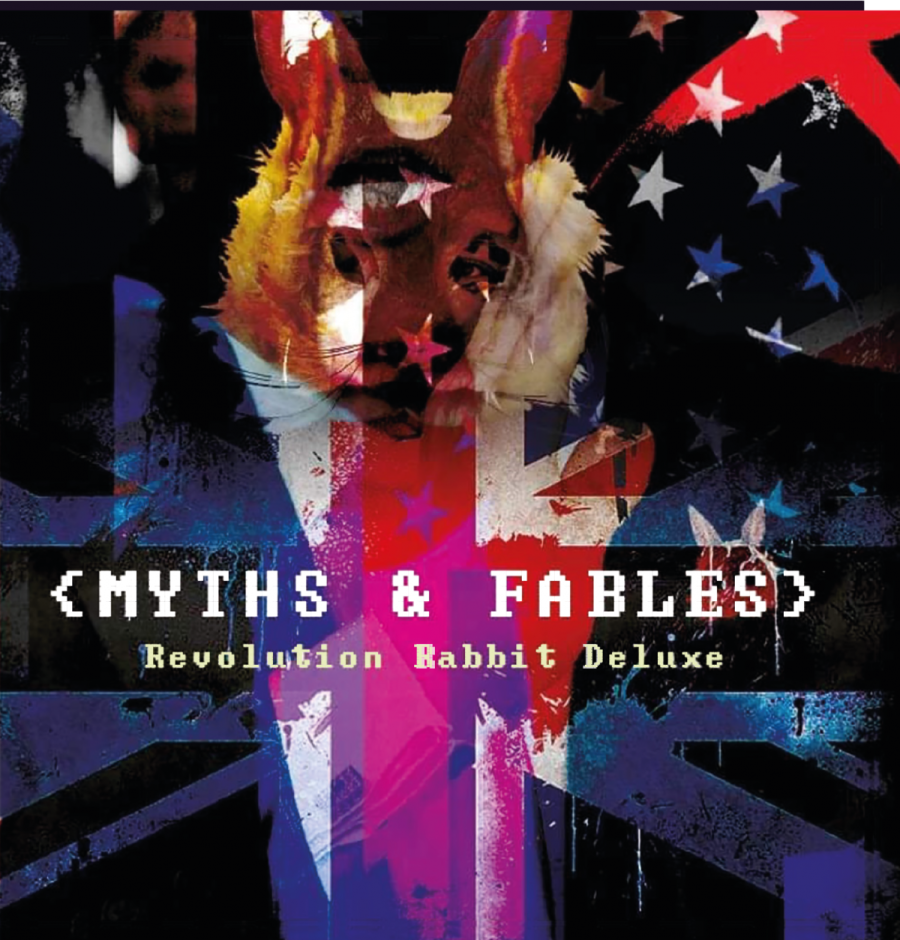
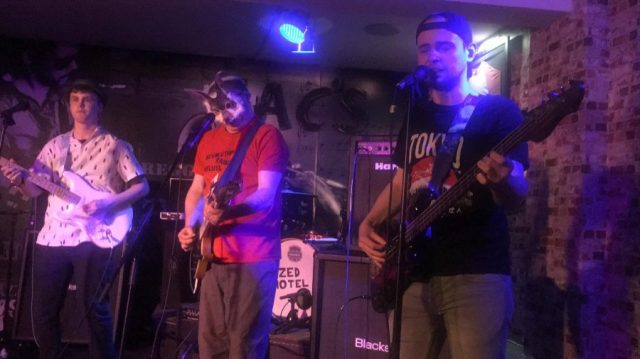
Revolution Rabbit Deluxe (RRD) is an indie alt-rock rock band hailing from south Wales. Their innovative and sometimes unorthodox music style and sound draw from Brit-rock, pop and punk influences, with meaningful lyrics tackling topical issues ranging from politics, culture and environmental justice to mental health. RRD started out as a solo project for founder and guitarist Rev Rab, but gradually evolved into a four-piece band that now includes Rev Rab on guitar and lead vocals, Dan on guitar and backing vocals, and Ben on bass and backing vocals. Their drummer Nick, who played drums on their latest album, recently left the band.
With two previous albums under their belt – Tales From Armageddonsville and Swipe Left (you can read my reviews by clicking on the Related links at the bottom of this page) – RRD is back with their third album Myths and Fables. Like their previous albums, Myths and Fables is a concept album of sorts, in that its overall theme addresses politics, the media, and societal myths like celebrity and fame that people blindly accept as truths. It also has a darker and edgier feel, both lyrically and vocally, with Rev Rab sounding angrier and more frustrated than ever.
The album kicks off with “Generation Voyeur”, a song about the addictive allure of social media, specifically a person who documents everything from what they last ate, to their most intimate personal dramas and trauma. But in a broader sense, it speaks to the voyeuristic nature of society and our attraction for watching a personal train wreck: “There’s a time and a place and a space for disgrace. And then we took a look. He fell down from the ledge as we pushed from the edge. And then we took a look. She cried out to above as she died without love. And then we took a look.” The strong pulsating beat is overlain with spooky psychedelic industrial synths and rolling riffs of gnarly guitars, giving the track an almost sinister vibe.
On “Killswitch”, RRD decries the cannibalistic profiteering by corporations in monetizing and selling our personal information: “Turning the on switch off / They tell you it’s progress, it’s progress baby / Stealing your life away / They tell you it’s progress, it’s progress baby. They’ll thrill you, betray you, then they’ll bill you / It’s big business now.” I like the song’s urgent chugging psychedelic groove and mix of sharp chiming guitars and grimy distorted riffs, along with the shrill sounds of what seem to be steel train wheels breaking on a track.
The title track “Myths and Fables” sees RRD railing about tired and ubiquitous old saws and platitudes people have repeated for years like “it’s better to have love and lost” or “all roads lead to Rome”, and how they’re just meaningless bullshit that never result in action: “It’s time for truth, open eyes, no secret lies / It’s time to choose, we’re outa time / The planet burns and we choose lies.” And on “Channel 5” he laments about the depressing effects of TV news: “And you’re watching it live, on channel five / You’re taking me down, taking me down down down / I don’t want to drown.“
One of my favorite tracks is “Pretty Escarpment”, with it’s bouncy yet melancholy opening piano riff and ensuing galloping rhythms. The lyrics speak of a past love who wasn’t a good match, but whose memory still haunts you: “Too many memories in your shade / Too many echoes from your walls / Do I get up and walk away or stand at the edge and plunge into the pretty ravine that held my eyes / The pretty escarpment built from lies...” “Superstar” is a cheeky take down of superstar celebrities, with their superficial and often excessive lifestyles: “You drive a big fast car / You travel ‘round with your harem of young blondes / You say they keep you young / Any younger you’ll reenter your mother’s womb.”
“Battle Hymn (Of the New Republic)” seems to be an attack on the nationalistic attitudes that resulted in Brexit and the election of leaders like Boris Johnson and Trump. Lets take care of ourselves and screw everyone else. “The track’s jaunty melody contrasts with the biting lyrics “Tell me you feel safe in this land of hope and Tory / Will anybody stand or take the cheque and plead the fifth / We excuse ourselves, denying our responsibility / Taking all we can, we screw the system / It’s do or be done or be damned.”
This theme continues on “TV Junkies”, with RRD calling out politicians and the media for feeding us an endless stream of fear and lies to keep society divided and angry, not to mention upping their ratings: “In darkened rooms throughout the land TV junkies get sky high / They throw us targets for our hate / They fan the flames and toy with fate.” I think we can all identify with the powerful sentiments expressed in this song, regardless of our political persuasion.
While I don’t think Myths and Fables is quite as strong an album as Tales From Armageddonsville or Swipe Left, it’s still a solid work filled with songs featuring timely and compelling lyrics, along with some terrific instrumentals.
Though many music writers and critics believe The Pretenders debut album Pretenders is their best work (in 2013 Rolling Stone Magazine named it the 13th best debut album of all time), I prefer their third album Learning to Crawl on the strength of its outstanding tracks like “Back on the Chain Gang”, “Middle of the Road”, “Show Me”, “Time the Avenger” and “My City Was Gone”. While I’d liked their 1980 breakthrough hit “Brass in Pocket” well enough, it was the bittersweet “Back on the Chain Gang”, with its jangly guitars, haunting lyrics, Chrissie Hynde’s distinctive lilting vocals, and the chain-gang chant in the chorus that really caught my attention. To this day, the song remains one of my favorites of the 1980s.
Learning to Crawl was literally a phoenix rising from the ashes, as it was recorded in the wake of upheaval and tragedy for the band and, as such, many of its songs deal with various aspects of loss. In June 1982, after they finished touring in support of their commercially and critically disappointing second album Pretenders II, Hynde and fellow band members guitarist James Honeyman-Scott and drummer Martin Chambers fired bassist Pete Farndon over his diminishing performance resulting from his escalating heroin abuse. Two days later, Honeyman-Scott died of heart failure brought on by his own cocaine abuse. (Sadly, Farndon would die 10 months later by drowning in a bathtub after passing out from a heroin binge.)
Band lineup for the recording of Learning to Crawl, including Malcolm Foster, Martin Chambers, Chrissie Hynde and Robbie McIntosh
Hynde and Chambers decided to soldier on in grief. In a 1984 interview with Rolling Stone Magazine, Hynde said, “What else were we going to do? Stay at home and be miserable, or go into the studio and do what we dig and be miserable?” A month after Honeyman-Scott’s death, Hynde hired Big Country bassist Tony Butler and Rockpile guitarist Billy Bremner, along with Robbie McIntosh (who would go on to become the band’s lead guitarist) to record a new single “Back on the Chain Gang” along with its B-side “My City Was Gone” (with its now iconic thumping bass groove that the execrable Rush Limbaugh later adopted as the theme for his radio show).
The single was released that September, and would become The Pretenders’ highest-charting single in the U.S. (“Brass in Pocket” is their highest-charting single in the UK.) Hynde wrote “Back on the Chain Gang” as a tribute to Honeyman-Scott and dedicated it to him. The song was also written during her strained on-and-off relationship with Kinks front man Ray Davies, and recorded when she was three months pregnant with their daughter. They split up for good six months later.
Through the rest of 1982 and into 1983, in between having and raising a baby and mourning Farndon (who died in April 1983), Hynde would periodically return to the studio with Chambers, new guitarist Robbie McIntosh and new bassist Malcolm Foster to record songs for an album she would name after her baby daughter Natalie’s first attempts to become mobile. In a sense, Learning to Crawl could also be a metaphor for The Pretenders regaining their footing as a band. The album was finally released in January 1984, receiving unanimously positive reviews. With regard to the notion that the album’s songs are mostly about loss, in that 1984 Rolling Stone interview Hynde was dismissive, saying, “It’s just a collection of 10 measly songs. It’s not a real important deal. I hate this sort of romantic or sentimental take people have on it—you know, the tragic demise, the reawakening. It wasn’t like that at all. I even regret naming the album ‘Learning To Crawl’, because it just sounds pathetic. I mean, I’m not sentimental.”
Be that as it may, many tracks do speak to a sense of loss, whether it be missing a loved one on “2000 Miles”, happier times on “Back on the Chain Gang”: “I found a picture of you / Those were the happiest days of my life.”, the “pretty countryside” surrounding her childhood home of Akron, Ohio ruined by urban sprawl and over-development on “My City Was Gone”, or one’s dignity and reputation in the wake of an adulterous affair on “Time the Avenger”: “Nobody’s permanent / Everything’s on loan here / Even your wife and kids / Could be gone next year”.
The band’s strong and incredibly tight musicianship is nicely showcased on several tracks. One of my favorites is the rousing album opener “Middle of the Road”, with its aggressive driving beat and stellar guitar work. Highlights for me are Chambers’ blasting drumbeats, McIntosh’s dazzling guitar solo in the bridge, and Hynde’s angry growl as she launches into her blazing harmonica solo toward the end. It’s such a great song, and I never understood why it wasn’t a bigger hit (it peaked at only #19 on the Billboard Hot 100).
Another favorite is the stunning “Show Me”, a hopeful plea for love and humanity as an antidote for mankind’s inherent tendencies for conflict: “Welcome to the human race, with its wars, disease and brutality / You with your innocence and grace restore some pride and dignity to a world in decline.” The shimmery chiming and jangly guitars are gorgeous, and I love the intricate music touches such as the spacey little ascending guitar chord that plays when Hynde sings “Welcome here from outer space”.
“Time the Avenger” starts off with an infectious head-bopping beat, throbbing bassline and simple guitar riff, then gradually builds into a storm of Hynde’s and McIntosh’s intertwining riffs that’s downright exhilarating. The band seems to give a nod to Johnny Cash on “Thumbelina”, a lively rocker with a chugging train-style rhythm beautifully expressing the cross-country journey of a mother and her child as they head toward a new beginning.
One of the earliest songs recorded for the album was the beautiful cover of the Persuaders’ hit “Thin Line Between Love and Hate”, in which guitar was played by Billy Bremner, bass by Andrew Bodnar and piano by Paul Carrack (formerly of Squeeze, Ace and Roxy Music). “Watching the Clothes” is not a particularly strong track, though I do like its frantic punk rock vibe. The lyrics speak to the boredom of dealing with chores, but also to toiling in the service sector at a dead-end job: “I’ve been kissing ass / Trying to keep it clean / So that the middle class has a clean routine.”
In the years following the release of Learning to Crawl, The Pretenders would unfortunately continue to experience more internal upheaval and numerous changes in lineup. From what I can tell, some of it seems to stem from Hynde’s perfectionism and mercurial nature. Soon after recording sessions began for their next album Get Close, she declared that Chambers was no longer playing well and dismissed him. Discouraged at the loss of his bandmate, Foster then quit, leaving Hynde and McIntosh to record the rest of the album in New York and Stockholm with assorted session musicians. Despite all the upheaval, the Pretenders are still going strong in 2020, and in July dropped their 11th album Hate For Sale, which is actually pretty good.
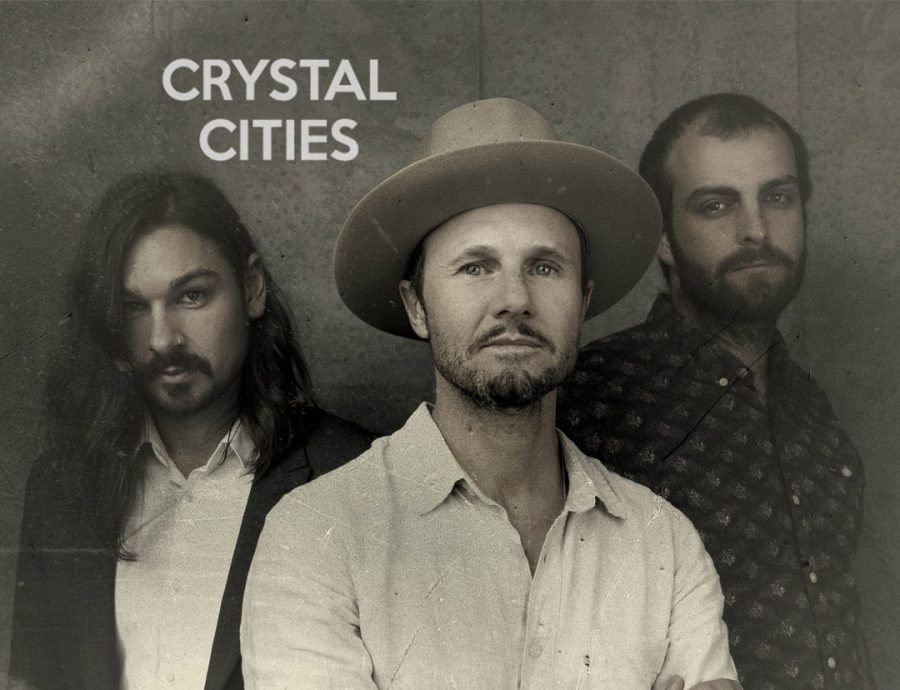
Ever since first hearing their stunning and critically-acclaimed debut EP Who’s Gonna Save Us Now in early 2017, I’ve been head over heels in love with the music of Sydney, Australia-based dream rock band Crystal Cities. With a sound they describe as “like Death Cab For Cutie had a War On Drugs with The Beatles” – all three bands I love – it’s no wonder I would love their beautiful music too. The supremely talented trio consists of Geoff Rana (vocals, guitars, keyboard), Jared King (bass, backing vocals) and Daniel Conte (drums, percussion).
In 2019, the guys had the opportunity to record their gorgeous debut album Under the Cold Light of the Moon at the famed Abbey Road Studios. The album featured eight stellar dream rock gems, most with lush orchestral arrangements and instrumentation. The dramatic title track “Under the Cold Light of the Moon” was inspired by the story of young North Korean girl Yeonmi Park. who bravely escaped North Korea in search of freedom. I reviewed the song, and loved it so much that it went to #1 on my Weekly Top 30, and ranked #10 on my Top 100 Songs of 2019 list. The album helped further cement their reputation as an outstanding group of exceptional songwriters and musicians. In recent weeks, they’ve posted back stories with lyrics for each of the album’s tracks on their Instagram page.
Now, Crystal Cities return with their latest single “Don’t Speak Too Soon“, which I’ve chosen as my New Song of the Week. The song, which drops today, August 21st, is the lead single from their forthcoming second album Hold Me Close Hold Me Tight. Both single and album see the band taking a different approach this time around, foregoing the fancy studio and producer and instead choosing to produce the album themselves.
With that in mind, at the beginning of this year, lead singer/guitarist and primary songwriter Geoff Rana decided to learn all the ins and outs of recording. With the help of free educational resources such as YouTube, he began putting his new-found knowledge to work as he tracked “Don’t Speak Too Soon” at his house in Sydney. It was definitely a trial and error experience, and the added responsibility and steep learning curve nearly overwhelmed him. “‘Don’t Speak Too Soon’ is my first attempt at being an engineer and producer. It was a lot more involved than just showing up to the studio to record my parts! I think more hours were spent reading and watching tutorials than actually recording. One of the biggest mental and technical hurdles I had to overcome was losing all my vocal takes and having to re-record them all over again.”
Well, I’d say that Rana did a masterful job, as “Don’t Speak Too Soon” turned out splendid. With the help of renowned L.A.-based mix engineer Paul Lani (David Bowie, Prince), the band has produced another winning single that retains their signature dream rock elements while delivering a more hard-hitting and edgier vibe. The frantic, guitar-driven melody is downright electrifying, and I think it’s the most exciting song Crystal Cities has done yet. Rana sets the airwaves ablaze with blistering riffs of jangly and gnarly guitars. I always thought he was a great guitarist, but here he blows me away with the sheer ferocity of his performance.
Jared King and Daniel Conte keep the powerful rhythm rampaging forward with their hard-driving bassline and smashing drumbeats. I especially love how Conte pounds out a single thumping blow to his drums at various breakpoints in the song to great effect. Then there’s Rana’s hauntingly beautiful vocals that are another highlight for me, as I love his singing voice. With a sense of sad resignation, he passionately laments that perhaps he overplayed his hand in love: “And it burns my eyes down through the bone. Why did I listen to love? Did I speak now too soon?“
I’ve loved every single one of Crystal Cities’ songs, and happily add “Don’t Speak Too Soon” to the list. Spectacular job guys!
The cool vintage-looking lyric video was produced by bassist Jared King.
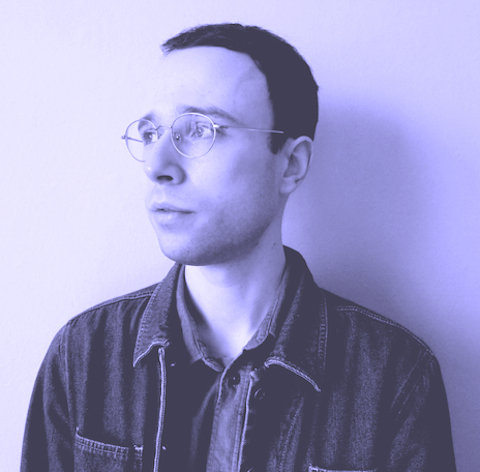
Benjamin Belinksa is an earnest and thoughtful young singer-songwriter and musician based in Newcastle, England. Born in Stoke-On-Trent to Welsh and Polish parents, Benjamin moved to Newcastle when he was 17, but soon thereafter spent time in Glasgow, Berlin, and then Paris, working at a series of menial jobs while also writing music as time permitted. After meeting fellow musician E.A.R in Paris, the two formed the band Paris, Texas, and released two albums with cult producer Kramer (Low, Will Oldham, Daniel Johnston). Eventually, they moved back to Newcastle together, where Benjamin suffered two serious setbacks: First, while rushing to catch a connecting train in York station, he left behind a suitcase containing most of his early songs, which he never recovered. Then, months later, he was viciously assaulted in a random attack by four guys in broad daylight as he was walking home from work, suffering injuries to his eye and throat that landed him in a hospital.
It was during his recovery period that he decided to stop drifting once and for all, and set down roots in Newcastle. He also got the impetus to write songs for what would become his debut solo album Lost Illusions, set for release on August 28. Thinking back on his years of drifting, and how it became an inspiration for the album, he told Ali Welford in an interview for NARC. Magazine: “Drifting is not a bad thing – it allows you to let go of many illusions, but still, they are very attractive. I wanted to grab hold of one again – namely, that I am the master of my own direction. The title ‘Lost Illusions’ is a reference to the childish disappointment that we all go through when we discover that the world is just a lot of silliness. But despite this, it only has one theme – the extraordinary sadness and wretchedness of human life, and my amazement at the fact that this wretched life can nevertheless be so beautiful and precious.”
On July 31st, Benjamin released “Young in Baltimore“, the lead single from the album. Like all the tracks on Lost Illusions, the song was recorded by Benjamin with a back-up band, and mixed and mastered at Soup Studio in London by Giles Barrett and Simon Trought. It’s a charming dream pop track, with a sunny, retro vibe that calls to mind some of the great soft rock and synth pop songs of the 1980s. The song has a lovely, upbeat melody, with a lively toe-tapping beat overlain by chiming synths and warm guitar notes. It all creates an enchanting soundscape that serves as a pleasing backdrop for Benjamin’s gentle, heartfelt vocals as he sings the bittersweet lyrics about a woman contemplating love’s regrets: “When you were young and dumb, he promised to make you his wife. Natural, and he’s cold, you say you’ve wasted your life.” The song also strikes a particular chord with me, as I grew up in San Jose, California, which is mentioned in the lyrics: “Was the winter in San Jose, yeah, the heart attack by the bay? What will you do, your past is blue, and your life is stuck there.”
About “Young in Baltimore”, Benjamin told me “While writing the song, I was thinking about the pressure to conform that we all go through, and how some of us enter into situations, relationships – not out of passion, but out of the illusion that we have no choice. I had moved to a new city, I was working a job I hated. I kept asking myself questions like ‘Have I made the right decision? Should I be doing this? Was it better before, when I was younger?’ I was also obsessed with Robert Frank’s photo-book ‘The Americans’, thinking about the people in those pictures, imagining their lives. I kept coming back to this image of a woman on a train. All of my regret, reluctancy and nostalgia collided with this image. It became a prism out of which another formed; somebody considering the end of a marriage. Only later did I realise it was a symbol of my life at that moment.
As for the bright-sounding music, it’s there to counteract the story. I was living in Glasgow at the time, too. It rains a lot there, so it was also in defiance of that. A rainy place needs sunny music.”
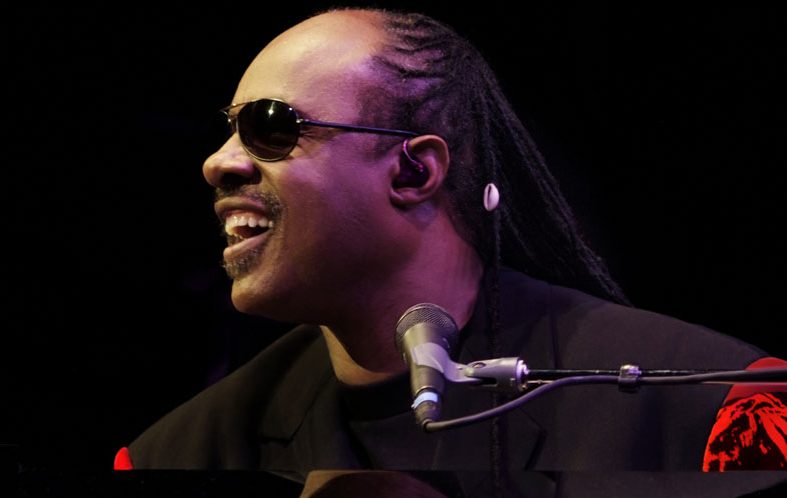
For as far back as I can remember beginning as a pre-teen, I’ve been a huge fan of Stevie Wonder; one of the earliest 45 singles I ever bought was “My Cherie Amour”. Of all the many albums he released over a career spanning more than 50 years, my favorite is his magnificent masterpiece Songs in the Key of Life.
Born Stevland Morris in 1950, he became blind shortly after his birth (he was born six weeks premature, and the oxygen-rich atmosphere in the hospital incubator aborted the growth of his eyes and caused his retinas to detach, resulting in blindness). Despite his handicap, he was a child musical prodigy, learning to play piano, harmonica and drums as a young boy. He signed with Motown’s Tamla label when he was only 11 years old, and first became known professionally as Little Stevie Wonder. In 1963, his single “Fingertips, Part 2” topped the Billboard Hot 100, making him the youngest artist to ever have a #1 song on that chart. He eventually dropped “Little” from his name, and in 1966 came roaring back as Stevie Wonder with his electrifying hit “Uptight”. From that point on he would practically rule the charts for the next 20 years.
Released in September 1976 when he was 26, Songs in the Key of Life was Wonder’s 18th album. It’s generally regarded as his magnum opus, and the culmination of his “classic period”, which began in 1972 with the releases of Music of My Mind and Talking Book, the latter of which included the song “Superstition”, which featured the distinctive sound of the Hohner Clavinet keyboard that came to define Wonder’s sound. His next three albums produced during this highly creative period – Innervisions, Fulfillingness’ First Finale and Songs in the Key of Life – all won Grammy Awards for Album of the Year, making him the only artist to have won the award for three consecutive album releases. In 1976, when Paul Simon won the Best Album Grammy for Still Crazy After All These Years, he quipped, “I’d like to thank Stevie Wonder, who didn’t make an album thisyear.”
Surprisingly, Songs in the Key of Life almost didn’t happen. Despite the fact that by 1975 Wonder was one of the most successful music artists in the world, with his three previous albums all critical and commercial successes, he seriously considered quitting the music industry. He’d become interested in humanitarian issues in Africa, and wanted to emigrate to Ghana to work with handicapped children. Fortunately for his music fans, he reconsidered and went on to sign a lucrative new contract with Motown to continue recording more albums.
The album was recorded primarily at Crystal Sound studio in Hollywood, with some sessions recorded at the Record Plant in Hollywood, the Record Plant in Sausalito, and The Hit Factory in New York. According to Wikipedia, during the recording process, Wonder would often stay in the studio 48 hours straight, not eating or sleeping, while everyone around him struggled to keep up. “If my flow is goin’, I keep on until I peak,” he said. A total of 130 people worked on the album, including notable jazz and R&B artists Herbie Hancock, who played Fender Rhodes on “As”, George Benson, who played electric guitar and sang backing vocals on “Another Star”, and Minnie Riperton and Deniece Williams, who sang backing vocals on “Ordinary Pain”.
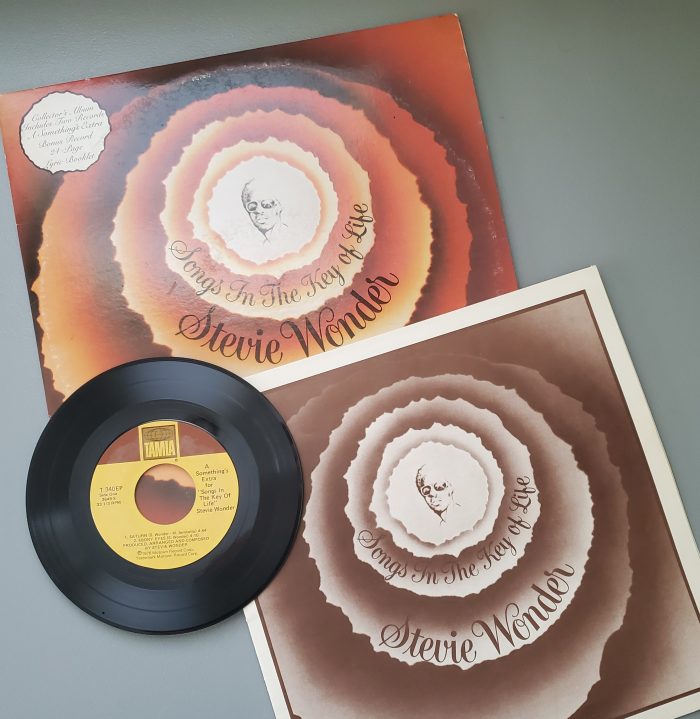
That Wonder’s creative flow kept going til he peaked is an understatement, as he ultimately recorded an astonishing 21 songs, released as a double album and a bonus 7-inch 45 featuring four tracks, along with a booklet containing all the song lyrics and credits. Incorporating a wide range of genres and music styles, including soul, R&B, pop, funk, jazz, gospel, Afrobeat and even classical, Songs in the Key of Life is widely considered one of the greatest albums ever recorded and his signature album. It’s the best-selling album of his long career, and ranks #4 on Rolling Stone Magazine’s most-recent 2020 list of The 500 Greatest Albums of All Time. In 2002, it was inducted into the Grammy Hall of Fame, and in 2005 was inducted into the National Recording Registry by the Library of Congress, which deemed it “culturally, historically, or aesthetically significant”.
The album is Wonder’s celebration of love, a testament to his faith, and his belief in the idea that love can conquer hate. In the booklet that accompanied the album, he wrote: “’Songs in the Key of Life’ is only a conglomerate of thoughts in my subconscious that my Maker decided to give me the strength, the love+love-hate=love energy making it possible for me to bring to my conscious an idea.” Opening track “Love’s In Need of Love Today” sets the tone for the album with Wonder’s heartfelt plea for people to put hate aside and try and love one another, a message that certainly bears repeating today: “Hate’s goin’ round/Breaking many hearts/Stop it please before it’s gone too far.”
Some of the album’s highlights are the big hits “I Wish”, a joyously upbeat song that sees Wonder reminiscing on the joys of his childhood, and “Sir Duke”, a jazzy tribute to the legendary Duke Ellington, both of which went to #1 on the Billboard Hot 100. Though not released as a single, “Isn’t She Lovely”, a loving ode to his baby daughter Aisha, went on to become one of his most beloved songs. But the album’s full of many more outstanding tracks and deep cuts like the gorgeous love song “Knocks Me Off My Feet”, the enchanting and hopeful “If It’s Magic”, the bittersweet “Summer Soft” and the pleasing multi-cultural gem “Ngiculela-Es Una Historia-I Am Singing”.
Two of my personal favorites are the spectacular Side 4 epic tracks “As” and “Another Star”, both of which were released as singles but failed to crack the Top 30. The soulful “As” has a beautiful, almost gospel feel, and encapsulates the album’s overall theme of the enduring power of love. Wonder sings “Did you know that true love asks for nothing/Her acceptance is the way we pay/Did you know that life has given love a guarantee/To last through forever and another day.” Wonder goes on to list all the ways his love will endure, then the song immediately segues into “Another Star”. An electrifying eight and a half minute long masterpiece, this song is one of my favorites on the album, and ranks among my all-time favorites of Wonder’s many great songs. I love the exuberant Latin beat, sunny keyboards and soulful guitars, but the highlights for me are the exhilarating horns, head-bopping percussion and Wonder’s jubilant vocals that warm my heart and bring a tear to my eyes. Though the lyrics speak of an unrequited love, Wonder extolls the virtues of his love interest with such joy that you just cannot help being swept up in his bliss. Both songs really showcase his phenomenal songwriting, musicianship and vocal abilities.
Wonder also addressed issues of racism and social injustice on such tracks as “Pastime Paradise”, “Village Ghetto Land” and “Black Man”, the latter two of which he co-wrote with radio DJ, poet, songwriter, producer, rapper, and community activist Gary Byrd. On the brilliant and haunting “Pastime Paradise”, Wonder speaks first to those who remain stuck in the past, clinging to their racist and bigoted beliefs, then to the victims of that institutional racism, bigotry and other forms of oppression, “living in a future paradise/looking in their minds for the day that sorrow’s gone from time.” He admonishes us to start “living for the future paradise”, and “Shame to anyone’s lives living in a pastime paradise.”
On “Village Ghetto Land”, Wonder uses a sedate classical minuet as a lovely musical backdrop that sharply contrasts with the biting lyrics that speak to the harshness of ghetto life: “Broken glass is everywhere/It’s a bloody scene/Killing plagues the citizens unless they own police/Children play with rusted cars/Sores cover their hands/Politicians laugh and drink – drunk to all demands.” The urgent, jazz/funk infused eight and a half minute long “Black Man” speaks to the accomplishments of often-overlooked people of color: “Heart surgery was first done successfully by a black man/The railroads for trains came on tracking that was laid by the yellow man/Friendly man who died but helped the Pilgrims to survive was a red man/Farm workers’ rights were lifted to new heights by a brown man/And the leader with a pen signed his name to free all men was a white man.” The song ends with a dramatic spoken call and response by teachers and students of the Al Fann Theatrical Ensemble in Harlem, shouting out the names and accomplishments of notable people of color as well as whites.
I’ve already made note of the album’s incredible legacy, but want to elaborate a bit more by referencing some of the accolades other noted artists have heaped on Songs in the Key of Life. Elton John once wrote “Let me put it this way: wherever I go in the world, I always take a copy of ‘Songs in the Key of Life’. For me, it’s the best album ever made, and I’m always left in awe after I listen to it.” In an interview with Ebony magazine, Michael Jackson called Songs in the Key of Life his favorite Stevie Wonder album. George Michael cited the album as his favorite of all time, and along with Mary J. Blige, he covered “As” in 1999. Michael also performed “Love’s in Need of Love Today” on his Faith tour in 1988, and released it as a B-side to “Father Figure”. He also performed “Village Ghetto Land” at the Nelson Mandela 70th Birthday Tribute in 1988. He later covered “Pastime Paradise” and “Knocks Me Off My Feet” in his 1991 Cover to Cover tour.
Rapper Coolio sampled the haunting groove of “Pastime Paradise” on his 1995 single “Gangsta’s Paradise”. Prince called it the best album ever recorded, Mariah Carey has named it one of her all-time favorites, and Whitney Houston also remarked on the influence of the album on her singing. In an interview with webzine CLRVYNT, heavy metal singer Phil Anselmo described a live performance of many of the album’s songs with reverence: “Watching Stevie Wonder and just being in his presence is truly like watching a living, breathing miracle right before your eyes. It really is. It was stunning, and it still stuns me to this day.” (Wikipedia)
Stevie Wonder was unquestionably one of the most important and influential musicians of the 1970s, and Songs in the Key of Life was his greatest triumph in a career spanning five decades.
London-based electro-rock band Heist At Five is a wickedly talented and undeniably charismatic foursome with an international pedigree. Band front man and lead vocalist Oskar Abrahamsson is from Sweden, guitarist Jozef Veselsky is from Slovakia, bassist Marco “Fuzz” Paone hails from Italy, and drummer Josh Needham is from England. Together, they play an aggressive, innovative style of alternative rock that borders on experimental, with complex melodies, intricate chord progressions, spine-tingling electronic and guitar-heavy instrumentation, and electrifying vocals. And the icing on the cake is that every one of them is as gracious and kind as they are handsome.
Since first learning about them in early 2018, they’ve become one of my favorite British bands, and I’ve featured them a number of times on this blog, most recently in May 2019 when I reviewed their magnificent single “Falling With Style”. I loved it so much that it went all the way to #1 on my Weekly Top 30 and ranked #20 on my Top 100 Songs of 2019 list. Now, after keeping their fans eagerly awaiting new music from them for more than a year, Heist At Five are back with their new single “Friday Night“. Having been prevented from touring or performing live over the past six months due to the pandemic, the band has instead focused their creative energies into recording new music. They plan to release two more singles in the coming months, and hope to return to performing live again in 2021.
“Friday Night” is a bit of a departure from their typical edgy and harder experimental rock sound. Here, the band introduces an intoxicating Latin-flavored dance-pop element to their usual blend of guitar and electronic arrangements, along with the sultry croons of guest vocalist Francesca Confortini, to create a jubilant feel good summer anthem. Despite its more accessible, radio-friendly vibe, the song still features many of the stylistic elements and complex instrumentation that make their music so brilliant. I love the interplay between Jozef’s intricate and funky guitar riffs and that gorgeous swirling melodic synth that just grabs hold and sticks in our mind. Then there’s Marco’s distinctive bassline and Josh’s galloping drumbeats keeping the song’s sexy rhythmic grooves.
The song’s lyrics speak to celebrating good times and better days, and not wanting them to end. The band states that “the song focuses on the concept of not wanting to return to a state of normality when you are at your highest and everything is going your way.” Oskar is a great singer, and I love how his Swedish accent shines through in his fervent vocals as he sings about a women who lifts him up: “Dressed in gold/ She don’t need luck, she’s bringing her own/ When the light is gone look into my eyes and tell me I’m wrong/ When you’re aflame/ The morning sky is never the same/ We’ll bring you back to another fabulous Friday Night.” Francesca seductively croons her reassuring response: “Reset the sunset, let us start again/ To live a life that never ends/ Like gold in the black/ Gold in the black (like a Friday Night). ”
The song is so damn infectious, and I love it more with each listen!
The colorful psychedelic and surreal video was produced, directed and edited by Oskar. It features him and I’m guessing his sister Elin represented as dancing gold figures, as well as his mouth colored gold and blue singing the song (similar to the famous Rocky Horror Picture Show scene for the song “Science Fiction Double Feature”) set against a background of instruments and a kaleidoscope of patters and colors. It’s fantastic, so do watch and listen:
While most singer-songwriters tend to express themselves through their music to one degree or another, Tyler Costolo really bares his heart and soul on his songs. And like a number of musicians, The Fort Lauderdale, Florida-based singer-songwriter and multi-instrumentalist has chosen to articulate his feelings through song under a unique moniker to identify his music project. In Tyler’s case, there are two of them: Two Meters, which he created in 2018, and more recently, Ghost Fan Club, which he started earlier this year.
The music he creates as Two Meters has an edgier, more experimental vibe, with unconventional melodies and time signatures, heavily-textured guitars, harsh industrial synths and unusual lo-fi ambient sounds. Together with his distinctive off-kilter and monotone vocals that go from gentle whisper to impassioned screams, Two Meters’ songs are haunting, sometimes beautiful, and often startling. Under Ghost Fan Club, which he calls his “emo partner to Two Meters”, Tyler explores his softer side, with music consisting of mostly strummed acoustic and electric guitars, accompanied by more understated synths, drum fills and vocals. But with both projects, his deeply personal and honest lyrics explore the dark themes of loss and death.
He’s released a few singles as Ghost Fan Club, his latest of which is the poignant “Speak to Me“, which dropped August 14. Released through the independent label Knifepunch Records, the song was written recorded, produced and mixed by Tyler in his bedroom. It’s a very short track, running only one minute, twenty seconds, but makes quite an impact in that brief time. The song was inspired by Tyler’s memories of his mother: “One thing I didn’t consider when my mom passed away is that I’d eventually forget the sound of her voice.”
The song has a languid, moody vibe, but with an air of hopefulness. Over a reverb-heavy jangly guitar riff, Tyler layers sparking synths and gentle percussion to create a haunting, yet enchanting soundscape. With his soothing, breathy monotone, he expresses out loud his mental conversation with his deceased mother, telling her that he misses her and wishes he could hear her voice: “When I wake up I miss you most. I stay haunted by your Ghost. Speak to me, so I don’t forget your voice.” It’s positively sublime.
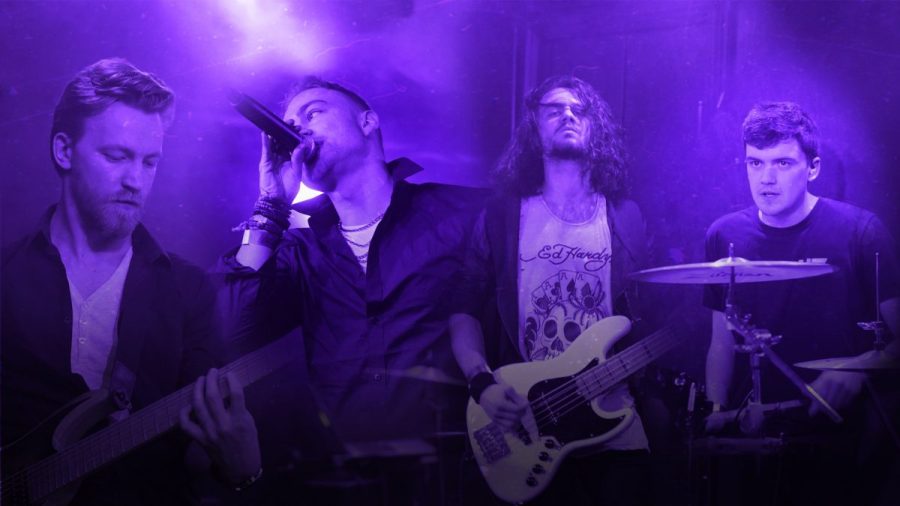
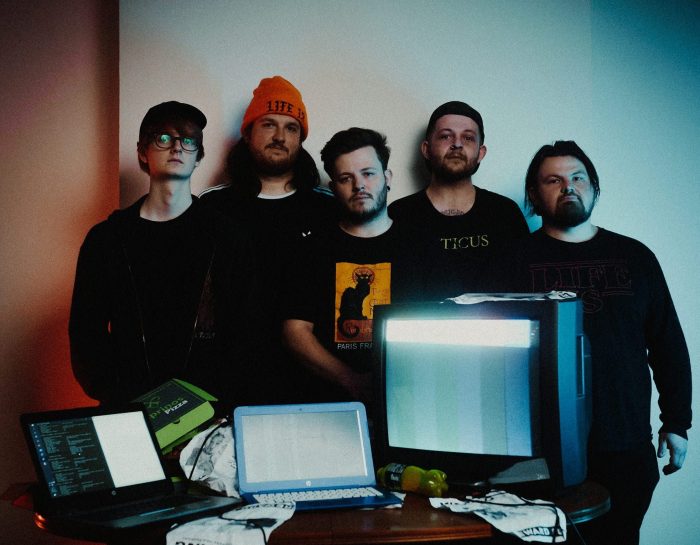
Blight Town are a relatively new five piece alternative/math rock band based in Nottingham, England. Formed just a little more than a year ago, the band consists of brothers Jake (vocals) and Sam Hough (guitar), Will Emmerson (guitar), Scott Taylor (bass) and Joseph Smith (drums). Together, they combine elements of progressive, math, pop and metal rock with powerful instrumentation, complex time signatures and a dramatic mix of screamo and melodic vocals to create their unique and wildly explosive sound.
Last September (2019) they released their terrific debut single “Jejunum”, and on August 8th they returned with “Argument Bargument“, the cheekily-titled second single from their forthcoming self-titled EP, due out later this year. The band states that the song is “A wistful retrospective on the transient nature of modern relationships and the lengths we will go to in order to rationalise our lived experience.”
The song opens with an enchanting strummed electric guitar that gradually becomes enveloped in wobbly reverb, piquing our interest as to what’s about to ensue. Suddenly, our ears are hit with a burst of chaotic gnarly riffs, throbbing bass and aggressive drumbeats as the song evolves into a rousing, melodically complex and discordant banger. Amid some lovely guitar noodling that punctuates the otherwise tumultuous proceedings, Jake’s vocals gymnastics are a thing of wonder as he either sweetly croons or scarily screams the lyrics. At first listen, I found his screamo vocals a bit off-putting, but after a few listens they grew on me to the point where I cannot imagine the song sung any other way. The contrast between his smooth and harsh vocals nicely complements the sense of tension and discord expressed in both the electrifying music and lyrics.
“Argument Bargument” is a brilliant song, and if it and “Jejunum” are any indication, their EP is sure to be a winner.
Yeah, been throwing pennies down a wishing well “Oh, what the hell?” I thought I always knew that I would wish you well You never wanted an argument, well now you’ve got it And that’s why they call me the cynicist
Yeah, it’s so quiet When you go to sleep But we retire We get busy, getting busier
Were not leaving, didn’t expect you would show (Sore eyes, dead brain) I’ve been reading, I think I’m losing control (Sore eyes, dead brain)
You know I’d appreciate Being kept in the loop Yeah, you know I’d appreciate if somebody could tell me Why what I did was so wrong
Don’t try to ghost me ‘Cause you don’t see through me It’s beautiful It ends too soon
That Hidden Promise is the music project and alter ego of British singer-songwriter and multi-instrumentalist Wayne Lee. Based in Somerset, England, he’s been recording and performing under that moniker since 2011. The talented and versatile fellow writes his own songs, creates all his own music, including beats and percussion, and plays acoustic and electric guitar. He’s produced an extensive catalog of alternative and pop-rock music over the past nine years, often incorporating blues, post-punk, folk, electronic, psychedelic and shoegaze elements into the mix, resulting in a varied and eclectic sound, and delivered with exceptional guitar work and vocals that remind me at times of Bob Dylan.
I first featured him on this blog in May 2017, when I reviewed his single “All Things, All Will Come”, then again in October 2018 when I reviewed his wonderful all-acoustic EP Drifted Hope. In August 2019, he released a compilation album All Things Here, Till Now (2011-2018), a sort of greatest hits album volume one, featuring 22 of his best recordings over that seven year period, including the five songs from Drifted Hope. Many of the tracks are really excellent, and I highly recommend my readers give them a listen on one of the music streaming platforms listed at the end of this review.
Now he returns with “You Can Have the World“, the lead single from his forthcoming album Who Knows Now?, scheduled for release in early October. The album was entirely self-produced and recorded between March and May 2020, and Lee explains that many of its songs explore the subject of “trying to understand where we are individually and as a society, hence its title ‘Who Knows Now?‘” He further elaborates “The concept behind the single, is of someone looking into a city and world riven by division, chaos and revolution, whilst seeing the potential to rise through sacrifice and failure and up against a system all too quick to take the credit.”
The song blasts open with an onslaught of chiming and fuzz-coated gnarly guitars, accompanied by thunderous percussion that never lets up for an instant. Lee’s intricate guitar work is nothing short of spectacular as he delivers an explosive torrent of ever-changing textures that go from beautifully melodic to aggressive buzz-saw to screaming distortion. It all serves to create an electrifying and powerful backdrop for his plaintive vocals, driving home the urgency expressed in his biting lyrics. I think it’s one of the best songs he’s ever recorded.
As the city breaks down I will look across and smile For a thousand times or more, I’ve seen it die
A silhouette of reflections A beating heart of righteous rage Brings us to a point of certain change And it goes And it goes Again
You can have the world If you’re gonna pay Though have you got the nerve To fail again and again Those who lead won’t keep you down They may seek acclaim But it’s clear If I win, If I fail In this world Ain’t a damn thing to do with them











 ECLECTIC MUSIC LOVER