
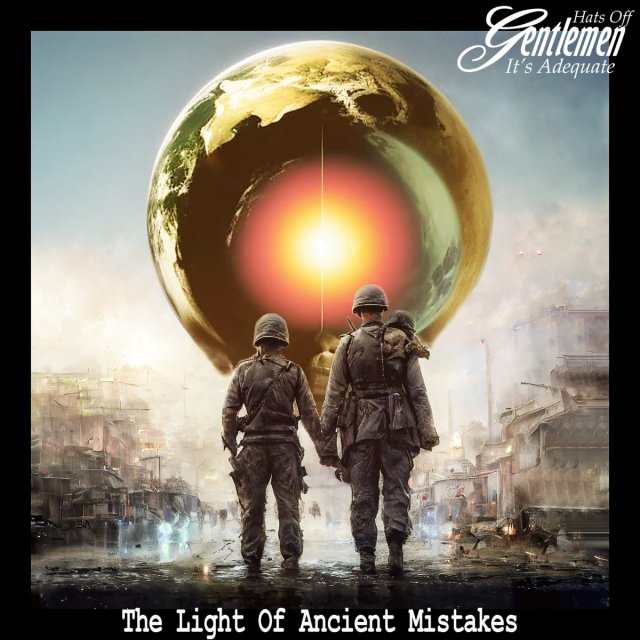
In my eight years as a music blogger, I’ve written about quite a few artists and bands with odd or quirky names, but one of the strangest of them all has to be that of British duo Hats Off Gentlemen It’s Adequate. Based in London and comprised of singer-songwriter, multi-instrumentalist and producer Malcolm Galloway and multi-instrumentalist and co-producer Mark Gatland, with help by Malcolm’s wife Kathryn Thomas on flute and backing vocals, they create their unique brand of progressive alternative rock, infused with experimental and classical elements, minimalist, metal, folk, funk, and electronica. I’m not exaggerating when I say they’re both multi-instrumentalists, as Malcolm plays lead guitar, keyboards/synths, percussion/drums and programming, while Mark plays bass, guitar, slide guitar, keyboards/synths, Chapman Stick (an electric instrument resembling the fretboard of an electric guitar, devised by Emmett Chapman, which has ten or twelve individually tuned strings) and additional percussion/drums.
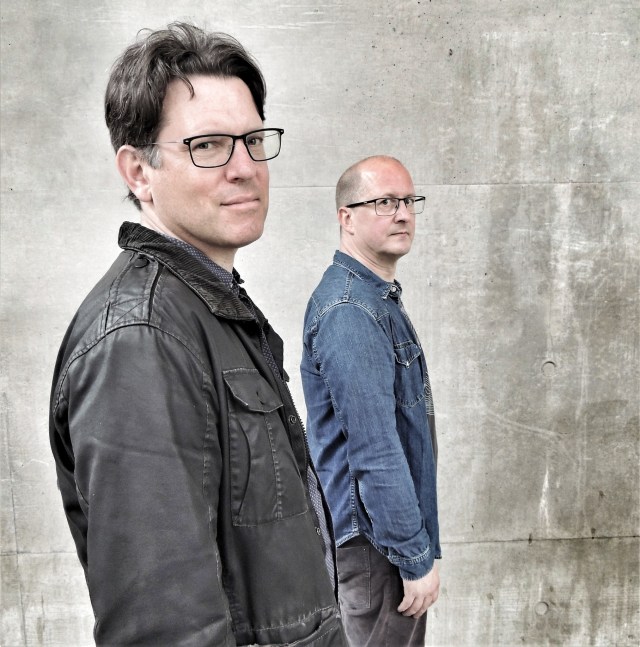
Longtime friends who’ve been playing together since they were in school, Malcolm and Mark’s music often explores scientific and philosophical themes, and they’re strong advocates of social and environmental causes. Accordingly, they’ve organized and supported charity events for Save the Children, Cancer Research UK, Marie Curie Cancer Care, Ehlers-Danlos Support UK, Brain Tumour UK and Prog The Forest, which raises money to protect over 40 acres of threatened habitat. From what I can tell, they’ve released quite a lot of music since 2012, including six albums, three EPs and numerous singles. On September 9th, they’re finally dropping their long-awaited seventh album The Light of Ancient Mistakes.
When they reached out to me about the album in July, I was initially overwhelmed by its size, subject matter and scope, and I admit it’s taken me a while to fully absorb this ambitious and fascinating work. Also, I’m a master procrastinator who always waits until the last minute to write my reviews, a bad habit going back to my college years that I’m afraid I’ll never be able to break. And finally, after reading some superb reviews of the album written by others, I’m now left feeling both intimidated and deflated, wondering how I can ever write a coherent review that does justice to this amazing album. I will give it my best effort.
Although not necessarily a concept album, many of the songs on The Light of Ancient Mistakes are inspired by various books, including works by Adrian Tchaikovsky, Iain M. Banks, David Cornwell (who wrote as John le Carré), Philip K. Dick, and Conservative MP Chris Bryant, as well as issues of personal importance and concern for Malcolm, who wrote all the lyrics. The music was co-written by him and Mark. The album contains 15 tracks, seven of which feature lyrics and vocals, while eight are instrumentals. The Bandcamp version of the album also includes four bonus tracks that are radio edits of four of the original 15.
The album opens with “Sold the Peace” a bitter diatribe against the corporate greed and political cowardice that have essentially negated all the hard-fought gains in the battle against authoritarianism in World War II and the Cold War period that followed, ushering in a new generation of despots, expressed in the lyrics “We risked it all to set the world free. Dead or free, the opportunity cost of the unused bombs. So much invested. We stormed the citadel, then bought the lease. We won the war, we sold the peace.” To drive home their point, the guys start with a grungy bass groove, then layer cinematic industrial synths, noirish piano chords and jagged guitar notes to create an unsettling soundtrack for Malcolm’s exasperated-sounding vocals.
Next up is the hauntingly beautiful six-minute 40-second-long Pink Floyd-esque title track “The Light of Ancient Mistakes“, inspired by science fiction author Iain M. Banks’ novel Look To Windward. Malcolm explained the song to David Edwards of The Progressive Aspect blog, “It explores the long-lived consequences of an atrocity. The light from a sun-destroying explosion has travelled for 800 years before reaching an orbital where a commemoration for the tragedy is due to take place. The protagonist of the song is an artificial intelligence trying to show the futility of cycles of hatred to someone planning an act of mass destruction.”
This is followed by the electronic instrumental track “Arvana Kern is Made of Ants“, which along with tracks 6 “The Requisitioner and the Wonder” and 8 “Gothi and Gethli“, refer to a character, two spaceships and a pair of crow-like creatures which insistently deny they are sentient in Adrian Tchaikovsky’s Children of Time series. The frantic skittering beats and swirling keyboards on “Arvana Kern is Made of Ants” cleverly evoke the non-stop flurry of activity one would see in a colony of ants, while the somber atmospheric tones of “The Requisitioner and the Wonder”, punctuated by some beautiful guitar notes, convey images of two spaceships traversing the heavens. Mark’s deliciously funky bass and Malcolm’s jazzy piano work make the jaunty “Gothi and Gethli” one of the most upbeat tracks on the album.
Track 4, “The Anxiety Machine Part 1“, is the first of a three-part triptych of darkly beautiful contemporary classical instrumental interludes that serve as connectors within the album, creating unsettling feelings of loneliness, resentment and desolation, in keeping with the overall feel of the album. This immediately segues into the heartbreaking “Sixteen Hugless Years“, a song inspired by the childhood experiences of David Cornwell, better known as John le Carré, namely the abandonment he felt after his mother left him and his family when he was five years old. The 16 years referenced in the song is the time that passed before his mother initiated a reconciliation. Malcolm’s vocals are filled with pain as he bitterly recalls “You packed your Harrod’s suitcase and left. You didn’t even slam the door. I was left with a hole. I didn’t grow up, I just got older. I was only five years old. Sixteen hugless years. Sixteen long, long years. I’ve grown old and I’m cold and hard but I’m told I’m the life and soul but it feels so hollow after 16 hugless years.” The musical highlights for me are Mark’s deep, throbbing bassline and Malcolm’s haunting guitar.
“The Glamour Boys” was inspired by Labour MP Chris Byrant’s book of the same name about the experiences of a group of mostly homosexual or bisexual Conservative MPs who argued against appeasement towards Nazi Germany and Fascist Italy, despite threats from Prime Minister Neville Chamberlain to expose their secrets. Many went on to risk, and in some cases lose their lives in the Second World War. “They call us the glamour boys. The punishment for speaking out. The leaks and smears and telephone taps. The hints the threat the veiled attacks.“
One of my favorite tracks on the album is “imtiredandeverythinghurts“, a chugging, energetic rocker inspired by Malcolm’s experiences with an invisible disability due to Ehlers-Danlos Syndrome (a group of inherited disorders that affect the bodies’ connective tissue, primarily skin, joints and blood vessel walls, resulting in chronic pain), and the challenge of responding honestly to the well-intentioned and seemingly benign question “how are you?” Malcolm elaborated to The Progressive Aspect blog, “I don’t want to be dishonest with people by pretending to be fine when I’m not, but I also don’t want to drag people into a conversation about chronic pain that they may not be comfortable with. On the other hand, for those of us with conditions that vary from day to day (or hour to hour), it may be important to communicate what our current level of functionality is. I am also aware that there is no negative intention behind the question, and the last thing I want to do is to discourage people from communicating.” He plaintively sings “I keep smiling so you might not notice that I’m falling apart. I’m close to an edge. I need help. If this time you’re really asking, I’m tired and everything hurts.“
The centerpiece of the album is “Walking To Aldebaran“, an epic progressive rock masterpiece inspired by the science fiction novella of the same name by Adrian Tchaikovsky. Clocking in at just under nine minutes, the song features an exciting and eclectic mix of styles and textures, including progressive metal, free-form jazz, contemporary classical and musical theater, as it tells the story of space-ship pilot Garry Rendell who, due to a miscommunication between himself and an old, possibly malfunctioning but well-intentioned machine, is transformed into a monster. The colorful, intricate guitar work, jazzy piano, swirling synths and Kathryn’s lovely flute are all utterly exquisite throughout. Malcolm’s dynamic vocals alternately remind me of David Bowie, Al Stewart and a myriad of male vocalists from such Broadway musicals as Les Misérables and Phantom of the Opera as he forlornly laments “I’ve become what the monsters are scared of. I’ve been changed by the mother machine. I am the thing that used to be me.“
“Goodbye Cassini” is a beautiful instrumental tribute to the NASA probe that spent 13 years exploring Saturn and its moons. When its fuel supply was finally exhausted on September 15th, 2017 it plunged into Saturn’s atmosphere, still returning data right up until its end. The musical highlight of this track is Kathryn’s gorgeous flute. The effervescent instrumental “The Man Who Japed” is named after the 1950s Philip K. Dick novel of the same name, in which a previously obedient government official “japes” – i.e. commits a practical joke – by severing the head of a statue of their dictator in a symbolic act of resistance, thereby putting himself at personal risk. Malcolm created all the artwork for the album using AI assisted art creation software, and the one for this track is particularly good:

The final track “Burn the World” is an hauntingly beautiful and unsettling song about the perils of global warming, sung from the perspective of someone in the future looking back with regret on measures humans could have taken, but didn’t. Malcolm’s melancholy plaintive vocals are drenched in sadness and despair as he laments over lost opportunities that could have helped avert climate disaster: “We could have cared just enough to give ourselves a chance. But it’s easier to fail. We never learned to change. All the things we could have done, and we chose to burn the world.” The track has a strong progressive feel, with a meandering melody overlain by a mix of chiming and wailing guitar notes, ethereal synths, gritty bass and measured percussion. Hats Off Gentlemen It’s Adequate released “Burn the World” as a single in support of Prog The Forest, an environmental fundraising festival that donates to the World Land Trust, which acquires threatened rainforests and other valuable habitats to place them in protective trust in collaboration with local communities. They will be donating all proceeds from sale of the single until at least the end of 2024.
I’ve gone on and on, so will close by simply saying that, in my opinion, The Light of Ancient Mistakes is a certifiable masterpiece. The amount of thought, care, and effort Malcolm and Mark have put into creating this ambitious undertaking is truly astonishing, and they should be very proud of what they’ve accomplished. While the depth and complexity of the music and the rather dark, provocative subject matter of the lyrics may not be everyone’s cup of tea, I think it’s brilliant and worth a listen. If you like excellent progressive rock, you will enjoy this album.
Connect with Hats Off Gentlemen It’s Adequate: Facebook / Twitter (X) / Instagram
Find the album on Bandcamp / Spotify / Apple Music / Amazon Music / YouTube
 ECLECTIC MUSIC LOVER
Great band! Coincidentally, I’l be playing one of their tunes on my radio show next week!
LikeLiked by 2 people
#spoileralert!!
LikeLiked by 2 people
Wow! Just listened to the titular track, and if the rest of the album is anything like that I completely understand why it was a daunting task to review. You’re absolutely right that it is not for everyone, fortunately I am not everyone! By the way, when I was looking for the album to listen to, I found a song with the same name -“The Light of Ancient Mistakes” by Aphobic, a Northern Irish post-rock group. Great review, I will definitely be checking out some of their previous stuff.
LikeLiked by 2 people
Thanks Irwin, and glad you like it too! They are two very talented musicians.
LikeLiked by 2 people
Wow, this album is quite an opus! There is so much going on here, which essentially makes it impossible to get your arms around it quickly. I imagine writing this review must have been a challenge. Based on my initial impression, “The Light of Ancient Mistakes” is very impressive.
Unusual band names can help draw attention. I have a great-sounding jam band in my new music review scheduled for tomorrow. Their name definitely helped get them on my radar screen.
LikeLiked by 1 person
Exactly, Christian, like I stated in my review, at first I was completely overwhelmed by it all, and yes, I had a difficult time with the review. Thankfully, I was able to get a clearer picture by reading some of the previous reviews written by others, which a part of me can’t help but feel was a form of cheating.
LikeLiked by 2 people
This really feels like a major piece of music. I hope I get a chance to spend more time with it. Lack of the latter has been a challenge. I also try to do most of my writing Friday night and over the weekend since during the week it’s oftentimes tough. But I don’t mean to wine. This is supposed to be fun! 🙂
LikeLiked by 2 people
Yes it is, though truth be told, writing reviews can sometimes feel like torture for me. I think about quitting nearly every day, as I’m tired, burned out, and disheartened by the mediocre response to most of my reviews that I invest so much time and effort to write.
LikeLiked by 1 person
Part of my motivation to blog is to use it as an escape hatch from everything that’s going on around me. As such, I really want it to be fun, which is why I try to blog on my own terms as much as I can.
That’s one reason I generally don’t do “reviews by request”. I don’t want it to become an obligation.
That said, I can’t deny that with three recurring features I have each week , I sometimes feel I’m boxed in a bit, and my readers “expect” to see other installments.
I know this notion is kind of ridiculous since it’s obviously up to me and I could stop anytime. But I guess I’m also a bit of a nerd! 🙂
LikeLiked by 1 person
Sadly, I allowed my blog to become an obligation the moment I started accepting submissions for reviews. I’ve struggled with this the entire time, vacillating between genuinely wanting to help promote indie artists and bands, yet feeling resentful and sometimes used.
LikeLiked by 1 person
I hear you, Jeff. Not that you would need any advice from me, I would say try to do it on your terms as much as you can, even if it means declining reviews. I know it’s hard to do because you’re so passionate about supporting music artists, which I think is great. At the same time, I guess there has to be a balance. You shouldn’t ruin yourself over this!
LikeLiked by 1 person
You’re absolutely right Christian. Thanks for the encouragement and also your continued support.
LikeLiked by 1 person
A lot of epic sounds with the synths… every song sounds important.
LikeLiked by 1 person
Wow. This is massive. It’s a very interesting piece of art and I totally understand why it took awhile to fully grasp all of the subtleties. A well done introspective review.
LikeLiked by 1 person
Thank you Ralph. It truly is!
LikeLike