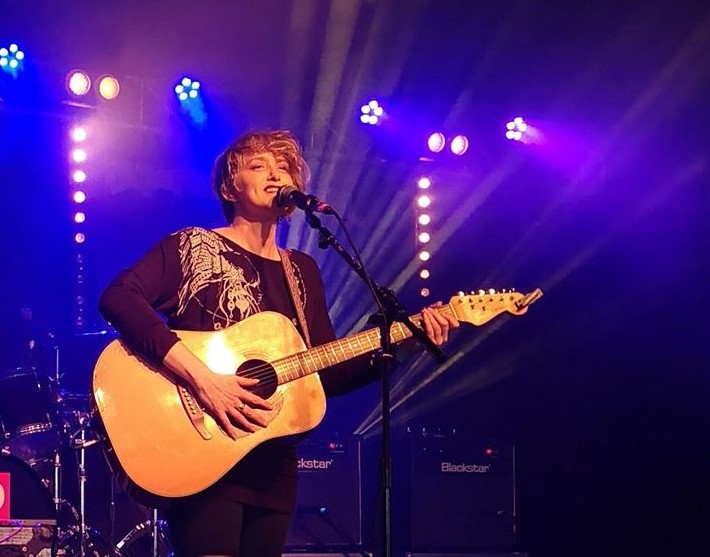
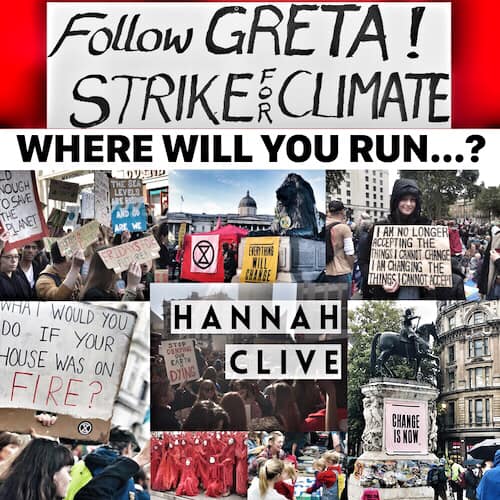
Hannah Clive is a lovely and engaging singer/songwriter based in London, England who writes from her heart and soul. Influenced by such legendary ladies of song as Adele, Carole King, Kate Bush and Janis Ian, Hannah pens observational, often personal songs that cross many genres, including indie rock, folk, pop, alt-country, blues and jazz. Two years have passed since she released her stunning single “Remember to Breathe” (which I reviewed), and she now returns to grace our ears with a brand new single “Where Will You Run?” Inspired by the outspoken and courageous young Swedish activist Greta Thunberg, the song is a heartfelt clarion call for action to address the existential global threat of climate change. It’s an important message, which is why I’ve chosen it as my New Song of the Week.
The song was written by Hannah and her frequent collaborator Brian Tench (Kate Bush, Hounds of Love, Bee Gees), who also produced the track, along with assistance from his son Jake. The song has a haunting melody that beautifully evokes the seriousness of the subject. Brian employs a rich mix of dark, swirling keyboards and pulsating percussive synths to create an arresting soundscape for Hannah’s enthralling vocals. She has a marvelous singing voice, going from whispered purrs to impassioned pleas with ease, to great emotional effect. It’s a beautiful and deeply moving song.
Our planet teeters on the edge But money talks with no regrets Plastic tide washes high Frost is melting despite Greta’s cry
But the change is not fast enough Do you need to watch it all burn up? Before you ditch that coffee cup, where will you run? When the seas rise, fish will die When all is lost is that when you’ll cry? We all wanna live ‘n’ thrive, where will you run?
Hannah also produced an excellent promotional video for the song that’ worth watching:
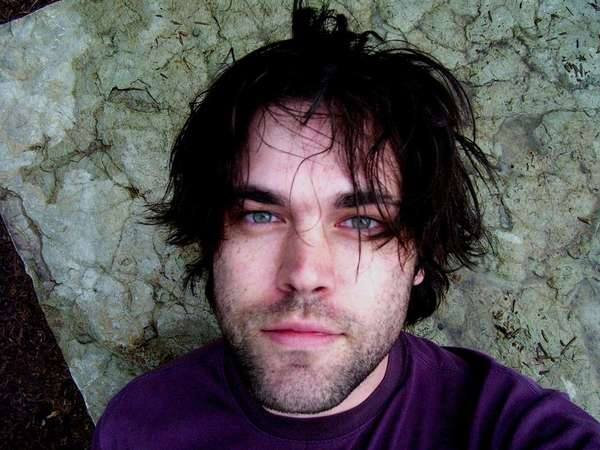
I always enjoy learning about talented artists who’ve been making really great, innovative music for years that somehow slipped under my radar, then making up for lost time by listening to their back catalog of songs. One of the more interesting artists I’ve discovered recently is Warmer, the solo project of singer, songwriter, composer and multi-instrumentalist Jesse Gunn. Based in the bucolic Western Oregon city of Eugene, Warmer fuses elements of Alternative, Metal, Industrial, Electronic and Art Rock to create singularly unique music that pushes boundaries, stirs our emotions and gives us a lot to think about. He cites as some of his influences the likes of Radiohead, Nine Inch Nails, Sigur Ros, The Black Heart’s Procession, David Bowie, Godspeed You Black Emperor, Interpol, Spanking Dynamite, Faith No More, Beck, Diffuse, 16 volt, Depeche Mode, The Cure, “and a bunch of bad pop I don’t want to admit to.” Hey, we all have our guilty pleasures!
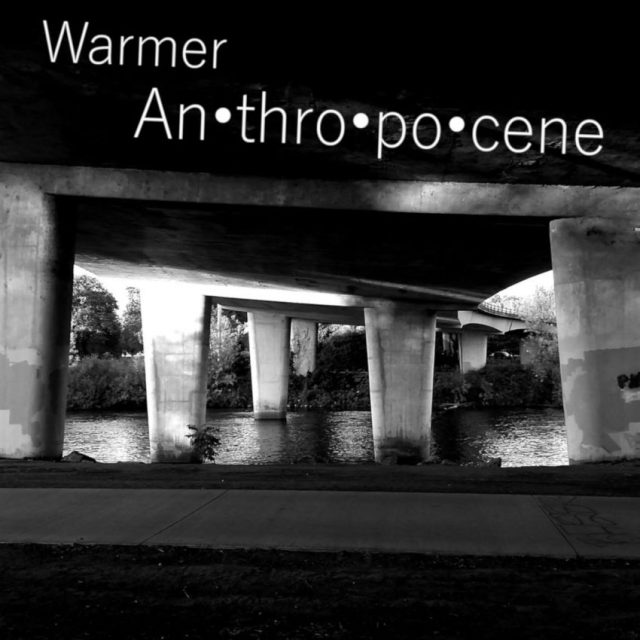
Since releasing his debut self-titled EP in 2005, Warmer has been quite prolific, dropping seven albums – some containing between 15 and 22 tracks! – as well as writing several soundtrack scores for films and video games. His latest effort is Anthropocene, a brilliant and scathing diatribe on the current fucked-up climate situation on several fronts – political, social and environmental. His songs are filled with powerful and biting lyrics, set to often dense and complex soundscapes.
Before getting to the music, I thought I’d provide a little geology lesson to explain the album’s title. Though not yet an officially recognized geologic time period, the term “Anthropocene” has been proposed by earth scientists to define the current period during which human activity has been the dominant influence on climate and the environment as a new epoch in the Geologic Time Scale. The word combines the root “anthropo”, meaning “human” with the root “-cene”, the standard suffix for “epoch” in geologic time. Debate has raged for years as to when this epoch began, with some placing it as early as 12,000 years ago with the rise of agriculture (which would generally coincide with the current Holocene epoch), the late 1700s with the beginning of the Industrial Revolution, or even as recent as 1945, with the detonation of the first nuclear bomb (though most dismiss this later date). But what is agreed upon is that the Anthropocene identifies Earth’s most recent geologic time period as being human-influenced, or anthropogenic, based on overwhelming global evidence that atmospheric, geologic, hydrologic, biospheric and other earth system processes are now being significantly altered by humans.
The album opens with “Anthropocene Theme“, a somber and haunting piano instrumental that sets the tone for what’s to come. Then Warmer launches into an epic take down of humankind and the abuse we heap upon our planet with “Our Mother“. Starting off with a simple piano riff, moody synths and harsh percussion gradually enter the mix, creating a strong sense of foreboding. Warmer’s raw vocals are filled with anger as he lists the ways we are hurting our mother earth: “The earth our mother, she’s really sick, and its no wonder she’s got a hit on us. We drain her blood right from out of the ground. We drop our bombs and we leave our shit around.” He then shifts to a falsetto as he sings about how so many people are more concerned with their own personal appearance and well-being than the earth they live on: “I want to live forever. I want a real good health plan. I wanna stay looking so young with botox and collagen.” His vocals are backed by his own whispers, adding a menacing feel to the dirge-like track.
The brilliant and provocative video opens with American currency floating down, then scenes of nature, both beautiful and brutal, are shown until the song is abruptly interrupted by jarring images and a dire announcement of a possible attack from space – a nuclear attack perhaps? This is followed by the sound of a man screaming, then footage of President Trump calling global warming a hoax. As the song resumes, we’re shown images of man’s destruction and pollution, followed by scenes of space and a volcanic eruption. Once the song ends, we see a static-covered scene of an American flag, with the camera closing onto an expanding hole within it, accompanied by an increasingly distorted and harsh refrain of the song’s somber melody.
On “Pretty Bait Click Machine” Warmer addresses our manipulation by social media to the point of obsession (I’m sadly guilty as charged), and being perfectly complacent about staying in our own information bubbles “It’s so safe on the inside of this echo chamber that I hide. Cuz I will never see a different point of view other than me. It’s engineered algorithmically feeding the pretty click bait machine./We are just meat machines eating the programming. Notify me with dopamine. I’ll keep on posting endlessly.” This track is more guitar-driven, with light industrial synths and a rather upbeat melody that belies the serious lyrics. And by this point, I’m already hooked on Warmer’s rich and varied vocal style, which at times reminds me of Rufus Wainwright and Matt Berninger (of The National and EL VY).
“Gimmie” speaks to man’s bottomless greed and willingness to destroy anything and everything in order to get more material things: “We’re just a bunch of animals raping the world we love. Don’t kind yourself, we’re not cultured and civil. Killing for the gods above. Gimmie precious oil and nicotine. Killing in the name of greed./Whatcha gonna do with all that stuff? When is enough really ever enough?” “Sugar” is about the conflicting feelings of employing a hooker: needing the sexual pleasures they provide, yet condemning the life choices they’ve made. Warmer’s vocals are seductive as he croons: “Be my vacation in this sea side hotel room. A skin destination I’m gonna crawl all over you. Please be my sugar baby. I need you so bad honey. Evolution is dead. It’s all about the money. Oh my sugar baby this is no way to live.” The track features gritty industrial and psychedelic synths and a low-key surf guitar. On “Lip Service” he ruminates on life choices and paths taken, wondering about different outcomes: “In times like these we analyze. we pick apart our very lives. Oh what could i have become if my fears had not won.”
One of my favorite tracks is “Orange Maniac“, a bitter renunciation of the vile cretin currently occupying the American White House, whom I despise with every fiber of my being. The song is dark, with a beautiful but mournful piano riff and an alternating mix of glittery (beautiful) and harsh (ugly) synths. Warmer’s vocals also vary, going from plaintive when he sings “Orange maniac he’s ruling me” to sneering: “You had better fall in line. You had better know your place. My world has become Anthropocene because my tiny handed president is an illiterate.” On the bleak and discordant “adaywhennothinggoeswrong“, he sings of wishing for a problem-free day. The track has a bit of a Nine Inch Nails vibe.
Channeling both Nine Inch Nails and Depeche Mode, Warmer delivers gnarly guitars, gravelly bass and ominous industrial synths on the dark instrumental track “This is Your Warning“. “The Great Dying” opens with sounds of his labored breathing, then he forlornly laments of the coming end of humanity: “Life used to be much more simple. I knew of less tragedies and friends were real people. Oh honey I’m not a rich man. I won’t be able to save you in the end. When they come to your home for your genome, crispr’s gonna take a piece out of you. We will draw the line that defines who survives the Great dying.” The music alternates between a gloomy piano-driven melody and a barrage of thrashing industrial synths and fierce percussion. It’s a hard-hitting and monumental track.
The video combines both tracks, first showing only explosive flashes against a black backround for “This is Your Warning”, then psychedelically distorted scenes from old TV shows and commercials for “The Great Dying”. Credit for both this video and the one for “Our Mother” goes to Jon Curry.
Warmer gives us a much-needed interlude with the hauntingly beautiful piano instrumental “Waltz for Bonnie“, which showcases yet another aspect of his impressive musicianship. He closes out the album on a jolt back to cruel reality with “House of Slaughter“, a very depressing song about the horrors of working in a slaughterhouse that really speaks to the larger issue that animals must die to satisfy mankind’s appetite for meat. Musically, the track is simple, featuring only Warmer’s strummed acoustic guitar and mournful vocals that convey a sense of numbness and sad resignation as he sings: “Damn the clang of the bell. Jolts me back into hell, my dreams my only escape. I try to wash off the stink from my face into sink. It hangs in the air like a mist. Off to another day, deaf to cries of helpless. Their calls heard for miles around. Yes this is, a house of slaughter. Yes this is hell on earth. It sticks inside my clothes. It’s always in my nose, the evidence of my cruel day. And if it comes down to it you know that i’d do it. Just know that i’ll eat you first. Cuz you are the sweetest meat, the sweetest I’ve ever seen.”
OK, now I’m feeling pretty numb myself, yet also blown away by the sheer power of this dark and brilliant album. Warmer holds nothing back as he stirs our senses with incredible soundscapes, while punching us in the gut with his brutally honest and compelling lyrics. Anthropocene is an important album that needs to be heard by as many ears as possible.


 ECLECTIC MUSIC LOVER