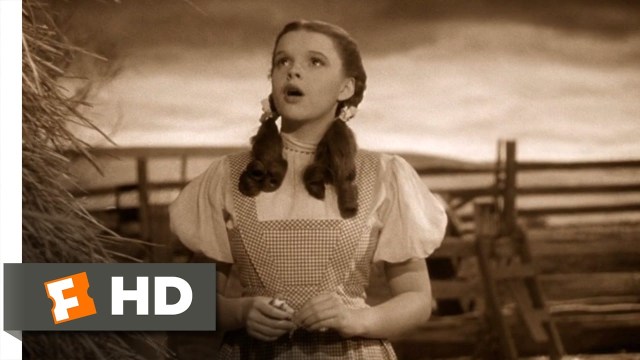
The subject for Day 24 of my 30-day Song Challenge is “A song from a movie you love“, and there was only choice for me – “Over the Rainbow“, sung by Judy Garland in The Wizard of Oz. The 1939 classic has been my favorite film for my entire life, and I’ve seen it more than 50 times. Each time I watch it, it moves and excites me every bit as much as it did when I was a child, and I never grow tired of seeing it. There are so many great scenes and songs in the film, and one of the best of them all is when Garland, as young teenager Dorothy Gale, wistfully sings “Over the Rainbow” after being told by her Auntie Em to find “a place where you won’t get into any trouble“.
“Over the Rainbow” was written by composer Harold Arlen, with lyrics by Edgar “Yip” Harburg, who together wrote all the wonderful music and song lyrics for The Wizard of Oz. “Over the Rainbow” was the final song written for the film, as Arlen and Harburg had struggled to come up with an appropriate song for the Kansas farm scene that takes place early in the film. Harburg claimed his inspiration was “a ballad for a little girl who was in trouble and… wanted to get away from Kansas – a dry, arid, colorless place. She had never seen anything colorful in her life except the rainbow“. Arlen decided the idea needed “a melody with a long broad line“. (Walter Frisch (2017) Arlen and Harburg’s Over the Rainbow)
Shockingly, the song was initially deleted from the film at the direction of MGM chief Louis B. Mayer because he thought it slowed down the picture, was too far over the heads of its targeted child audience, and “sounded like something for Jeanette MacDonald, not for a little girl singing in a barnyard“. Mayer was clearly wrong on all counts, as Garland’s heartfelt, vulnerable vocals beautifully conveyed a young girl’s hopes and dreams of a better place, far away from her dull, troubled life. Though still only 16 when she recorded “Over the Rainbow”, Garland had a powerful, incredibly emotive vocal style beyond her tender years.
Director Victor Fleming, producer Mervyn LeRoy, associate producer Arthur Freed, and Garland’s vocal coach and mentor Roger Edens all joined together to fight to have the song reinserted into the film. Freed told Mayer “The song stays—or I go,” to which Mayer replied: “Let the boys have the damn song. Put it back in the picture. It can’t hurt.” (Gary Shapiro (2017) Columbia News)
For a song that almost didn’t happen, “Over the Rainbow” has become one of the most beloved songs of all time, leaving an indelible legacy for both The Wizard of Oz and Judy Garland. It was awarded an Oscar for Best Original Song, and in 2001, was voted the greatest song of the 20th century in a joint survey by the National Endowment for the Arts and the Recording Industry Association of America. Numerous singers have recorded their own versions of the song, with one of the most popular being that of Hawaiian artist Israel Kamakawiwoʻole, who included “Over the Rainbow” in a beautifully moving ukulele medley with Louis Armstrong’s “What a Wonderful World”.
The subject for Day 23 of my 30-day Song Challenge is “A song that tells a story“. I feel confident in stating that just about everyone loves songs that tell a story, as they’re often very compelling, reeling us in as their lyrics unfold, and keeping our attention all the way to the end. Some of the great “story” songs that come to mind are “El Paso” by Marty Robbins (which I wrote about in 2019, and is my 8th most-viewed post ever), “Harper Valley P.T.A.” by Jeannie C. Riley, “A Boy Named Sue” by Johnny Cash, “Me and Bobby McGee” by Janis Joplin, “Stairway to Heaven” by Led Zeppelin, “Taxi” by Harry Chapin, “The Wreck of the Edmund Fitzgerald” by Gordon Lightfoot, and “Stan” by Eminem. But the one I’ve chosen is one of the very best – “Ode to Billie Joe” by Bobbie Gentry. I remember loving it as a 13-year old back in 1967.
My 45 single of “Ode to Billie Joe”
Bobbie Gentry wrote “Ode to Billie Joe” with the intention of having Lou Rawls record it. But after Capitol Records producer Kelly Gordon received her demo for her song “Mississippi Delta”, he liked it and asked her for a B-side that could be released on a single. She then recorded a demo of the song, with just her vocals accompanied by an acoustic guitar, in February 1967. Gordon liked her vocals on the demo, but decided to add an instrumental arrangement to the recording. He enlisted Jimmie Haskell (a composer and arranger for both motion pictures and an array of popular artists, including Elvis Presley, Neil Diamond, Crosby, Stills & Nash, Steely Dan, Billy Joel, and the Everly Brothers) to prepare a string arrangement with four violins and two cellos. Haskell felt the song sounded like it could be from a film and decided to write the arrangement with a more cinematic feel, as if it were a score. Gordon then overdubbed Gentry’s recording with the haunting string arrangement, and decided that “Ode to Billie Joe” would be the A-side of the single, with “Mississippi Delta” as the B-side.
The song was written in the form of a first-person narrative, told by the young daughter of a rural Mississippi Delta family, and sung by Gentry. It features perfect rhymes from the first to the sixth line of every verse and, unlike most songs, contains no chorus. The lyrics tell the story of the family’s reaction to the news of the suicide of Billie Joe McAllister, a local boy to whom the daughter (and narrator) is connected. The song quickly became popular upon its release in July 1967, because it created curiosity in listeners, leaving them wondering what the narrator and Billie Joe threw off the Tallahatchie Bridge, and what caused Billie Joe to commit suicide. In numerous interviews, Gentry clarified that she intended the song to portray the family’s indifference to the suicide in what she deemed “a study in unconscious cruelty”, while she remarked the object thrown was not relevant to the message.
In an August 1967 interview with the Los Angeles Times, Gentry compared the song to a play, and said she wanted to show “people’s lack of ability to empathize with others’ tragedy“. She pointed at the mother, noticing but not understanding her daughter’s lack of appetite, while later in the song, the daughter seems unable to fully grasp the similarity of her mother’s behavior after the father dies. Gentry explained that both characters had “isolated themselves in their own personal tragedies“, and remained unconcerned for the others. Regarding the object thrown off the Tallahatchie Bridge, she commented that people had found more meanings than she had intended, such as “a baby, a wedding ring, or flowers“, among other things. While she indicated that what happened at the bridge was the motivation behind Billie Joe’s suicide, she’d intended to leave that open to the listener’s interpretation, adding that her sole motivation was to show “people’s apathy“. (Wikipedia)
“Ode to Billie Joe” was a big hit, spending four weeks at #1 on the Billboard Hot 100, and also reaching #1 in Canada. Surprisingly, it peaked at only #17 on the Country chart. The song was also nominated for eight Grammy Awards, with Gentry and arranger Jimmie Haskell winning three between them, and later adapted for the 1976 film Ode to Billy Joe.
It was the third of June, another sleepy, dusty Delta day I was out choppin’ cotton, and my brother was balin’ hay And at dinner time we stopped and walked back to the house to eat And mama hollered out the back door, y’all, remember to wipe your feet And then she said, I got some news this mornin’ from Choctaw Ridge Today, Billie Joe MacAllister jumped off the Tallahatchie Bridge
And papa said to mama, as he passed around the blackeyed peas Well, Billie Joe never had a lick of sense; pass the biscuits, please There’s five more acres in the lower forty I’ve got to plow And mama said it was shame about Billie Joe, anyhow Seems like nothin’ ever comes to no good up on Choctaw Ridge And now Billie Joe MacAllister’s jumped off the Tallahatchie Bridge
And brother said he recollected when he, and Tom, and Billie Joe Put a frog down my back at the Carroll County picture show And wasn’t I talkin’ to him after church last Sunday night? I’ll have another piece-a apple pie; you know, it don’t seem right I saw him at the sawmill yesterday on Choctaw Ridge And now ya tell me Billie Joe’s jumped off the Tallahatchie Bridge
And mama said to me, child, what’s happened to your appetite? I’ve been cookin’ all morning, and you haven’t touched a single bite That nice young preacher, Brother Taylor, dropped by today Said he’d be pleased to have dinner on Sunday, oh, by the way He said he saw a girl that looked a lot like you up on Choctaw Ridge And she and Billie Joe was throwing somethin’ off the Tallahatchie Bridge
A year has come and gone since we heard the news ’bout Billie Joe And brother married Becky Thompson; they bought a store in Tupelo There was a virus going ’round; papa caught it, and he died last spring And now mama doesn’t seem to want to do much of anything And me, I spend a lot of time pickin’ flowers up on Choctaw Ridge And drop them into the muddy water off the Tallahatchie Bridge
The subject for Day 22 of my 30-day Song Challenge is probably the most challenging of them all – “A song from an obscure music genre“. My pick is a composition titled “Necrofantasia” by TheTrustedComputer.
In doing an online search for music genres I was not familiar with, I came across one that looked kind of interesting: Black MIDI (not to be confused with the English rock band of the same name, whose music has no relation to the genre). Black MIDI is a sort of sub genre of electronic music. Since I knew nothing about it, nor any of the music from that genre, I’m going to be doing a lot of paraphrasing and quoting in this post.
In a nutshell, Black MIDI music essentially consists of compositions that use MIDI (Musical Instrument Digital Interface) files to create a song or a remix containing a large number of notes, typically in the thousands, millions, billions, or even trillions. The term “Black MIDI” comes from the fact that these huge numbers of notes are layered in such close proximity to one another in a composition that the music score would appear almost entirely black on traditional sheet music. People who create Black MIDI pieces are known as blackers.
A section of Black MIDI music by Ian Trobsky
Though Black MIDI’s exact origins are unclear, artists and musicians such as Canadian virtuoso pianist Marc-Andre Hamelin, whose player piano composition “Circus Galop” features a complex arrangement with up to 21 notes played simultaneously, and Frank Zappa, who wrote a dense and extremely difficult composition called “The Black Page”, have long experimented with computers and music software to push boundaries of traditional methods and practices for creating music.
According to an article by Sam Reising for webzine New Music Box, Black MIDI was first employed in Japan in 2009 when the first blacker, Shirasagi Yukki at Kuro Yuki Gohan, created a piece based on “U.N. Owen Was Her?”, an extra boss theme from the Touhou Project shooter video game The Embodiment of Scarlet Devil, which he uploaded to the Japanese video site Nico Nico Douga. Public awareness and popularity of Black MIDI started to spread from Japan to China and Korea over the next two years, then eventually migrated to Europe and the United States by early 2012.
Black MIDIs were created with MIDI sequencers such as Music Studio Producer, and Singer Song Writer, and played through MIDI players such as MAMPlayer and Timidity++. Many are based on the music from video games and cartoons, thanks to a healthy crossover in interest between blackers, anime heads and gamers, the majority of whom were males in their teens or even pre-teens. These blackers were often fiercely competitive, battling one another to see how many notes they could cram into a single composition. Soon, blackers from around the world began pushing limits of the style by making compositions with notes increasing into the millions, often using an enormous number of colors and patterns in their videos to match the complexity of the notes.
The first of these tracks to reach the million-note mark was “Necrofantasia”, from Touhou Project video game Perfect Cherry Blossom. The piece was arranged by California-based blacker TheTrustedComputer, aka TTC, when he only 15. At the time, he was one of Black MIDI’s reigning kings and the moderator of The Impossible Music wiki. He’s recorded numerous remixes, and this one contains three million notes! The composition, which sounds like a classical piece on steroids, is both strangely beautiful and macabre. You can hear the distortion in several places where the notes are crammed together so tightly that they just become tortured noise.
The number of notes and file sizes that could be played back have grown with the rising amount of processing and 64-bit programs that computers are able to handle, and while Black MIDIs of Japanese video game music and anime are still common, the genre also spilled over to compositions based on modern-day pop songs, such as “Wrecking Ball” by Miley Cyrus. (Reising, New Music Box)
Despite this increased computer storage capacity, there are still Black MIDI files so large they can cause an operating system to slow down or crash. The three largest Black MIDIs are “Armageddon v3”, “TheTrueEnd”, and “Ashes”, all of which contain the maximum number of notes allowed in the MIDI standard (approximately 93 trillion). Due to the nature of their creation and their sheer size, they are unable to be played back and recorded. (Wikipedia)
Here’s an interesting video from 2014 of YouTuber Sam Sutherland explaining Black MIDI:
My new favorite song this week is the uplifting and poignant “Unconditional I (Lookout Kid” by Canadian art-rock band Arcade Fire. Released in late April, it’s the second single from their sixth studio album WE. About the song, band front man Win Butler told Pitchfork “‘Lookout Kid’” is a reminder, a lullaby for the end times, sung to my son, but for everyone…. Trust your heart, trust your mind, trust your body, trust your soul. Shit is going to get worse before it gets better, but it always gets better, and no one’s perfect.” The video, produced by Ben Matheny and Nathan Harrison, and directed by Benh Zeitlin, is delightful.
Singer-songwriter and rapper Lizzo advances to #2 with her feel-good dance song “About Damn Time”. Debuting this week at #s 28-30 are “Lemon Tree” by L.A.-based alternative/indie folk rock band Mt. Joy“, “Tek It” by Brooklyn-based electro-pop duo Cafuné, and “Compliance” by British alt-rock band Muse.
UNCONDITIONAL I (LOOKOUT KID) – Arcade Fire (2)
ABOUT DAMN TIME – Lizzo (3)
SEVENTEEN GOING UNDER – Sam Fender (1)
A LITTLE BIT OF LOVE – Weezer (6)
TELL ME THE TRUTH – Two Feet (4)
BELIEVE – Caamp (5)
AS IT WAS – Harry Styles (8)
SYNCHRONIZE – Milky Chance (10)
THE FOUNDATIONS OF DECAY – My Chemical Romance (11)
CLOSER – The Frontier (12)
LONELY – Sea Girls (13)
THE FUNERAL – YUNGBLUD (14)
IN THE MIRROR – The Interrupters (15)
WARNING SIGNS – Band of Horses (16)
MISTAKES – Sharon Van Etten (17)
2am – Foals (7)
MY LOVE – Florence + the Machine (9)
DESPERATELY WANTING – Brian Lambert & Marc Schuster (20)
The subject for Day 21 of my 30-day Song Challenge is “A song sung in a different language“, and my pick is “Sukiyaki” by Kyu Sakamoto. I vividly remember hearing it played a lot on the radio in the summer of 1963, and even though I was only eight years old and couldn’t understand a single word he sang, I absolutely loved it. The beautiful song was a big worldwide hit, reaching #1 not only in Sakamoto’s home country of Japan, but also in the U.S., Canada, Australia, New Zealand and Norway.
Originally titled “Ue o Muite Arukō” – represented in Japanese as 上を向いて歩こう, and translated into English as “I Look Up as I Walk” – the song was alternatively titled “Sukiyaki” (the name of a Japanese hot-pot dish with cooked beef) for its release in English-speaking countries. The word ‘sukiyaki’ does not appear in, nor have any connection to, the song’s lyrics, but was used only because it was short, catchy, recognizably Japanese, and more familiar to English speakers. Written by lyricist Rokusuke Ei and composer Hachidai Nakamura, and sung by young Japanese crooner Kyu Sakamoto (who was only 19 when he recorded the song), “Ue o Muite Arukō” was first released in Japan in 1961. It quickly topped the Japanese pop music chart, and went on to become the #1 song of the year there.
Released in the U.S. in Spring 1963, “Sukiyaki” spent three weeks atop the Billboard Hot 100 in June 1963, one of the few non-English songs to do so. It was the only single by an Asian artist to top the Hot 100 until “Dynamite” by South Korean band BTS in 2020. “Sukiyaki” ranks among the best-selling singles of all time, selling over 13 million copies worldwide as of 2009.
In contrast to the upbeat arrangement and sunny instrumentals, the poignant lyrics tell the story of a man who looks up and whistles while walking so that his tears will not fall, with the verses describing his memories and feelings. Ei wrote the lyrics while walking home after having participated in the 1960 Anpo protests against the U.S.-Japan Security Treaty. Though he was expressing his frustration and dejection at the failed efforts to stop the treaty, his lyrics were purposefully generic so that they might also be interpreted to be referring to a lost love. (Wikipedia)
Tragically, Sakamoto died in August 1985 in the crash of Japan Airlines Flight 123. All 524 passengers and crew were killed in the crash, which remains the deadliest single-aircraft accident in global aviation history.
An alternative version of “Sukiyaki” was later recorded in 1981 by American band A Taste of Honey, who’d had a #1 hit in 1978 with their disco song “Boogie Oogie Oogie”. Just like me, A Taste of Honey vocalist Janice-Marie Johnson heard the original “Sukiyaki” on the radio in the summer of 1963 when she was nine years old, and loved it. Despite not understanding the lyrics, she was deeply moved by the song, demanding “Mom! Buy me this record!” She played the record constantly, phonetically learning its lyrics and teaching them to her sister, and before long the pair would sing “Sukiyaki” at neighborhood talent shows while performing their approximation of an Oriental dance number.
Years later, after Johnson heard the Linda Ronstadt cover of Smokey Robinson and the Miracles’ “Ooo Baby Baby” on her car radio, she thought remaking a 1960s hit could be a good career move for her band. Her obvious choice being her beloved “Sukiyaki”, Johnson contacted the song’s lyricist Rokusuke Ei, who provided her with a literal translation of what he had written. Because his translation did not yield complete sentences in English, Johnson set out to write a new set of lyrics she felt would capture the spirit of the song. Johnson later recalled the reaction of vice-president of Capitol Records Cecil Hale, who upon hearing her sing the lyrics she had written for “Sukiyaki” in the slow ballad style she envisioned for the track, said, “‘absolutely not! Black people don’t want to hear Japanese music.’ I was stunned [having been] so sure he would like it. I looked at him and I said ‘Last time I looked in a mirror I was black and I want to hear it.‘”
Producer George Duke, who was assigned to produce the upcoming A Taste of Honey album Twice asSweet, shared Hale’s lack of enthusiasm. In a 2010 interview with All About Jazz, Duke recalled: “‘Man, what am I going to do with “Sukiyaki”?’ I thought [Johnson] was crazy, but I said ‘If that’s what she wants to do, I’ll do it.'” He brought in Clare Fischer to play the string arrangement and June Kuramoto, of the jazz band Hiroshima, to play koto, giving the track a Japanese flavor. “We added an R&B section, and that was it. It was a simple tune I never thought would become a hit. To this day, I can’t believe it was as big a record as it was.”
Though Capitol Records exec. Cecil Hale remained resistant to the song, after two released tracks from Twice as Sweet failed to gain traction, he finally relented and released “Sukiyaki” in January 1981. Even though I personally don’t much care for the song, it reached #1 on both the Billboard R&B and Adult Contemporary charts, and #3 on the Hot 100.
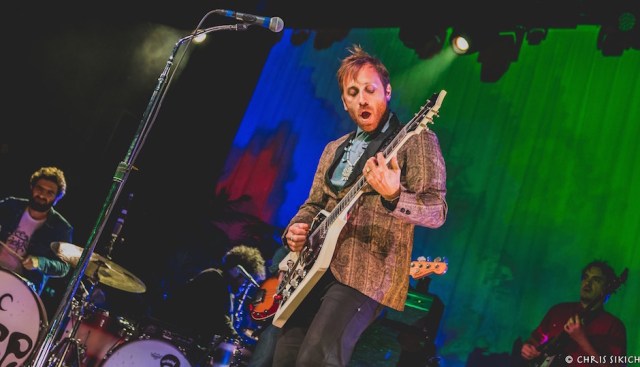
The subject for Day 20 of my 30-day Song Challenge is “A song from an artist’s side project“, and my pick is “Outta My Mind” by The Arcs. The Arcs was a side project of Dan Auerbach, guitarist and vocalist of the Black Keys. He formed the band in 2015 when The Black Keys were on a brief hiatus while drummer Patrick Carney recovered from a shoulder injury. In an interview with Pitchfork, Auerbach explained his impetus for creating the band: “I just wanted to do my thing and get extra weird. I wanted everything to flow [and] be cohesive. It’s basically everything I love about music all wrapped up into one record.”
The record he referred to was their debut – and thus far only – album Yours, Dreamily, released in September 2015. Besides Auerbach on lead vocals and guitar, The Arcs consists of Leon Michels on farfisa organ, synthesizer, guitar and drum pads, Nick Movshon on bass guitar, Homer Steinweiss on drums and percussion, and Richard Swift, who sadly passed away in 2018, on drums, percussion, keyboards and backing vocals.
“Outta My Mind” was the second single released from Yours, Dreamily, and their only single to chart, peaking at #17 on the Billboard Alternative Airplay chart. The song’s terrific, a delicious blend of garage rock, R&B and rock’n’roll, highlighted by marvelous psychedelia-tinged surf and blues guitars. The entire album is great, and along with “Outta My Mind”, my other favorite tracks are “Put a Flower in Your Pocket”, “The Arc” and “Pistol Made of Bones”.
The subject for Day 19 of my 30-day Song Challenge is “A song that’s a superior cover of the original“, and my pick is “All Along the Watchtower” by Jimi Hendrix. The magnificent song was technically recorded by The Jimi Hendrix Experience, which consisted of Hendrix on guitar, Noel Redding on bass, and Mitch Mitchell on drums. For this song, however, Hendrix also played bass, as he felt that Redding “did not put his heart into the bass.”
“All Along the Watchtower” was written by Bob Dylan, who recorded it in 1967 for his album John Wesley Harding, but Hendrix’s cover became the most iconic. Hendrix took Dylan’s acoustic original and radically rearranged it into a more dynamic and dramatic song, befitting the lyrics that many have stated are an allegory about the entertainment business, with artists feeling exploited by their managers and record labels. His complex, multi-layered blend of blues and psychedelic guitars is positively jaw-dropping and nothing short of spectacular.
In choosing to cover the song, Hendrix stated: “All those people who don’t like Bob Dylan’s songs should read his lyrics. They are filled with the joys and sadness of life. I am as Dylan, none of us can sing normally. Sometimes, I play Dylan’s songs and they are so much like me that it seems to me that I wrote them. I have the feeling that Watchtower is a song I could have come up with, but I’m sure I would never have finished it. Thinking about Dylan, I often consider that I’d never be able to write the words he manages to come up with, but I’d like him to help me, because I have loads of songs I can’t finish. I just lay a few words on the paper, and I just can’t go forward.” (Songfacts)
In a 1995 interview with the Fort Lauderdale Sun Sentinel, Dylan described his reaction to hearing Hendrix’s version: “It overwhelmed me, really. He had such talent, he could find things inside a song and vigorously develop them. He found things that other people wouldn’t think of finding in there. He probably improved upon it by the spaces he was using. I liked Hendrix’s [recording] and ever since he died I’ve been doing it that way. Strange how when I sing it, I always feel it’s a tribute to him.”
There must be some kind of way outta here
Said the joker to the thief
There's too much confusion
I can't get no relief
Business men, they drink my wine
Plowmen dig my earth
None will level on the line
Nobody offered his word
Hey, heyNo reason to get excited
The thief, he kindly spoke
There are many here among us
Who feel that life is but a joke
But, uh, but you and I, we've been through that
And this is not our fate
So let us stop talkin' falsely now
The hour's getting late, heyAll along the watchtower
Princes kept the view
While all the women came and went
Barefoot servants, too
Well, uh, outside in the cold distance
A wildcat did growl
Two riders were approaching
And the wind began to howl, hey
All along the watchtower
“All Along the Watchtower” was released as a single in September 1968, with the B-side “Burning of the Midnight Lamp”. Both songs were included on the album Electric Ladyland. Shockingly, it was Hendrix’ only song to reach the top 40 of the Billboard Hot 100, where it peaked at #20.
The subject for Day 18 of my 30-day Song Challenge is “A song you sing well(ish) at karaoke“. Now let me state upfront that I’m not, nor have I ever been, a singer, nor have I sung karaoke very much. And most of the few times I did, I was embarrassingly bad. One of the eye-opening things about attempting karaoke is how really difficult it is to stand up and sing into a microphone when you’re not a singer, nor have any real experience singing in public.
My very first attempt at singing karaoke was back in the early 90s while at a bowling alley in Sacramento, CA with friends. After bowling a few games, during which we also drank a fair amount of alcohol, the six of us went into a room where people were singing karaoke. I and two friends, who were also co-workers, decided we’d tackle the B-52s classic “Love Shack”. Despite its fun, party-like vibe, “Love Shack” is not as easy a song to sing as one would think, partly because there are both male and female parts, but also because they’re meant to be sung in a colorful, animated style that requires a bit of vocal talent. Patricia sang the female parts okay, but Jim (who had an even worse singing voice than me) and I literally mangled the male parts. We were so bad, our other three friends began jeering and throwing food at us!
A few years later, after my partner and I moved to St. Louis, we had a friend who liked to go to karaoke bars. Curiously, though he played piano and sang beautifully, he never wanted to sing karaoke, but only watch others do it. We tagged along with him a few times, and one night, after I’d taken in just the right amount of liquid courage to lower my inhibitions but still maintain adequate mental acuity, I first sang the Olivia Newton-John/John Travolta number from Grease, “You’re the One That I Want”, in a duet with the bar owner’s daughter. Then I did a decent job singing the Archies’ bubble-gum classic “Sugar, Sugar”. With my newly-found confidence, on a subsequent visit to the karaoke bar, I summoned the courage to sing the Bee Gees‘ “You Should Be Dancing“. And much to my own surprise, I gave a stellar performance, falsetto and all!
Sadly, all my following attempts at karaoke, of which I can remember only three more – The Diamonds’ 1950s classic “Little Darlin'” (WTF was I even thinking that I could possibly handle that song, which I butchered in front of Patricia, of the “Love Shack” debacle, and her husband Keith, who were visiting from Sacramento), Sonny & Cher’s “The Beat Goes On”, in a pathetic duet with my friend Sue while on a cruise, and Queen’s “Crazy Little Thing Called Love”, which was far more difficult to sing than I’d imagined. After that humiliation, my karaoke days were over!
Now, for a bit of info about my song pick: As everyone knows, though the Bee Gees began their career writing and singing mostly heartfelt ballads, they transitioned to a more rock-oriented style in the 1970s, which later included a number of dance songs. Although the brothers Gibb felt their songs like “Jive Talkin'” and “Stayin’ Alive” were actually rock songs, they were labeled disco by both music critics and fans. I do consider “You Should Be Dancing”, with it’s infectious, thumping dance beat, as a true disco song, and what a fun song it was to dance to! Released in 1976, it was later used for one of the great dance scenes in the film Saturday Night Fever, where John Travolta wows us with his amazing moves on the dance floor.
Here’s the scene from Saturday Night Fever of John Travolta dancing to “You Should Be Dancing”:
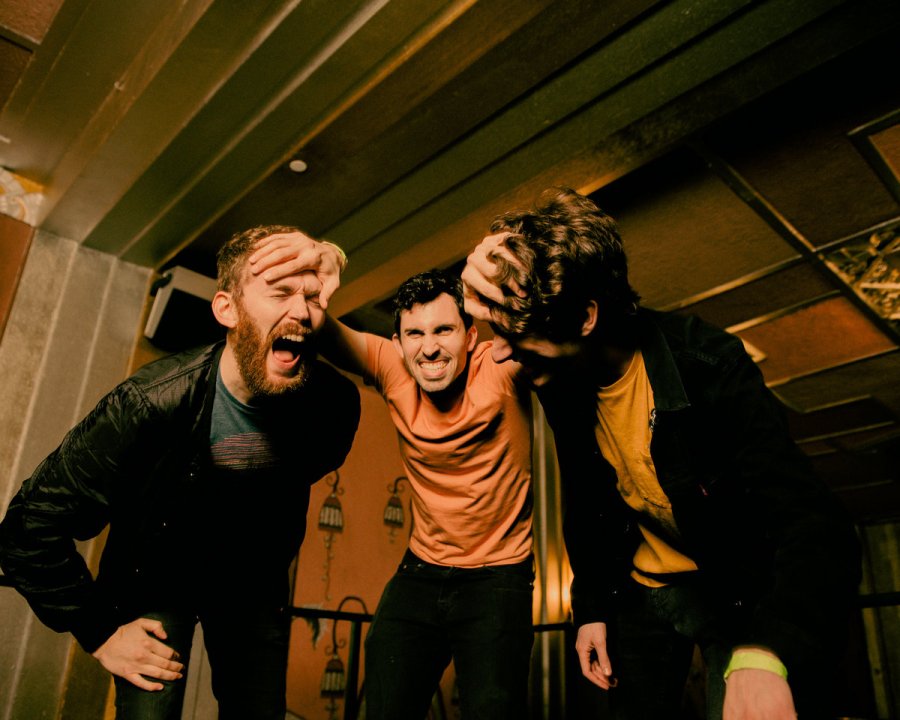
The subject for Day 17 of my 30 Day Song Challenge is “A songreleased this year“. This was another tough one, as there are literally thousands of songs to choose from. To help narrow my list of possible choices a bit, I decided to choose a song I like by an artist or band who follows me on Twitter, and who I’ve not yet written about in 2022. And the very first act that popped into my head is L.A.-based trio The Rare Occasions, and their terrific new single “Seasick“. I love their music, a glorious cornucopia of colorful melodies, sparkling arrangements, exuberant instrumentals, compelling lyrics and endearing vocals. With songs that are immediately memorable and delightfully addictive, it’s not surprising they’ve earned a massive following, with over 5.7 million monthly listeners on Spotify alone.
I first wrote about them in September 2020 when I reviewedtheir fantastic single “Alone”, so I won’t repeat a lot of background information about them that can be found in that article. But to summarize, with origins in New England, and based in Los Angeles since 2017, The Rare Occasions now consists of three very personable and talented guys: Brian McLaughlin on lead vocals and guitar, Jeremy Cohen on bass, and Luke Imbusch on drums. They’ve been putting out great music since the release of their debut EP Applefork in 2013, and last summer (of 2021), they released their outstanding second album Big Whoop. When I wrote about them two years ago, their song “Notion” had garnered approximately 1.7 million streams on Spotify. But after the song went viral on TikTok late last year, it’s now racked up more than 237 million streams! With their explosion in popularity, nine of their other songs have earned between 1-9 million streams.
Their latest single “Seasick” is a fun romp, with a bouncy, lighthearted groove set to Jeremy’s galloping rhythm, and highlighted by Luke’s thumping drumbeats and Brian’s exuberant surf guitars. Brian’s plaintive vocals are wonderful too, rising to electrifying wails in the lively choruses. The lyrics, which feature lots of nautical metaphors, speak to struggling with fears and insecurities that hold us back, preventing us from moving forward in life, living our truths and reaching our goals: “I can’t keep pushing back the plans I got, impersonating something that I’m not. / We get caught up in the little things, displaced from what we know. Though I’m not too fond of traveling, there’s a long long wake behind me.“
The animated lyric video, with sweet artwork by Rhea Hanlon of Lost Lines Studio, and animation by Arianna Soto & Mamasoto Design & Media, shows the band floating in the sea on a small inflatable raft.
The subject for Day 16 of my 30 Day Song Challenge is “A songfrom the 1990s“, and my pick is “Bittersweet Symphony” by The Verve. I’ve always loved songs with lush soundscapes and cinematic orchestration, and “Bittersweet Symphony” fits the bill quite nicely. The magnificent song is one of my favorites from that entire decade.
Though they’d been releasing music for over five years, their singles and albums failed to gain traction in the U.S. or elsewhere outside of the UK. “Bittersweet Symphony” proved to be their breakthrough hit, making them international stars. Released first in the UK in June 1997, the song reached #2 on the UK Singles Chart, and was nominated for Best British Single at the 1998 Brit Awards. It was named Single of the Year by both Rolling Stone and NME, and is considered one of the defining songs of the Britpop era. “Bittersweet Symphony” was subsequently released in the U.S. in March 1998, where it reached #3 on the Billboard Adult Alternative, #8 on the Adult Top 40, and #12 on the Hot 100 charts. The song was also nominated for a Grammy Award for Best Rock Song, and the music video was nominated in three categories at the 1998 MTV Video Music Awards. Surprisingly, it was their only song to ever chart in the U.S., though their albums UrbanHymns and Forth both reached #23 on the Billboard 200 Album chart.
The Verve have had a rather troubled history, facing numerous challenges, including name and line-up changes, break-ups, health problems, drug abuse and various lawsuits, for most of their existence. Originally formed as ‘Verve’ in 1990 while still in their teens, the Wigan, England-based group consisted of lead vocalist Richard Ashcroft (who Coldplay front man Chris Martin said is the best singer in the world), guitarist Nick McCabe, bass guitarist Simon Jones and drummer Peter Salisbury. (Guitarist and keyboard player Simon Tong later became a member during their first reunion period.) But within a year, American record label Verve, known for its extensive jazz catalogue, took issue with the band’s name and demanded they change it. Both parties reached a compromise by the band agreeing to add ‘the’ to their name.
From its beginnings, “Bittersweet Symphony” – whose title would become sadly apropos – was also beset with controversy. The song is based on a sample of a 1965 orchestral version of the Rolling Stones song “The Last Time” by the Andrew Oldham Orchestra, a group formed by Andrew Loog Oldham, the former producer and manager of the Rolling Stones. There was no actual orchestra, but rather a group of session musicians that sometimes included members of the Rolling Stones. Their recording of “The Last Time” was included on their album The Rolling Stones Songbook, featuring symphonic versions of Rolling Stones songs.
When Richard Ashcroft heard the Andrew Oldham Orchestra version of “The Last Time”, he thought it could be “turned into something outrageous“, as he later recalled to David Fricke for Rolling Stone. He sampled and looped four bars from the original recording, then added dozens more tracks, including additional strings based on the melody in the sample that were arranged by Wil Malone, along with guitar, percussion and his own layered vocals. In that Rolling Stone interview, Ashcroft said he imagined “something that opened up into a prairie-music kind of sound“, similar to the work of the Italian composer Ennio Morricone, and that “the song started morphing into this wall of sound, a concise piece of incredible pop music“.
The Verve obtained the rights to use a few notes of the string melody from the Andrew Oldham Orchestra’s “Last Time” by the copyright holder, Decca Records, in exchange for half of The Verve’s royalties on “Bitter Sweet Symphony.” However, they were not given permission from another former Rolling Stones’ manager Allen Klein, who owned the copyrights to the their pre-1970 songs, including “The Last Time”. When “Bitter Sweet Symphony” was about to be released as a single, Klein, by then head of ABKCO Records, refused clearance for the sample, saying The Verve had used a larger portion than previously agreed to. The Verve’s co-manager Jazz Summers turned to their American record label Virgin Records for help. Virgin played “Bitter Sweet Symphony” for Mick Jagger and Keith Richards, who liked the track, but declined to become involved in the dispute. Summers also sent a copy to Oldham, who wrote back: “Fair cop! Absolute total pinch! You can see why [ABKCO are] rolling up their sleeves.” (Rolling Stone)
ABKCO Records filed a lawsuit, which forced The Verve to relinquished all royalties to Klein, and change the songwriting credits to Jagger–Richards. Ashcroft received only $1,000. According to The Verve bassist Simon Jones, “We were told it was going to be a 50/50 split, and then they saw how well the record was doing. They rung up and said we want 100 percent or take it out of the shops, you don’t have much choice.” Rolling Stone wrote that the outcome was “patently absurd”, noting that Jagger and Richards were not involved with the sample or Ashcroft’s melody and lyrics. Ashcroft said sarcastically that “Bitter Sweet Symphony” was “the best song Jagger and Richards have written in 20 years“. Asked in 1999 whether he believed that the situation was fair, Keith Richards said: “I’m out of whack here, this is serious lawyer shit. If The Verve can write a better song, they can keep the money.”
In 1999, Oldham sued AKBCO, saying he was owed up to £1 million in royalties for the use of the sample. Years later he joked that he had bought “a pretty presentable watch strap” with his royalties, and said: “As for Richard Ashcroft, well, I don’t know how an artist can be severely damaged by that experience. Songwriters have learned to call songs their children, and he thinks he wrote something. He didn’t. I hope he’s got over it. It takes a while.” Billboard estimated that “Bitter Sweet Symphony” had generated almost $5 million in publishing revenue by 2019. In 2018, Ashcroft expressed his anger over the situation, saying: “Someone stole God-knows-how-many million dollars off me in 1997, and they’ve still got it … Anyone, unless you are mentally ill, will always remember the day when 50 million dollars was stolen off them.”
In early 2019, Ashcroft’s managers approached Jody Klein, who’d become head of ABKCO following his father’s death in 2009, for reconsideration of the lousy judgement. Klein then connected them to the Rolling Stones’ manager, Joyce Smyth, who agreed to speak to Jagger and Richards about the issue. That April, ABKCO, Jagger and Richards agreed to return the “Bitter Sweet Symphony” royalties and songwriting credits to Ashcroft. Ashcroft announced the agreement a month later at a ceremony in which he received the Ivor Novello Award for Outstanding Contribution to British Music. He said it was a “kind and magnanimous” move, adding “I never had a personal beef with the Stones. They’ve always been the greatest rock and roll band in the world. It’s been a fantastic development. It’s life-affirming in a way.” In a statement, the Rolling Stones said they acknowledged the financial and emotional cost of “having to surrender the composition of one of your own songs.” (Wikipedia)
Here’s the full album version of the song:
And here’s the instrumental version of “The Last Time”, by the Andrew Oldham Orchestra, that served as the basis for “Bittersweet Symphony”:







 ECLECTIC MUSIC LOVER