
Joe Peacock is a British singer-songwriter and musician based in Birmingham, England. Describing himself as “a genre-hopping storyteller, whose music has been compared to Bowie, Blur and Costello”, he cheekily adds “all money from the digital sales of my music go into paying producers/mixing & mastering engineers.” As I do for all music artists or bands I’m writing about for the first time, I read all I could find about him on his own social media pages, as well as other websites and blogs, and listened to a fair amount of his substantial music catalog. In the process, I learned that he grew up in rural Herefordshire, went to university in Stoke, and spent seven years living in St. Petersburg, Russia before settling in Birmingham. Not only is he a hard-working and talented songwriter and musician who’s not afraid to continually experiment and push himself beyond his comfort zone, but also a thoughtful family man who cares deeply about the environment, social justice and inequality, things he spoke passionately about in a January 2022 interview with COOLTOP20 music blog.

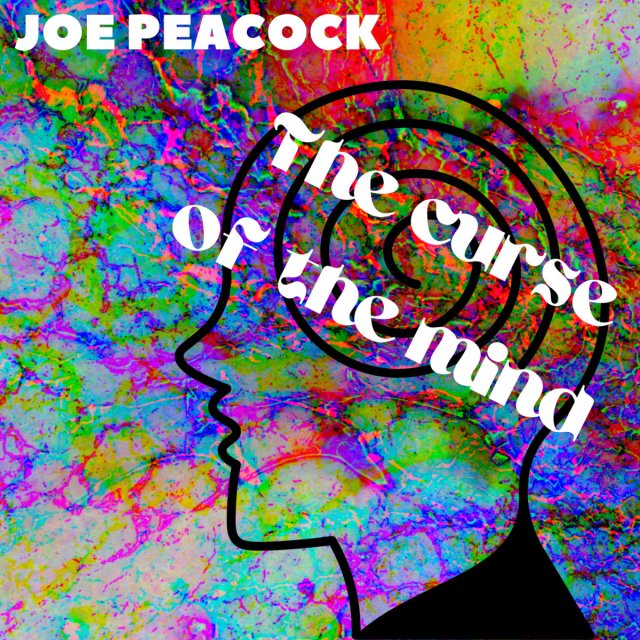
According to his bio, Mr. Peacock rediscovered his creative spark during the Covid lockdowns, and began writing and recording songs at home, handling all aspects of performance and recording. From what I can tell, the prolific artist has released a tremendous amount of music in less than three years, including three albums – I’m Only Here, in April 2021, Before the robots told us where to go, in December 2021, and Mirror Neuron Generator, in July 2022 – as well as two EPs and numerous singles. In addition, he’s also one half of art-folk duo The Missed Trees, his side project with singer/fiddle player Louisa Davies-Foley, who released their three-track EP Animals in April. Now he’s back with a new EP The curse of the mind, featuring four marvelous tracks written, performed and recorded by him, and beautifully mixed and mastered by Adam Whittaker.
The first track, “Thought Camera“, is a magnificent and complex tour de force that, to my ears, sounds like David Bowie singing a Radiohead song that was arranged by Pink Floyd. Incorporating elements of alternative, progressive and dream rock with a stirring orchestral arrangement, Peacock creates a gorgeous cinematic fantasia. His dramatic instrumentation, particularly the haunting piano notes, soaring strings, gnarly guitars and tumultuous percussion, are truly spectacular.
The searing lyrics explore aspects of privacy and mind-control, which he elaborated on in a Tumblr post: “it’s about privacy and the desires by the powerful to monetise our thoughts. Nikola Tesla had an idea for a thought camera, which would project our thoughts onto a wall. Now social media is big business – monetising our anger from us posting our thoughts online. I wonder why Elon Musk is so keen to throw money at Twitter – he named his car company after Tesla, so does he want to use that to help control our thoughts?” He sings “Could we light the world up with the electricity generated by your hatred? /These electrical impulses should be put to use! How will we know if this is all an illusion? You can think deeply and be quite insane. Are there signs we should look out for? Mr. Orwell might be quite amazed by the surveillance, but we still don’t have a mind-reading machine. So I can make sense of your world, I need the thought camera that Nikola dreamed of.“
On “Poltergeist“, which Peacock states was inspired by The Haunting of Alma Fielding, a book by Kate Summerscale that explores a case where a woman reported being haunted by a poltergeist, as well as what he calls “a few bits of personal experience on exploring the supernatural at an impressionable age and (probably unrelated) psychological problems”, he touches on mental health issues: “Scaring everyone like a poltergeist. Have you opened the door into another mind? Can you tell me what’s wrong?” As the title suggests, the song has a haunting quality, yet Peacock employs some melodic touches like a breezy melody, soothing orchestral strings, warbly guitar notes and falsetto vocals to lighten the mood a bit.
He addresses brainwashing and thought-control by authoritarian regimes on “Cult of fake heroes“, using the Soviet Union as an example. He further explains on his Tumblr post: “I use the story of Pavlik Morozov, who, according to the propaganda of the time, informed on his father for anti-communist activities and was a model soviet citizen brutally murdered by others in his family for what he’d done. His story was then told by Stalin’s regime (despite the dictator being scathing of him when he initially heard the story) to inspire others to inform on family, friends and neighbours during the red terror and he inspired patriotism in pioneers and schoolchildren.” He expresses this story thusly: “Every school kid learned his name. The storyline was powerful. At the time they needed heroes. From a village in Siberia got his dad into trouble. Murdered and made an icon.”
I love the track’s intense jangly guitars and emphatic drumbeats, punctuated by stabbing rhythmic flourishes, which Peacock created using an odd 5/4 time signature, which he said gives it a slightly strange, unbalanced feel.
“The Outsider“, which Peacock says is about the outside artist Henry Darger, is for me the most unusual track on the EP, both from a musical and lyrical standpoint. He elaborates about the artist on Tumblr: “He suffered traumatic events in his childhood, which affected his ability to interact with people. He had very few friends and mainly kept himself to himself, working as a janitor and then locking himself away in his room. It was not until he became very ill and was moved into a hospice that his artworks and graphic novels were discovered. He’s acknowledged as the archetypal outsider artist.” He tells Darger’s story with his colorful descriptive lyrics: “15,000 pages of fantasy, in the realms of the unreal. 9-foot-long drawings on both sides, his panoramic sagas. Emotionally arrested, he didn’t know what to do with freedom. He wrote about the weather, when not in fantastic battles in his mind.”
To create the unsettling but darkly beautiful soundscape, he used fragments of guitar parts he chopped up and then put back together. He layers them over a droning melody, accompanied by harsh industrial synths, chiming guitar notes and a strong synth bass groove. That, combined with his array of echoed vocals, otherworldly chants of “ah-bah-suh-duh”, and menacing whispers, the song would be a perfect fit for the musical Sweeney Todd: The Demon Barber of Fleet Street.
Given it’s rather unusual song structures, creative arrangements and unique instrumentation, it took a couple of listens for me to fully appreciate the magnificence of this remarkable EP. With The curse of the mind, Joe Peacock has pushed himself to create an exquisite piece of musical art, and I’m so happy he reached out to me about it!
Connect with Joe: Facebook / Twitter / Instagram
Find his music on Bandcamp / Spotify / Apple Music / YouTube / Soundcloud
 ECLECTIC MUSIC LOVER
I’ve been a fan of Joe Peacock for a while now… Always intriguing stuff!
LikeLiked by 1 person
Yes, I remember you mentioning him in the past. He’s an interesting and talented guy!
LikeLiked by 1 person
We could certainly use more lyricists like this that explore real issues.
LikeLiked by 1 person
Yes indeed!
LikeLiked by 1 person
Based on my initial initial impression, I quite like what Joe Peacock is doing on this EP.
It’s also good to hear that amid all the havoc COVID has caused and is still causing (though nobody talks about it much any longer), the pandemic also had some positive impact, such as artists finding themselves with lots of extra time – time they otherwise would have spent on the road.
Of course, I don’t want to romanticize that situation either and realize not having been able to tour was a very double-edged sword, especially if gigs are your main source of income!
LikeLiked by 1 person
I do like Poltergeist right off the bat…I like the atmosphere he creates. I’ve read the phrase before…but “art rock” fits him…in my mind anyway. He has alot going on but it’s like painting a picture.
LikeLiked by 1 person
Yes, Joe’s quite a talented instrumentalist who’s adept at creating fascinating soundscapes.
LikeLiked by 1 person
Pingback: JOE PEACOCK – EP Review: “Beast Mode” – ECLECTIC MUSIC LOVER