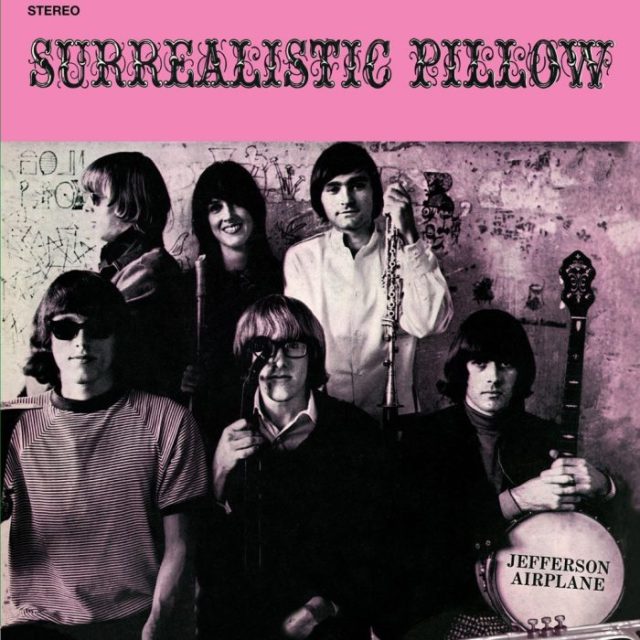
EML’s Favorite Albums – JEFFERSON AIRPLANE: “Surrealistic Pillow”

surrealistic-pillow-1024x1024

Surrealistic Pillow by Jefferson Airplane was one of the earliest albums I remember buying as a teenager growing up in the San Francisco Bay Area, where the band was based. I’d loved their two hit songs “White Rabbit” and “Somebody to Love”, but when I heard the album in its entirety at a friend’s house when it was played by her older sister, I was immediately smitten. I loved every song on the album, and had to have my own copy.  To this day, it remains one of my top 10 all-time favorite albums, and I still cherish my copy, now more than 50 years old. I also think it’s one of the best album covers ever!

Originally formed in 1965, Jefferson Airplane became one of the pioneering bands of psychedelic rock, and came to define what was then called the ‘San Francisco Sound’. They released their debut album Jefferson Airplane Takes Off in 1966 to critical acclaim and decent sales, eventually enough to have it certified gold. It’s a very good album, with songs that were more folk-rock oriented, and inspired by the music of bands like the Beatles, the Byrds and the Lovin’ Spoonful. A turning point in the band’s sound came after the departure of their original female vocalist Signe Anderson in October 1966, who wanted to devote more time to raising her baby daughter. She was replaced by Grace Slick, who’d previously been with the band The Great Society. In addition, founding drummer Skip Spence had earlier been replaced by Spencer Dryden. This new Jefferson Airplane lineup, which would last until early 1970, now consisted of Marty Balin (vocals), Grace Slick (vocals), Paul Kantner (guitar, vocals), Jorma Kaukonen (lead guitar, vocals), Jack Casady (bass) and Spencer Dryden (drums).

Slick’s joining the band proved pivotal to the Airplane’s commercial breakthrough, as her wonderful resonant contralto voice nicely complemented Balin’s beautiful tenor voice, and was well-suited to the band’s increasingly amplified psychedelic sound. In addition, being a former model, her good looks and on-stage charisma greatly enhanced the band’s live performances. She also contributed two of what would become the band’s signature songs – “White Rabbit” and “Somebody to Love”, both of which she originally recorded while with The Great Society (Slick wrote “White Rabbit” and her brother-in-law Darby Slick wrote “Somebody to Love”).

Surrealistic Pillow was recorded in Los Angeles under the guidance of producer Rick Jarrard in only 13 days, at a cost of $8,000. According to Wikipedia, the title “Surrealistic Pillow” was suggested by the album’s “shadow producer” Jerry Garcia, when he commented that the album sounded “as surrealistic as a pillow is soft.” Although the band’s label RCA would not acknowledge Garcia’s considerable contributions to the album’s production, he is listed in the album’s credits as “spiritual advisor.” The album was released in February 1967, and remained on the Billboard 200 album chart for more than a year, peaking at No. 3. Rolling Stone Magazine has ranked the album at #146 on their list of the “500 Greatest Albums of All Time”.

OK, enough with the background information. Let’s get to the album. It kicks off with the rousing “She Drives Funny Cars”, and what a great opening track it is. The first sounds we hear are Dryden’s aggressive galloping drumbeats, which are soon joined by Kaukonen’s and Kantner’s dual guitars, and we’re off to the races. Their intertwining psychedelic riffs are incredible, and so is Casady’s powerful bass line. Balin sings lead vocals here, with Slick nicely crooning in the background. Before we can catch our breath, we’re hit with Slick’s verbal assault of “When the truth is found to be lies”, and for the next two minutes and 55 seconds the masterpiece “Somebody to Love” unfolds, pulling us willingly into its maelstrom of explosive psychedelic greatness. The guitar work on this track is positively wicked! The song became Jefferson Airplane’s highest-charting single.

“My Best Friend” was written by former drummer Spence, and is a pleasing folk-rock song with a Lovin’ Spoonful vibe that would have been at home on their first album. Balin and Slick’s vocal harmonies are particularly nice. Next up is the haunting Balin-Kantner penned love ballad “Today”, with gorgeous jangly and chiming guitars and featuring Balin’s fervent vocals, enveloped by a dramatic percussion-heavy wall of sound that would make Phil Spector proud. “Comin’ Back to Me” is a beautiful mellow ballad with strummed acoustic and electric guitars, some of which were reportedly played by Jerry Garcia. Highlights of the song are the haunting flute and Balin’s stunning heartfelt vocals.

As we continue with the album, it’s clear that every single track is outstanding, and that the band had an incredibly diverse and wide-ranging sound. The hard-driving psychedelic guitars on “3/5 of a Mile in 10 Seconds” are fantastic and gnarly as hell, showcasing the band’s ability to deliver down and dirty blues rock. They seem to channel the Byrds on the breezy gem “D.C.B.A.-25”, with glorious jangly guitars and more of Balin and Slick’s gorgeous vocal harmonies. The song has a different feel from most of the others on the album, but is one of my favorites. “How Do You Feel” is a nod to the Mamas and Papas, with its pleasing melody, beautiful harmonies and more of those beguiling flutes. And then we have the stunning instrumental “Embryonic Journey”, featuring a tour de force acoustic guitar solo performance by Kaukonen of a song he wrote.

Next up is my personal favorite Jefferson Airplane song “White Rabbit”. Slick has stated she wrote the song as a slap to parents who read their children novels like Alice in Wonderland, then wonder why their children later used drugs. In an interview with The Wall Street Journal, she mentioned that besides Alice in Wonderland, her other inspiration for the song was “the bolero used by Miles Davis and Gil Evans on their 1960 album Sketches of Spain,” which was itself inspired by the famous classical composition “Bolero” by Maurice Ravel. It’s the buildup to the crescendo that makes both “Bolero” and “White Rabbit” so wonderful. Here’s a performance of the song on the Smothers Brothers Comedy Hour in 1967.

The album closes with the bluesy “Plastic Fantastic Lover”, with more of those wonderful psychedelic guitars, accompanied by the kind of powerful head-bopping beat I love. It’s a fantastic finish to an album I consider a masterpiece. Although Jefferson Airplane would go on to release several more albums before splitting up in 1972 and going their separate ways with other music projects, none would match the phenomenal success of Surrealistic Pillow.

The album was later re-released with five bonus tracks not on the original 1967 release.


Ten Greatest Rock Songs of the 1960s

I’ve been thinking about the greatest rock songs of all time, and there are likely well over a thousand worthy candidates spanning a period of more than 50 years. I’m certain you could gather 100 people in a room and no two of them would agree on which songs are the greatest. I started to compile a list of what I thought were the best ten or twenty, but it was just too difficult. So, I decided to limit my list to just the 1960s, arguably one of the best decades for rock music.

The 1960s was the decade that hard rock as we know it came into being. Among other things, it was the use of the amplified electric guitar that ushered in a new, heavier sound than had ever existed previously. Just as the rock’n’roll of Elvis Presley, Chuck Berry and Bill Haley & the Comets thrilled young people in the mid to late 50s, the new hard rock music excited them to no end while driving their parents crazy in the mid to late 60s. As a kid, I remember my mother, who liked softer acts like the Mamas & Papas, Beatles and The Supremes, yelling “turn that shit off!” when a Stones or Led Zeppelin song played.

After a lot of careful consideration, here are my picks for the ten greatest rock songs of the 1960s. Naturally, the Rolling Stones are prominently featured, as they were without question the greatest rock band of the 60s, if not of all time.

10.  JUMPIN’ JACK FLASH – Rolling Stones (1968)
The hard-driving “Jumpin’ Jack Flash” is among my favorite Rolling Stones songs. It’s also the most frequently played song at their concerts.  As with so many of their songs, Keith Richards’ guitar work is fucking incredible. Mick Jagger told Rolling Stone in a 1995 interview that the song emerged “out of all the acid of Their Satanic Majesties Request. It’s about having a hard time and getting out.” And in a 1968 interview, Brian Jones described it as a return to their “funky, essential essence” following the psychedelia of Satanic Majesties. As for the song’s title, Richards said that he and Jagger were inspired while staying at his country house, where they were awakened one morning by the sound of Richards’ gardener Jack Dyer working outside. When Jagger asked what the noise was, Richards said: “Oh, that’s Jack – that’s jumpin’ Jack.” The song and lyrics evolved from there.

9.  WHITE RABBIT – Jefferson Airplane (1967)
One of my favorite songs of all time, “White Rabbit” was written by Grace Slick while she was with the band The Great Society. After they broke up in 1966, she joined Jefferson Airplane to replace their departed female singer, Signe Anderson. The first album Slick recorded with Jefferson Airplane was their incredible opus work Surrealistic Pillow – in my opinion one of the greatest albums ever recorded – and Slick provided two songs, “White Rabbit” and “Somebody to Love.”

She has stated the song was a slap to parents who read their children novels like Alice and Wonderland, then wonder why their children later used drugs. In an interview with The Wall Street Journal, she mentioned that besides Alice in Wonderland, her other inspiration for the song was “the bolero used by Miles Davis and Gil Evans on their 1960 album Sketches of Spain,” which was itself inspired by the famous classical composition “Bolero” by Maurice Ravel. It’s the buildup to the crescendo that makes both “Bolero” and “White Rabbit” so wonderful.

8.  MY GENERATION – The Who (1965)
“My Generation” is one of the most popular and signature songs from The Who, and is their highest charting song in the UK though, shockingly, it only peaked at #74 in the U.S. The song is an anthem of youthful rebellion, with one of the most quoted lines in rock history: “I hope I die before I get old.” It’s also considered a precursor of the punk rock movement that would emerge roughly ten years later. It’s been said that Pete Townshend was inspired to write the song after the Queen Mother allegedly had his 1935 Packard hearse towed off a street because she was offended by the sight of it during her daily drive through London’s Belgravia neighborhood.

7.  WHOLE LOTTA LOVE – Led Zeppelin (1969)
The first time I heard “Whole Lotta Love” I was blown away. I was very young and, while I found it too hard and even repellent at the time, I was also intrigued by Led Zeppelin’s aggressive and relentlessly heavy take-no-prisoners sound and Robert Plant’s fierce, high-pitched vocals. Eventually, I came to love it and now appreciate its status as a revolutionary song in the history of hard rock. There’s no denying that the cacophanous mix of intense guitar riffs, crushing bass, tons of wild reverb and Plant’s screams and moans all working together create one of the most complex and exhilarating rock songs ever. If all that weren’t enough, the racy lyrics pushed the envelope beyond anything even the Stones or the Doors had put out: “I’m gonna give you every inch of my love.

6. I PUT A SPELL ON YOU – Creedence Clearwater Revivial (1968)
An important and now classic song in rock and roll, “I Put a Spell On You” was originally written and recorded by Screamin’ Jay Hawkins in 1956, and has been covered by a number of artists over the past six decades. But in my opinion, the version recorded by Creedence Clearwater Revival in 1968 stands above the rest. It’s truly an epic recording that was under appreciated at the time, not to mention the band’s greatest song. Their powerful bluesy rendition, with its fierce, wailing guitar riffs and hammering drums is jaw-droppingly magnificent. John Fogerty’s impassioned screaming vocals bring goosebumps every time I hear the song.

5.  CROSSROADS (Live at Winterland) – Cream (1968)
The definitive version of “Crossroads” is the recording from Cream’s legendary concert in 1968 at Winterland in San Francisco. Eric Clapton’s guitar riffs and Jack Bruce’s bass are so drop-dead phenomenal that they bring chills to my bones and tears to my eyes. And Ginger Baker pounds his drums like his life depended on it. Rock just doesn’t get any better than this! I’m going to paraphrase WestLAGuy, who created a pretty decent video mash-up of the audio from that concert with footage from their farewell concert at London’s Royal Albert Hall (but has unfortunately been removed from YouTube). His discussion of Cream and the song is so good I cannot say it any better.

At the zenith of Cream’s tenure, you would see painted on walls around London ‘Clapton is God’, and this track is a good an example of why people felt that way. For me, the graffiti should have noted three deities, because on their respective instruments, Jack Bruce and Ginger Baker were just as unique as Clapton. Eric came from a blues background (John Mayall and the Yardbirds); Baker and Bruce may have had some experience with the style, but certainly both were excellent jazz musicians. Clapton was right [up] there, as well. Cream never played a song the same way twice. This version of the Robert Johnson song, “Crossroads” is a perfect example of three great players making music at that moment.

4.  (I CAN’T GET NO) SATISFACTION – Rolling Stones (1965)
One of the Stones’ biggest hits, and their first #1 charting single in the U.S., “(I Can’t Get No) Satisfaction” is a brilliant hard rock tirade about rampant commercialism, the stress of touring and sexual frustration. Keith Richards’ three-note guitar riff overlying a crushing bass line makes for an intense powerhouse of a song. In the UK, the song was initially played only on pirate radio stations because its lyrics were considered too suggestive, though it eventually received widespread airplay and reached #1 there.  This electrifying performance took place in Rio de Janeiro, Brazil in February 2006, when all the band members were in their early 60s.

3.  ALL ALONG THE WATCHTOWER – Jimi Hendrix Experience (1968)
Jimi Hendrix is widely considered the greatest guitarist of all time. In fact, in a panel assembled by Rolling Stone magazine in late 2015 of many of the greatest living guitarists – including Keith Richards, Carlos Santana, Eddie Van Halen, Ritchie Blackmore and Joe Perry – Jimi Hendrix came out on top (you can read the article here). In his tribute, Tom Morello wrote of Hendrix: “[He} exploded our idea of what rock music could be. He manipulated the guitar, the whammy bar, the studio and the stage. His playing was effortless. There’s not one minute of his recorded career that feels like he’s working hard at it – it feels like it’s all flowing through him. He seamlessly weaves chords and single-note runs together and uses chord voicings that don’t appear in any music book. His riffs were a pre-metal funk bulldozer, and his lead lines were an electric LSD trip down to the crossroads, where he pimp-slapped the devil.

The song was written by Bob Dylan, who recorded it in 1967, but Hendrix’s cover is the most iconic. In a 1995 interview with the Fort Lauderdale Sun Sentinal, Dylan described his reaction to hearing Hendrix’s version: “It overwhelmed me, really. He had such talent, he could find things inside a song and vigorously develop them. He found things that other people wouldn’t think of finding in there. He probably improved upon it by the spaces he was using. I liked Hendrix’s [recording] and ever since he died I’ve been doing it that way. Strange how when I sing it, I always feel it’s a tribute to him…

“All Along the Watchtower” was a groundbreaking song in late 1968 for all the above-stated reasons. Hendrix’ guitar riffs are beyond amazing, creating an aural orgasm of otherworldly psychedelia. It was a great tragedy he died at such a young age, denying us all the opportunity to hear more incredible music from him.

2.  GIMME SHELTER – Rolling Stones (1969)
Though not a big hit for the Stones, the powerful “Gimme Shelter” is one of their signature songs that some critics consider their best work. I certainly do. Written by Jagger and Richards at the height of the Vietnam War, the song speaks to the social upheaval and violence of the time. “That’s a kind of end-of-the-world song, really,” Jagger said in a 1995 interview with Rolling Stone. “It’s apocalypse.” Richards later said that his guitar fell apart on the last take, “as if by design.” Ironically, the song was released just days after a man was murdered at the Altamont Music Festival, which was headlined by the Stones.

The intro, strummed on an electric-acoustic guitar, conjures up feelings of impending menace before Jagger’s harmonica enters the scene. Guest singer Merry Clayton’s powerful wailing vocals do chilling justice to the searing lyrics as she screams: “Rape, murder, it’s just a shot away.” Clayton, who was pregnant at the time, was summoned from her bed by producer Jack Nitzsche for a last-minute recording session. Shortly after returning home she suffered a miscarriage, which she attributed to her exertion during recording.

1.  LIGHT MY FIRE (extended version) – The Doors (1967)
I’ll admit up-front that it might be debatable whether “Light My Fire” is the greatest rock song of the 1960s, however, the extended seven-minute album version is unquestionably a rock masterpiece. It is that epic long version that I believe is the greatest rock song – and my personal favorite – of the decade. In fact, it ranks #2 among my all-time favorite songs (“Stairway to Heaven” being #1). One of the things that makes the song so uniquely compelling is Ray Manzarek’s skillful use of the Vox Continental organ to create the incredible signature sound that continues unabated throughout the entire seven-minute track. For the recording, session musician Larry Knechtel played a Fender Precision Bass guitar to double the keyboard bass line (Wikipedia). The song was written by Robby Krieger, whose guitar solo during the instrumental break is spectacular, and Jim Morrison’s seductive and soaring vocals are positively electrifying.

Interesting bit of trivia: “Light My Fire” was performed live by the Doors on The Ed Sullivan Show on September 17, 1967. The Doors were asked by producer Bob Precht to change the line “girl, we couldn’t get much higher”, as the sponsors were uncomfortable with the possible reference to drug-taking (back in those days nearly everything was either taboo or illegal). The band agreed and did a rehearsal using the amended lyrics, “girl, we couldn’t get much better.” During the live performance, however, Morrison sang the original lyric. Ed Sullivan was furious and did not shake Morrison’s hand as he left the stage, and they were never invited back.

Honorable Mentions:
I could just as easily have included any one of these fantastic songs:

Paint It, Black – Rolling Stones
Sympathy For the Devil – Rolling Stones
Honky Tonk Women – Rolling Stones
Gimme Some Lovin’ – Spencer Davis Group
House of the Rising Sun – The Animals
Purple Haze – Jimi Hendrix Experience
Break On Through (To the Other Side) – The Doors
Sunshine of Your Love – Cream
I Can See For Miles – The Who
Born to be Wild – Steppenwolf
Piece of my Heart – Big Brother and the Holding Company

What are your favorites? Did I miss any great ones?