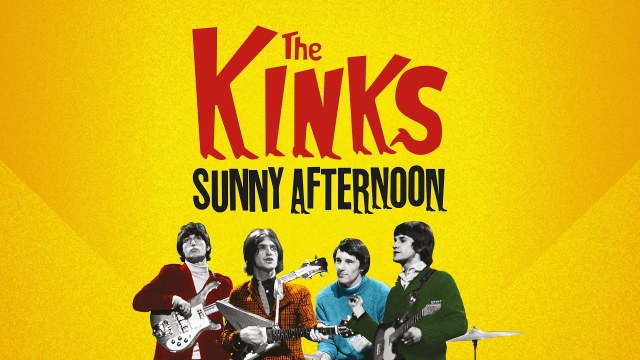
I was recently invited by fellow blogger Max Gower to participate in a special series on The Kinks for his terrific blog Power Pop… An Eclectic Collection of Pop Culture. I chose to write about their 1966 single “Sunny Afternoon”, which ranks among my top ten favorites songs by the Kinks. I was 11 when the song came out and I remember liking it a lot, not only because of its catchy, upbeat melody but also for the lines “Save me, save me, save me from this squeeze. I gotta big fat mama trying to break me” which, being an 11-year-old, I found pretty funny. Though I didn’t fully comprehend the deeper meaning of the lyrics at the time, my guess was that the song was generally about a guy’s discontent over his current life situation.
Written by Kinks frontman Ray Davies while he was at home suffering from a bad cold, “Sunny Afternoon” was inspired by the high levels of progressive tax imposed by the British Labour government of Harold Wilson (a subject also covered by the Beatles in their song “Taxman”), as well as a host of difficult issues he was facing at the time. Despite the Kinks’ immense success, group tensions, lawsuits, an unrealistic workload and unsupportive management was making them miserable. Davies was also dealing with new fatherhood, and had even left the band for a while.
In writing the song, Davis composed the melody first, then created an alter ego to express his feelings. He later recalled: “The only way I could interpret how I felt was through a dusty, fallen aristocrat who had come from old money as opposed to the wealth I had created for myself.” In order to prevent the listener from sympathizing with the song’s protagonist, a spoiled aristocrat bemoaning the loss of his vast unearned wealth, Davies said, “I turned him into a scoundrel who fought with his girlfriend after a night of drunkenness and cruelty.” (Songfacts)
Regarding those lyrics I loved as a kid, Davies explained in a 2016 interview with Q magazine: “My mother was quite large. But that also alludes to the government, the British Empire, trying to break people.”
Davies was still suffering from his cold on the day he recorded the song on May 13, 1966, and now that I know this, his nasal congestion is apparent in his vocals, which nevertheless still sound great to me. He recalled to Q magazine: “I did it in one take and when I heard it back I said, ‘No, let me do it properly,’ but the session was out of time. So that was the vocal. I heard it again the other day. I was 22 but I sound like someone about 40 who’s been through the mill. I really hang on some of the notes. A joyous song, though, even if it’s suppressed joy. I had real fun writing that.” Backing vocals were sung by Dave Davies, Kinks bassist Pete Quaife, and Ray Davies’ then wife Rasa.
With its strong music hall vibe (a type of British theatrical entertainment similar to American vaudeville that was popular from the Victorian era through World War I, characterized by a mix of popular songs, comedy and specialty acts), “Sunny Afternoon” was a continuation of the stylistic departure from the band’s earlier hard-driving, power chord songs like “You Really Got Me” and “All Day and All of the Night” that began with 1965’s “A Well Respected Man”. Besides Davies’ wonderful vocals, I love Pete Quaife’s jaunty bass riff, session musician Nicky Hopkins’ spirited piano, and the charming little musical touches like the harmonica, tambourine and lively percussion heard throughout the track.
Released as a single on June 3, 1966, “Sunny Afternoon” went to #1 on the UK Singles Chart that July, where it spent three weeks. The song also reached #1 in Ireland, Canada, the Netherlands and Norway, and peaked at #14 on the Billboard Hot 100 chart in the U.S. It was later included on their fourth album Face to Face, released in October 1966, as well as becoming the title track for their 1967 compilation album.
The promotional video produced for the single featured the band performing in a cold, snowy environment, in sharp contrast to the lyrics about enjoying a sunny afternoon.
I’ve been thinking about the greatest rock songs of all time, and there are likely well over a thousand worthy candidates spanning a period of more than 50 years. I’m certain you could gather 100 people in a room and no two of them would agree on which songs are the greatest. I started to compile a list of what I thought were the best ten or twenty, but it was just too difficult. So, I decided to limit my list to just the 1960s, arguably one of the best decades for rock music.
The 1960s was the decade that hard rock as we know it came into being. Among other things, it was the use of the amplified electric guitar that ushered in a new, heavier sound than had ever existed previously. Just as the rock’n’roll of Elvis Presley, Chuck Berry and Bill Haley & the Comets thrilled young people in the mid to late 50s, the new hard rock music excited them to no end while driving their parents crazy in the mid to late 60s. As a kid, I remember my mother, who liked softer acts like the Mamas & Papas, Beatles and The Supremes, yelling “turn that shit off!” when a Stones or Led Zeppelin song played.
After a lot of careful consideration, here are my picks for the ten greatest rock songs of the 1960s. Naturally, the Rolling Stones are prominently featured, as they were without question the greatest rock band of the 60s, if not of all time.
10. JUMPIN’ JACK FLASH – Rolling Stones (1968)
The hard-driving “Jumpin’ Jack Flash” is among my favorite Rolling Stones songs. It’s also the most frequently played song at their concerts. As with so many of their songs, Keith Richards’ guitar work is fucking incredible. Mick Jagger told Rolling Stone in a 1995 interview that the song emerged “out of all the acid of Their Satanic Majesties Request. It’s about having a hard time and getting out.” And in a 1968 interview, Brian Jones described it as a return to their “funky, essential essence” following the psychedelia of Satanic Majesties. As for the song’s title, Richards said that he and Jagger were inspired while staying at his country house, where they were awakened one morning by the sound of Richards’ gardener Jack Dyer working outside. When Jagger asked what the noise was, Richards said: “Oh, that’s Jack – that’s jumpin’ Jack.” The song and lyrics evolved from there.
9. WHITE RABBIT – Jefferson Airplane (1967)
One of my favorite songs of all time, “White Rabbit” was written by Grace Slick while she was with the band The Great Society. After they broke up in 1966, she joined Jefferson Airplane to replace their departed female singer, Signe Anderson. The first album Slick recorded with Jefferson Airplane was their incredible opus work Surrealistic Pillow – in my opinion one of the greatest albums ever recorded – and Slick provided two songs, “White Rabbit” and “Somebody to Love.”
She has stated the song was a slap to parents who read their children novels like Alice and Wonderland, then wonder why their children later used drugs. In an interview with The Wall Street Journal, she mentioned that besides Alice in Wonderland, her other inspiration for the song was “the bolero used by Miles Davis and Gil Evans on their 1960 album Sketches of Spain,” which was itself inspired by the famous classical composition “Bolero” by Maurice Ravel. It’s the buildup to the crescendo that makes both “Bolero” and “White Rabbit” so wonderful.
8. MY GENERATION – The Who (1965)
“My Generation” is one of the most popular and signature songs from The Who, and is their highest charting song in the UK though, shockingly, it only peaked at #74 in the U.S. The song is an anthem of youthful rebellion, with one of the most quoted lines in rock history: “I hope I die before I get old.” It’s also considered a precursor of the punk rock movement that would emerge roughly ten years later. It’s been said that Pete Townshend was inspired to write the song after the Queen Mother allegedly had his 1935 Packard hearse towed off a street because she was offended by the sight of it during her daily drive through London’s Belgravia neighborhood.
7. WHOLE LOTTA LOVE – Led Zeppelin (1969)
The first time I heard “Whole Lotta Love” I was blown away. I was very young and, while I found it too hard and even repellent at the time, I was also intrigued by Led Zeppelin’s aggressive and relentlessly heavy take-no-prisoners sound and Robert Plant’s fierce, high-pitched vocals. Eventually, I came to love it and now appreciate its status as a revolutionary song in the history of hard rock. There’s no denying that the cacophanous mix of intense guitar riffs, crushing bass, tons of wild reverb and Plant’s screams and moans all working together create one of the most complex and exhilarating rock songs ever. If all that weren’t enough, the racy lyrics pushed the envelope beyond anything even the Stones or the Doors had put out: “I’m gonna give you every inch of my love.”
6. I PUT A SPELL ON YOU – Creedence Clearwater Revivial (1968)
An important and now classic song in rock and roll, “I Put a Spell On You” was originally written and recorded by Screamin’ Jay Hawkins in 1956, and has been covered by a number of artists over the past six decades. But in my opinion, the version recorded by Creedence Clearwater Revival in 1968 stands above the rest. It’s truly an epic recording that was under appreciated at the time, not to mention the band’s greatest song. Their powerful bluesy rendition, with its fierce, wailing guitar riffs and hammering drums is jaw-droppingly magnificent. John Fogerty’s impassioned screaming vocals bring goosebumps every time I hear the song.
5.CROSSROADS (Live at Winterland) – Cream (1968)
The definitive version of “Crossroads” is the recording from Cream’s legendary concert in 1968 at Winterland in San Francisco. Eric Clapton’s guitar riffs and Jack Bruce’s bass are so drop-dead phenomenal that they bring chills to my bones and tears to my eyes. And Ginger Baker pounds his drums like his life depended on it. Rock just doesn’t get any better than this! I’m going to paraphrase WestLAGuy, who created a pretty decent video mash-up of the audio from that concert with footage from their farewell concert at London’s Royal Albert Hall (but has unfortunately been removed from YouTube). His discussion of Cream and the song is so good I cannot say it any better.
“At the zenith of Cream’s tenure, you would see painted on walls around London ‘Clapton is God’, and this track is a good an example of why people felt that way. For me, the graffiti should have noted three deities, because on their respective instruments, Jack Bruce and Ginger Baker were just as unique as Clapton. Eric came from a blues background (John Mayall and the Yardbirds); Baker and Bruce may have had some experience with the style, but certainly both were excellent jazz musicians. Clapton was right [up] there, as well. Cream never played a song the same way twice. This version of the Robert Johnson song, “Crossroads” is a perfect example of three great players making music at that moment.”
4. (I CAN’T GET NO) SATISFACTION – Rolling Stones (1965)
One of the Stones’ biggest hits, and their first #1 charting single in the U.S., “(I Can’t Get No) Satisfaction” is a brilliant hard rock tirade about rampant commercialism, the stress of touring and sexual frustration. Keith Richards’ three-note guitar riff overlying a crushing bass line makes for an intense powerhouse of a song. In the UK, the song was initially played only on pirate radio stations because its lyrics were considered too suggestive, though it eventually received widespread airplay and reached #1 there. This electrifying performance took place in Rio de Janeiro, Brazil in February 2006, when all the band members were in their early 60s.
3.ALL ALONG THE WATCHTOWER – Jimi Hendrix Experience (1968)
Jimi Hendrix is widely considered the greatest guitarist of all time. In fact, in a panel assembled by Rolling Stone magazine in late 2015 of many of the greatest living guitarists – including Keith Richards, Carlos Santana, Eddie Van Halen, Ritchie Blackmore and Joe Perry – Jimi Hendrix came out on top (you can read the article here). In his tribute, Tom Morello wrote of Hendrix: “[He} exploded our idea of what rock music could be. He manipulated the guitar, the whammy bar, the studio and the stage. His playing was effortless. There’s not one minute of his recorded career that feels like he’s working hard at it – it feels like it’s all flowing through him. He seamlessly weaves chords and single-note runs together and uses chord voicings that don’t appear in any music book. His riffs were a pre-metal funk bulldozer, and his lead lines were an electric LSD trip down to the crossroads, where he pimp-slapped the devil.”
The song was written by Bob Dylan, who recorded it in 1967, but Hendrix’s cover is the most iconic. In a 1995 interview with the Fort Lauderdale Sun Sentinal, Dylan described his reaction to hearing Hendrix’s version: “It overwhelmed me, really. He had such talent, he could find things inside a song and vigorously develop them. He found things that other people wouldn’t think of finding in there. He probably improved upon it by the spaces he was using. I liked Hendrix’s [recording] and ever since he died I’ve been doing it that way. Strange how when I sing it, I always feel it’s a tribute to him…”
“All Along the Watchtower” was a groundbreaking song in late 1968 for all the above-stated reasons. Hendrix’ guitar riffs are beyond amazing, creating an aural orgasm of otherworldly psychedelia. It was a great tragedy he died at such a young age, denying us all the opportunity to hear more incredible music from him.
2.GIMME SHELTER – Rolling Stones (1969)
Though not a big hit for the Stones, the powerful “Gimme Shelter” is one of their signature songs that some critics consider their best work. I certainly do. Written by Jagger and Richards at the height of the Vietnam War, the song speaks to the social upheaval and violence of the time. “That’s a kind of end-of-the-world song, really,” Jagger said in a 1995 interview with Rolling Stone. “It’s apocalypse.” Richards later said that his guitar fell apart on the last take, “as if by design.” Ironically, the song was released just days after a man was murdered at the Altamont Music Festival, which was headlined by the Stones.
The intro, strummed on an electric-acoustic guitar, conjures up feelings of impending menace before Jagger’s harmonica enters the scene. Guest singer Merry Clayton’s powerful wailing vocals do chilling justice to the searing lyrics as she screams: “Rape, murder, it’s just a shot away.” Clayton, who was pregnant at the time, was summoned from her bed by producer Jack Nitzsche for a last-minute recording session. Shortly after returning home she suffered a miscarriage, which she attributed to her exertion during recording.
1. LIGHT MY FIRE (extended version) – The Doors (1967)
I’ll admit up-front that it might be debatable whether “Light My Fire” is the greatest rock song of the 1960s, however, the extended seven-minute album version is unquestionably a rock masterpiece. It is that epic long version that I believe is the greatest rock song – and my personal favorite – of the decade. In fact, it ranks #2 among my all-time favorite songs (“Stairway to Heaven” being #1). One of the things that makes the song so uniquely compelling is Ray Manzarek’s skillful use of the Vox Continental organ to create the incredible signature sound that continues unabated throughout the entire seven-minute track. For the recording, session musician Larry Knechtel played a Fender Precision Bass guitar to double the keyboard bass line (Wikipedia). The song was written by Robby Krieger, whose guitar solo during the instrumental break is spectacular, and Jim Morrison’s seductive and soaring vocals are positively electrifying.
Interesting bit of trivia: “Light My Fire” was performed live by the Doors on The Ed Sullivan Show on September 17, 1967. The Doors were asked by producer Bob Precht to change the line “girl, we couldn’t get much higher”, as the sponsors were uncomfortable with the possible reference to drug-taking (back in those days nearly everything was either taboo or illegal). The band agreed and did a rehearsal using the amended lyrics, “girl, we couldn’t get much better.” During the live performance, however, Morrison sang the original lyric. Ed Sullivan was furious and did not shake Morrison’s hand as he left the stage, and they were never invited back.
Honorable Mentions:
I could just as easily have included any one of these fantastic songs:
Paint It, Black – Rolling Stones
Sympathy For the Devil – Rolling Stones
Honky Tonk Women – Rolling Stones
Gimme Some Lovin’ – Spencer Davis Group
House of the Rising Sun – The Animals
Purple Haze – Jimi Hendrix Experience
Break On Through (To the Other Side) – The Doors
Sunshine of Your Love – Cream
I Can See For Miles – The Who
Born to be Wild – Steppenwolf
Piece of my Heart – Big Brother and the Holding Company
What are your favorites? Did I miss any great ones?


 ECLECTIC MUSIC LOVER