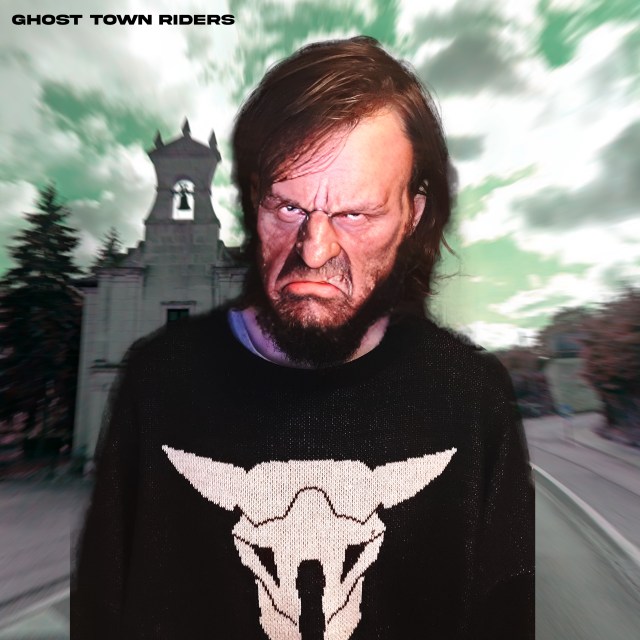
Perro del Kaos – Album Review: “Ghost Town Riders”

One of the most imaginative, creative and intelligent artists I’ve come across in my nearly ten years of writing about music for this blog is Kristian Møller-Munar, a singer-songwriter, composer and animation artist of Danish and Spanish heritage. Born in Copenhagen, Denmark, but raised primarily on the Mediterranean island of Palma De Mallorca until the age of 12, when he moved with his family back to Copenhagen, Kristian had the good fortune to experience two rich cultures, which I think imbues him with a perspective and worldliness beyond his years. He later moved to London to attend university, but when the Covid pandamic hit, he left London and split his time between Copenhagen and Mallorca. For the past few years, he’s been living in Spain.

I first learned about Kristian in 2017 when he was based in London and a member of alternative indie pop/rock band From the Cave. I featured them and their delightfully eclectic music several times on my blog between November 2017 and April 2019, shortly after which they split up, much to my chagrin. Fortunately, he’s continued to record music as a solo artist, and over the past six years has released an astonishing eight albums, all of them ambitious works featuring anywhere from 10 to 23 tracks in a variety of genres, but primarily sung in Spanish. Exactly four years ago today, I reviewed his magnificent fourth album Caldo, an exquisite and loving tribute to his Spanish heritage, specifically, his mother’s homeland of Mallorca. That album contains an impressive 18 tracks.

Kristian’s latest endeavor is his solo music project Perro del Kaos (Spanish for “chaos dog”), under which he’s just released an album Ghost Town Riders. A truly monumental work, the album features a mind-boggling 27 tracks, nine of which run over five minutes in length! I normally dislike reviewing full albums on a good day, so when Kristian reached out to me about possibly reviewing Ghost Town Riders, needless to say I was a bit overwhelmed! My initial gut reaction was “how or where do I even begin to tackle such a massive work as this?” After giving it some thought, I decided to first have Kristian provide a little background about his inspiration for creating the album. Secondly, so as not to make myself crazy or bore my readers, I would only touch on a handful of tracks that are either my favorites or those I feel are important to the album’s overall narrative.
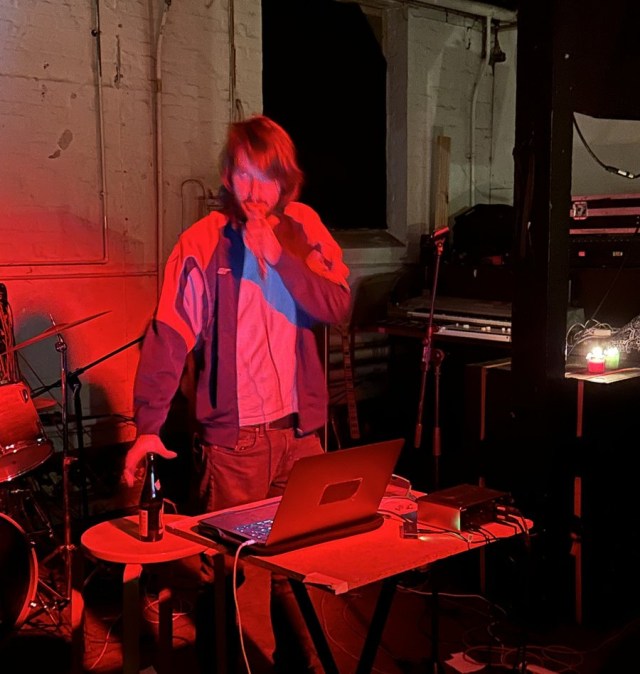
Here’s some of what Kristian provided about how Ghost Town Riders came to be: “Musically the album has been crucially influenced by an amazing group of collaborators I’ve had the pleasure of working with and alongside during 2024. I want to give a special mention to my friends Jo Hedegaard, Ekin Torner and Dilan Bohorquez, a group of kick-ass artists. Back in March 2024, Jo invited me to come alongside his self-funded punk-tour across Spain and Portugal to promote his film ‘The Great Grand Greatness Awards’. We travelled together for two weeks and I had the pleasure of listening to his awesome CD collection in the car. For hours every day we listened to records on the road, and in my opinion a car is one of the best places to listen to music. I think that experience instilled the idea of doing a “road trip friendly” album, something with a blend of rock and roll, blues, folk and music from the 60’s and 70’s.

In between the drives we spontaneously began doing some experimental film recordings on my phone, where Jo improvised a fictional alter ego character named “Palmer”. These raw recordings became the starting point for the punk/western “Peacehammer On The Flower Road”. As a side resuIt, I decided to launch myself completely into a new song project, with a key track (“Ghost Town Riders”) having its breakthrough moment on Ekin’s kitchen table. We were both drinking coffee and listening to random musical samples that I was putting together. The idea was to do a sort of unusual collage of sounds. A heavy metal riff, a bit of jazz double bass, some trap inspired beats, etc. A few hours later the same day I recorded the lead vocals in my bedroom. By the time the vocals were done I felt certain that this was something special. Particularly the lyrics “we sang the night away”, referencing my memory of many enjoyable nights with Jo at Copenhagen’s late night bodegas.

The following 10 days I wrote intensely from the bedroom in San Sebastian. Quickly songs like “Better Days”, ”Gold Fever” and “Poison” appeared. I remember doing the improvised vocal take on “Better Days” and shortly afterwards thinking, this might be one of the best songs I’ve ever written, but simultaneously feeling a bit careful of spoiling the magic. As the Christmas holiday closed in – I had to travel back to Mallorca to spend time with my family – I felt irritated because it seemed like this trip could potentially mess with the flow of the creative process. For the first time in a long time I felt like I might have a shot of completing a new album of songs. At one point, shortly after Christmas day, I had to accept the situation and the constant family plans, and almost mentally “let the album go”.

But then something unusual happened. One night I had a strange dream. I dreamt that I was suspended in the air surrounded by an intense white light. In the dream I received a sort of instruction or message that told me something like: “Don’t worry about the songs, your creativity, your ability or your inspiration. There is an infinite amount of songs that are contained within this light. And all the songs have already been written. They are all waiting here for you to use whenever you need them. They will be here in a day or in 10 years, the time doesn’t matter. You don’t have to struggle to get them. There is only one thing you need to do to access them.

And then the dream followed with a simple but powerful realization: “All you have to do to access these songs is to let go of your skin. The idea of who you think you are.” In the dream it was like my skin fell off. And I felt an incredible amount of peace. The next day when I woke up I felt like all the irritation from the Christmas “interruption” was gone. And I no longer worried whether I was going to be able to channel something creatively. I felt as if everything would always be there waiting for me to be used.

From then on the songwriting picked up pace in an incredible way, and I was pretty much writing a new finished song a day. But most importantly, the process was so much fun. The last week of recording I spent shouting loud choir vocal stacks at my grandparents old village house. Singing “Rocket To Hell”, “Fire”, “Tunnel Lights” and “Canyon Of Dreams” in front of an old fireplace from the early 20th century.

I’m very proud of the album and I look forward to trying these songs live. I really feel they channel some powerful feelings. I’m grateful that I still get to write new music and to have had these powerful experiences. I want to reach out to anyone out there who feels like they are struggling with their artistic practice and I want you to know that you are not alone. I’m sure you will find a way forward and I hope you will find peace and discover your own way. Sometimes things turn out in unexpected ways, we get disappointed and discouraged. But there’s plenty of light out there and I hope that we all get to receive its beauty and power.

I find it fascinating that a guy who grew up in Denmark and Mallorca, with a stint in London, would conceptualize an album with a theme partially set in the American Old West. But after all, Italian filmmaker Sergio Leone directed some of the finest Western films ever, including The Good, the Bad and the Ugly and Once Upon a Time in the West, so who am I to question? Kristian told me the American West concept was inspired by the “Peacehammer” movie universe, but also from listening to a lot of American music as a kid and watching Westerns with his grandparents.

Ghost Town Riders opens with the title track, a strange and sometimes chaotic five and a half-minute long fantasia that sets the overall tone for the album. Kristian’s mix of spoken word, chanted and sung vocals are accompanied by all sorts of sound effects and musical instruments ranging from guitars, horns and organ to gnarly industrial synths and tribal drumbeats. The lyrics cover a lot of ground, with him singing about friendships, familial and romantic relationships as the music and tempo continually change: “I was afraid to leave town, I was afraid to let you down. I thought you loved me before./ I’m not a fan of ghosts, ain’t never been a fan./ I’m sitting in the corner, and minding my own business. I don’t give a damn about any of your business./ Why don’t we call each other once in a while? I know you’ve been worried about the future and all the darkness in the world. But we can find a better way./ We sang the night away, and that’s a beautiful way to spend some time.

One of my favorites is the second track “Gold Fever“, a cool song both musically and lyrically. I love the mysterious synths, twangy guitars, sharp percussion and tribal drums, all set to a hypnotic driving beat. The lyrics speak to man’s inherent greed and eternal quest for the precious metal of gold, which was a long-running theme that played out time and again in the development and exploitation of the American West: “The answer to the goal is always gold. Gold fever is always on your mind. And you cry at night because you’re out of cash./ Gold fever, it’s getting to your head./ We need gold to get more gold./ Such a sexy type metal. It’s heavy metal.” Kristian does a pretty good job singing like an old man with a quirky mix of a Western and Southern accent.

He’s also a handsome guy, but he’s turned himself into a scowling and rather scary-looking old man in his videos.

Poison” opens with the provocative line “All aboard the bullshit train. Next stop, poison, Jersey and killer sharks…” before launching into a The Who-esque flourish that then segues into a deep bass riff reminiscent of “Bad Guy” by Billie Eilish. The song eventually settles into a discordant foot-stomping rocker, highlighted by some terrific Spanish guitar, aggressive percussion and lots of abrasive sound effects.

Better Days” is a poignant and lovely folk rock song that sees Kristian reflecting on his experiences growing up and living in different countries, meeting and making friends and also seeing loved ones pass away: “You know that it’s difficult to grow up. You know it’s difficult to move away from home. But along the trip, we made some beautiful memories. I know you’re worried on your own. It’s been a long time since we hanged out. And these busy times they get to my nerves. Makes me sad to see people go, to see people die. Tomorrow is a better day.” The beautiful twangy Western-flavored and shimmery guitars make this another of my favorites on the album.

One of the more interesting tracks is the 6:45-minute long “Junkyard Tower“, a dark and at times otherworldly song that would make it a great candidate for sci-fi movie soundtrack. Halfway through, the music transitions from an exotic Eastern-flavored vibe to a hip hop-infused alt-rock song. The lyrics seem to describe someone who’s so totally cynical about life that he’s fully checked out: “I see myself as bad parent to my kids. Abandoning them. I see myself as a selfish person, taking advantage of my friends for my own personal interest. Love is not real. Friendship, I guess you can call it a benefit. Time, my most valuable asset. I’m not going to share it with anyone, but you. Junkyard tower. It’s a beautiful place. It’s the place I know. It’s the place I love./ Getting me out of the goldmine. Getting me out of the tough times. Getting me out of the lockdown.

Another track that especially resonated with me is “Spotify“, a denunciation of the unfair and predatory practicies of the music streaming behemoth. Accompanied by just a solemn piano riff, Kristian laments: “Spotify, doesn’t pay me for my music. It’s been a long time like this, I can’t take it anymore. You might think it’s funny to be a musician living with your parents. And do some hard work on the things no one listens to. And then you don’t get paid. Music doesn’t have any worth./ We can make a change right now. End Spotify somehow.” I’m sure virtially all independent artists and bands would relate to this song.

Fire” is an exilarating, hard-driving track with super grungy riffs, a chugging bassline and lots of distortion. I’m not certain what the song’s about, but I like it, plus the chaotic video’s a trip. Kristian repeats the line “Before the future runs over your head, shake it, shake it“, so one guess is that the lyrics allude to the general chaos of life.

Canyon of Dreams” is a meandering and trippy six and a half-minute long tour de force that nicely showcases Kristian’s wild imagination and knack for incorporating a mind-blowing array of musical styles, textures and sounds into a single track. And on “The Tracks“, he once again employs several change-ups in tempo and vibe to create a compelling soulful song. And for the wonderful video, he uses some older footage from his time in England, including a few images of him and his former From the Cave bandmembers.

Kristian turns sentimental on the mellow, jazzy and poignant piano ballad “Someone New“, his vocals sounding world-weary as he plaintively croons to a former loved one now that their relationship has ended: “It’s just like we traveled through the darkest stars, the dark times. And you cannot keep up with that lack of trust./ It’s just like we belong in this world. And I know that you will find someone new.”

He closes out Ghost Town Riders on an upbeat note with “Dead or Alive“, a rousing, bass-driven romp with a garage rock feel, courtesy of frantic jangly guitars, insistent drums and even a bit of cowbell for good measure. The lyrics speak of a crazy woman who’ll stop at nothing to get what she wants: “She’s completely crazy, she’s out of her mind./ She wants to make out, dead or alive. And you might just as well be surprised. Be surprised. A tequila shot to the head, it’s a bloody mary massacre. You’re bleeding all over the bar. In Spain, there’s pain. Get it, get it, get me out of this place.”

Well, I think I’ve gone on long enough so in closing, all I can say is that Ghost Town Riders is an epic work showcasing Kristian’s vivid imagination, intelligent songwriting and masterful musicianship. I’ve long been impressed by his immense creativity and prodigious output, but he’s taken both to a whole new level here. While this album might not appeal to everyone, there’s no denying the incredible originality and thought that went into this thoroughly unique work. I’m quite fond of Kristian, and it’s been a joy to follow along with him on his musical journey over the past seven-plus years.
KRISTIAN MØLLER – Album Review & Interview: “Caldo”

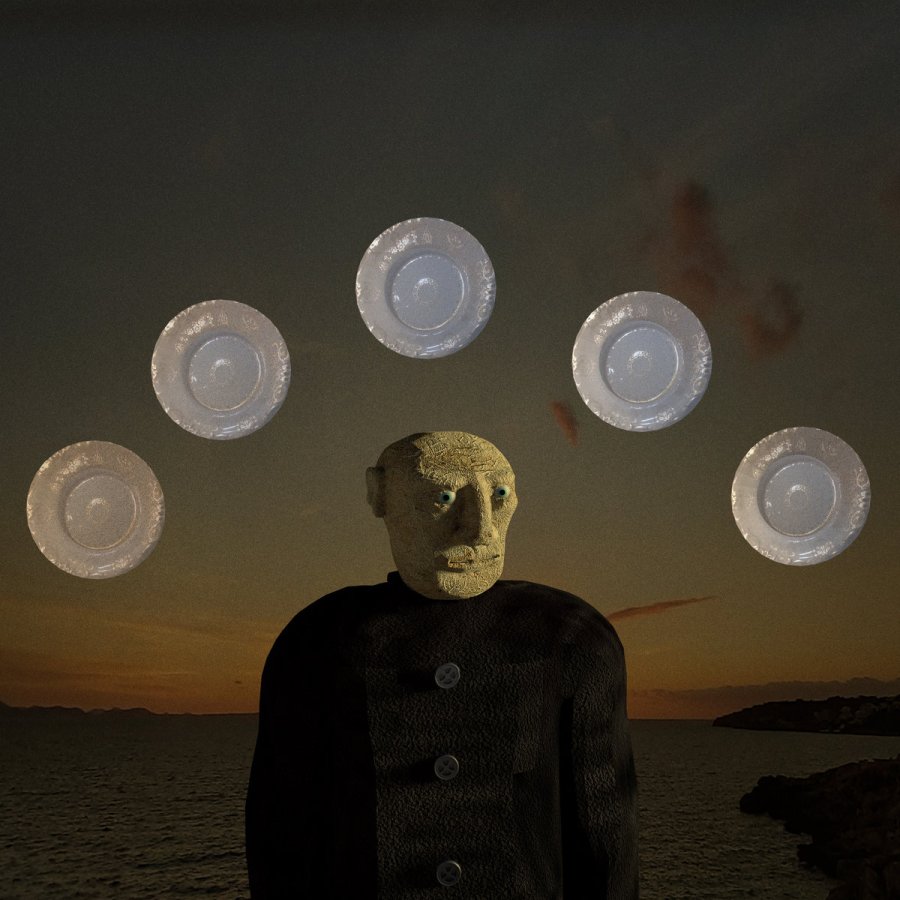
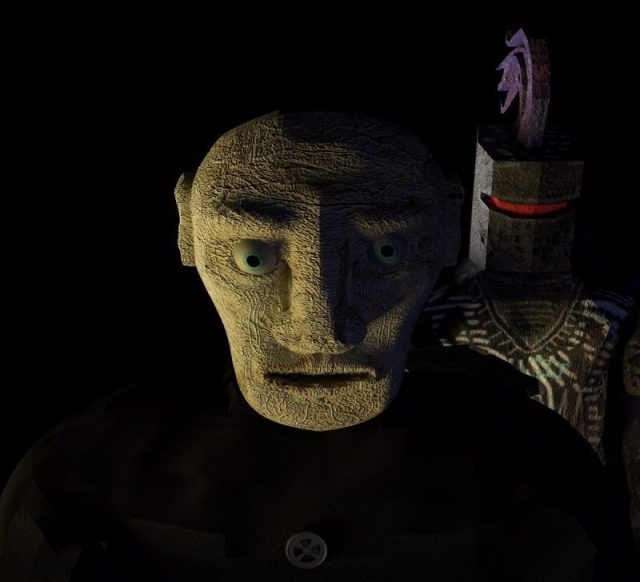
There’s a tremendous amount of talent throughout the music world, and I’ve had the pleasure of writing about quite a few truly gifted artists in my five-plus years of blogging. One of the most remarkable of them all is Kristian Møller, a young singer-songwriter, producer and visual artist who’s now based primarily in Copenhagen, Denmark. Not only is he insanely creative and artistically brilliant, he’s also smart, thoughtful, funny and kind. He’s handsome too, though so free of vanity that, unlike a lot of artists who have scores of photos of themselves plastered across their social media accounts, Kristian has almost none. Hence the only photo he provided is the rather spooky avatar of himself that he created, shown above.  

I first learned about Kristian in 2017 when he was based in London and a member of the alternative band From the Cave. I featured them and their delightfully eclectic music several times on this blog between November 2017 and April 2019, shortly after which they split up, much to my chagrin. Fortunately, he continued to record music as a solo artist, and over the past three years has released four ambitious, genre-bending albums, beginning in September 2018 with the trippy, experimental work Gamble. He followed with two albums in quick succession in 2019 – Incomplete in August, featuring 16 tracks, and I’m the Fucking Producer in December, containing a mind-boggling 23 tracks! I especially like the title track, a marvelous take down of music producers: “I’m the fucking producer, I’m going to ruin your tune. I take the life out of it, and I make it better, better”, but I digress…

On February 21st, Kristian dropped his fourth album Caldo, an exquisite and loving tribute to his Spanish heritage, specifically, his mother’s homeland of Mallorca, an island in the Mediterranean that’s part of Spain. He explained to me that the album’s title “Caldo” means “broth” in Spanish, adding: “The broth plays a big part in some traditional dishes that my family – and especially my Spanish grandparents – cook.” (He plans to follow up later this year with another album of songs sung in Danish as a tribute to his father’s and his homeland of Denmark.)  

The album is nearly epic in scope, running 55 minutes and featuring 18 songs, 14 of which are sung entirely in Spanish, as well as four instrumentals. When Kristian first approached me about reviewing this album, I was a bit apprehensive, as both its length and the fact it was sung entirely in Spanish presented a potentially daunting task. He kindly translated his lyrics into English for me, and once I began listening to the songs, my trepidation quickly evaporated as I found myself thoroughly enchanted by their breathtaking beauty.

Case in point is the opening track “Son Verí“, a beautiful ode to the Mallorcan seaside town where his family has a home: “From the moment I was born, there’s always been a place for me, in Son Verí / In every rock there are stories and thousands of memories that can’t be forgotten.” Kristian’s strummed Spanish guitar is stunning, and his baritone vocals have an earnest vulnerability that’s both comforting and deeply moving. He also creates wonderful, imaginative videos for many of his songs, and the one for “Son Verí” nicely captures the warmth and sun-kissed beauty of his family’s Mallorcan home.

On the next song “Invitación” (Invitation), he continues singing his praises of Mallorca: “I invite you to the view of the cathedral / I invite you to the view of the mountains and the ocean / I invite you to the sun and the nights filled with moonlight / I invite you to the tower of Cala Pi, pa amb oli and olives / We can have dinner together and be joyful people.” Once again, his strummed acoustic guitar work is sublime, only this time complemented by a deep bass groove and a gorgeous atmospheric organ riff. 

Besides extolling Mallorca’s virtues, Kristian weaves other subjects such as romantic love, the importance of family, and even his frustrations over the political upheaval that resulted in Brexit, into the narrative of some tracks. On “Tranquila” (Don’t Worry), he sings of his love for another, even though he must leave them: “You know that I’ve enjoyed our time together/ Even though I sometimes lose myself in the things I say, there’s something else that is about to begin / Yet again, I feel the need to make mistakes.” And on “Fuego” (Fire), he compares his passions for – and challenges of – making music with making love: “One hand in hell, another hand in heaven / In the tongue of heat, in the musical notes of pain / The orchestras of the sun live inside of your bedroom.

Like he did with From the Cave’s music, Kristian skillfully melds together disparate music elements like rock, hip hop, punk and electronic with Spanish folk and flamenco to create his own unique sound. On “Mallorca“, he combines acoustic Spanish guitar notes with a hypnotic dubstep beat to create a contemplative backdrop for his monotonal vocals as he sings of escaping to Mallorca to relieve his stress over worrying about his music career and trying to please everyone: “I’ve attempted it time and time again / I’ve tried it and I always want to be another person just to please everybody / I say “yes” way too quickly / “Yes” – what a load of shit / Here I am, stressed out once again, I need to slow down. Every day I wake up in a hurry to impress / Release yet another song that’s true / I’ve done it more than a hundred times / And so what? In the end, what difference does it make?” 

On the rousing “Basura” (Trash), he rails against autocratic leaders like Boris Johnson and Donald Trump, and how their divisive rhetoric damages their countries: “People with weird wigs who have presidencies / I want to be better than this / And you can be better than this trash without any shame /  We don’t have any other option but to remove these people who don’t have any compassion for the people around them / It doesn’t matter who’s right or wrong, they are completely mental.” I love the lively Spanish folk rock vibe and bold, colorful instrumentation and his emphatic vocals. Kristian created a wonderfully trippy animated video showing a fearsome prehistoric-looking creature pulling a large cart containing what appears to be a town square filled with piles of trash and strange robed men with antlers. His avatar stands at a console, controlling the proceedings as they all fly over the countryside, with several plates containing fried eggs circling overhead like flying saucers.

As the album proceeds, the great songs keep coming, including four gorgeous and compelling instrumentals: “Manzana” (Apple), “Agosto” (August), “Aleppo” and “La Casa De Los Abuelos” (The House Of The Grandparents). One of my many favorites on Caldo is “Salsa De Tomate” (Tomato Sauce), a beautiful, uplifting song celebrating the healing powers of food and family: “The plants are growing in your garden and they look like the ones in Son Verí / This black cloud will leave one day / The birds are flying above the wall / We’re people, We’re friends, We’re family.” The song has a powerful, driving beat overlain with enchanting strummed Spanish guitars and haunting flutes that give the song a wonderful Incan vibe. Kristian’s warm vocals are sublime, and the airy, female backing vocals add a nice touch to the song.

Patatas” (Potatoes) is yet another standout track, with bold strummed guitar notes accompanied by psychedelic synths and snappy percussion that produce a captivating Spanish punk sound. “El Caballero Oscuro” (The Dark Knight) is great too, with its dark, spooky synths, strong driving beat and terrific guitar work. Kristian doesn’t mince words as he tells a lover of his carnal intentions: “I want to be your dark knight / I want to see your face and your ass / I want to return, a tough guy who has a chance of becoming something / In the corner of my mind I’m a good guy who acts way too nicely / And that’s exactly why it isn’t working between us. I’m an animal, In my gut, inside of my medieval soul there’s something else to liberate / Because, I’m the dark knight and today I want to kick it hard.” 

The pleasing title track “Caldo” closes the album, summing up its overriding theme of finding solace in the enduring traditions of family, friends and food in a home we love: “Palma de Mallorca / We’re tourists and we’re locals / The broth of life / The broth of tradition / The broth of life.”

I had a lovely chat with Kristian, who graciously answered my questions about his upbringing, career choices and inspiration behind Caldo’s creation.

EML: You are truly multi-cultural Kristian. I know your father is Danish and mother is from Mallorca, which is part of Spain, and I believe you were born in Denmark, is that correct? Where were you raised, and/or did you spend time growing up in both Denmark and Mallorca?

Kristian: I was born in Copenhagen but I spent the majority of my childhood living in Palma De Mallorca. When I turned 12 we moved back to Copenhagen. I’ve been lucky to experience both cultures – the Danish and the Spanish sides – fully. Both my parents speak each-other’s languages fluently so I guess we’ve always had it all very blended together at home.

EML: When you and I first connected, you were living in London. How did you come to live there?

Kristian: Initially I applied for a songwriting degree in Copenhagen, but wasn’t accepted. Then I began looking for other options and we found a songwriting degree in London. I ended up staying in the city for 5 years. I’m glad it turned out that way.

EML: While in London, you had a terrific band From the Cave who played a wonderfully eclectic style of alternative rock with lots of exotic and ethnic elements. I loved your music, and reviewed quite a bit of it before you and your fellow band members decided to call it quits in summer 2019. What made you all decide to end From the Cave, and for you to subsequently relocate from London to Mallorca, or do you now split your time between Mallorca and London and/or Copenhagen?

Kristian: Thanks man. We always loved your reviews and they provided us with a lot of moral support. I think I realized that I wasn’t going to stay permanently in London. It was very expensive to get by. The prospect of a hard Brexit also creeped in on everyone. I realized I could move to our summer house in Spain, without having to pay rent.  I felt that quitting everything – including my job at a recording studio – to focus on our own music was a slightly scary but necessary step. There are other aspects to the story that I won’t go into detail with, but I’m very happy that all of us (including past From The Cave members) have been friends first and band-members second. We still keep in touch and I look forward to seeing everyone soon. We really had a great run and so many awesome memories and experiences came from the project. I’m thankful for all of it. I’m now based in Copenhagen but I also spend several months a year in Spain.

EML: Caldo is the first of two albums you’re making that pay homage to your dual Spanish and Danish heritage, and is a kind of beautiful love letter to Mallorca. What inspired you to want to make these two albums?

Kristian: During the 7 years that I lived abroad I found it hard to choose which family I should visit during the holidays. When you have your family spread out over two different countries – and you live in a third place –  it becomes a bit tricky. I’m very close to both my families, and it felt wrong not seeing them more often. When I moved to Spain I was finally able to make up for some of the lost time. Eight months later, when the pandemic hit, I had just arrived in Denmark to visit my Danish grandparent. During that stay I wrote the first song of the Danish album which will be released later this year. At the same time, my cousin had been sending me some short stories that he had been writing. They were really honest and beautiful. They took place in our own world, the world of our families. It found it very inspiring to read. In a way I think it also opened a door for me lyrically.

EML: The songs on Caldo are quite beautiful and melodic, nicely conveying images of an enchanting and fulfilling life on Mallorca. Many of the tracks touch on food and its importance to the culture, but others speak of the vagaries of love and passion. What were some of your inspirations for the songs, both musically and lyrically?

Kristian: Thank you, that’s very kind of you. The running theme of food is something – I must admit – I stole from one of my favourite bands: Sleaford Mods. In their album Eton Alive, they use food as metaphor and red thread throughout the album. I think it’s one of the best albums I’ve ever heard. It made me think about the role that food plays in our own family. For us it’s a central gathering point. A ritual where we show love and care for each-other through these traditions. Even meeting up for a coffé has a powerful symbolic value. I try not to be too nostalgic, but I feel like these things are a remedy for coping with the rapid passing of time. At least I feel like daily life is gradually accelerating more and more. This gives these rituals even more importance.

EML: You stated that you wrote, recorded and produced the album in your family’s basement. Did you do everything yourself? A few songs, such as “Salsa de Tomate” have female background vocals. Who sang them?

Kristian: Yes, I did everything here on my own. But I can’t claim that I’ve done it alone. My family have been incredibly supportive throughout the process, and I’ve shared all of the demos and demos and more demos… some more demos…with them on the go. Their company has been fundamental. On top of that my parents paid for some equipment, the guitar that I’ve used on everything on the album, and helped me make the home-studio in our basement. We really went all in on this thing haha! In response to all of that support I’ve given it everything I had. We would go on daily walks and talk through the ideas and the process. The vocals on “Salsa de Tomate” are from my aunt Ñesi. She’s a songwriter herself and she’s preparing the launch of her solo project soon. I’ve heard her new songs and they’re amazing. My two nieces are also singing in the background of the third chorus of the song. My aunt heard them sing the song spontaneously during her recording and then recorded it for me as a surprise.

EML: That was sweet of her! Is there anything you’d like to add that I may have neglected to ask?

Kristian: I would just like to thank you for taking the time to do this review and showing some genuine interest in the project. I really appreciate it and it’s been very fun to answer your questions. I look forward to continuing making music and try to enjoy it as much as possible. Muchas gracias!

Thank YOU, Kristian, for bringing the world some badly-needed joy and pleasure with your beautiful album. Listening to it is an immersive experience, and should be heard in its entirety to fully appreciate the beauty and brilliance of its many musical textures and sounds. In my not so humble opinion, Caldo is a masterpiece, and I implore my readers to do yourselves a big favor by taking the time to give it a full listen, and let its songs envelop you like they do for me!

Follow Kristian:  FacebookInstagram 

Stream his music:  SpotifyApple Music / SoundcloudYouTube 

Purchase: Bandcamp