

Well, I somehow managed to skip over the correct Day 9 subject of the 30-day song challenge and mistakenly went directly to Day 10 for Saturday’s post. So, for today’s Day 10 post I’m going to tackle “A song you never get tired of listening to“. And once again, this was a tough call, as there are hundreds of songs I love that I never tire of hearing. But pick one I must, and to make my selection a little easier, I’ve chosen a beloved song I’ve not previously written about. My pick is “For All We Know” by the Carpenters. (I have previously written about the Carpenters though, when I featured their song “Superstar” in 2019.)
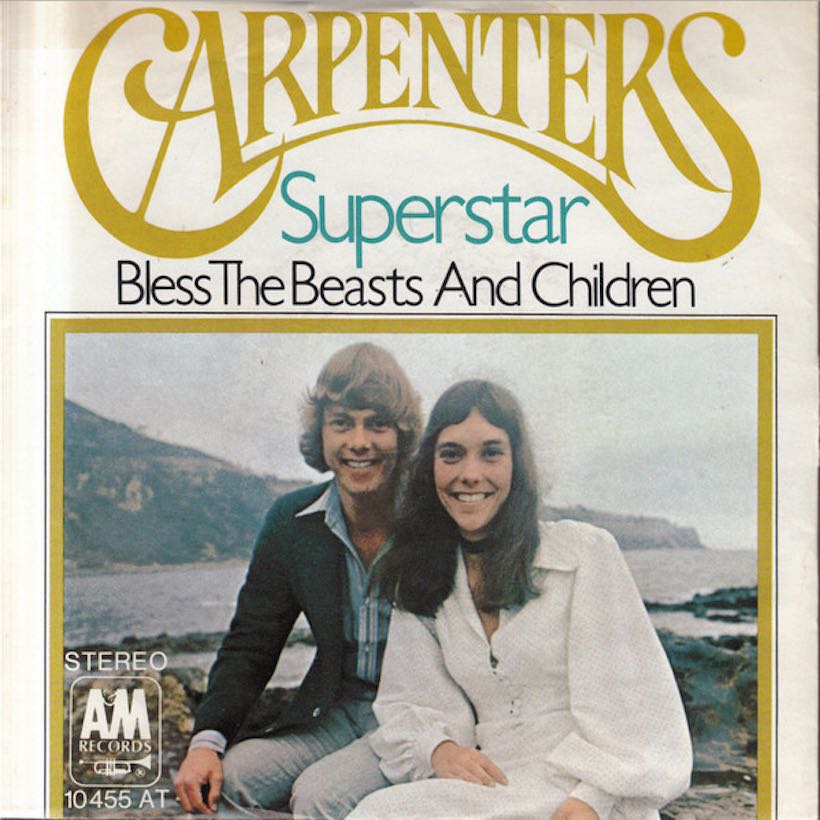
As I wrote in that earlier article, with their successful run of great singles from 1970-75, beginning with their massive hit “(They Long to Be) Close to You”, the Carpenters were one of my favorite acts back then. Their music was beautiful, with the kind of lush orchestration I love, and Karen Carpenter had the voice of an angel. Her distinctive, pitch-perfect contralto singing voice remains one of the finest of any female pop singer ever, in my opinion. I loved their music so much as a teen that I wrote a paper about them for my 11th grade English class (the only time I wrote about music or an artist until becoming a blogger several decades later).
“For All We Know” was written for the hilarious 1970 comedy Lovers and Other Strangers, with music by Fred Karlin and lyrics by Robb Wilson Royer and Arthur James Griffin (both Royer and Griffin were founding members of the soft rock group Bread). (Most of the songs recorded by the Carpenters were written by others, other than their hits “Goodbye to Love” and “Yesterday Once More”, which were co-written by Richard Carpenter and John Bettis, “Only Yesterday” by Carpenter, Bettis and Kōji Makaino, and “I Need to Be in Love” by Carpenter, Bettis and Albert Hammond.) The song was originally sung by Larry Meredith for the film’s soundtrack, and when Richard heard his version while watching Lovers and Other Strangers, he felt the song would be perfect for their style and Karen’s voice.
For the recording of the song, Richard initially wanted Jose Feliciano, who was a big fan of theirs and wanted to play on one of their records, to play guitar on the intro. They went into the studio, where Feliciano came up with an intro on his nylon string acoustic guitar, however, the following day Feliciano’s manager demanded that he be removed from the recording. (Wikipedia) Disappointed but undaunted, Richard removed Feliciano’s guitar intro and replaced it with a beautiful oboe intro by Earle Dumler (an esteemed musician who played on several Carpenters records, as well as with an eclectic range of artists such as Stan Kenton, Tim Buckley, J.D. Souther, Frank Zappa, Helen Reddy, Barbra Streisand, Robert Palmer and Nina Simone, among many others over the years). Though I haven’t heard Feliciano’s guitar intro, I believe Dumler’s sublime oboe intro had to have made the song much better. Besides Dumler’s oboe, the other instruments on “For All We Know” were played by Richard Carpenter (piano, Hammond organ, Wurlitzer electric piano), and Wrecking Crew members Joe Osborn (bass) and Hal Blaine (drums).
“For All We Know” was also recorded by Shirley Bassey at the same time as the Carpenters’ version, where it was a hit in the UK, peaking at #6, and later by Petula Clark and Nicki French. But it was the Carpenters’ recording that’s the best known and most popular, reaching #3 on the Billboard Hot 100 chart and #1 on the Easy Listening chart in 1971. The song also won the Academy Award for Best Original Song.
An interesting bit of trivia I learned in researching the song for this write-up is that the Motion Picture Academy did not previously allow artists to perform a best original song nominee at the Oscars if they had not appeared in a film, which finally explains for me why Anne Reinking sang “Against All Odds” (in a terrible performance that included a bizarre interpretive dance) at the 1985 Oscars instead of Phil Collins, but I digress. Since the Carpenters were not allowed to perform “For All We Know” at the ceremony, they requested that it be performed by their friend Petula Clark. Clark would later perform the song in tribute to Karen Carpenter at her concert at Royal Albert Hall on February 6, 1983, two days after Karen’s untimely and very sad death. Here’s a video of that poignant performance:

 ECLECTIC MUSIC LOVER