The subject for Day 19 of my 30-day Song Challenge is “A song that’s a superior cover of the original“, and my pick is “All Along the Watchtower” by Jimi Hendrix. The magnificent song was technically recorded by The Jimi Hendrix Experience, which consisted of Hendrix on guitar, Noel Redding on bass, and Mitch Mitchell on drums. For this song, however, Hendrix also played bass, as he felt that Redding “did not put his heart into the bass.”
“All Along the Watchtower” was written by Bob Dylan, who recorded it in 1967 for his album John Wesley Harding, but Hendrix’s cover became the most iconic. Hendrix took Dylan’s acoustic original and radically rearranged it into a more dynamic and dramatic song, befitting the lyrics that many have stated are an allegory about the entertainment business, with artists feeling exploited by their managers and record labels. His complex, multi-layered blend of blues and psychedelic guitars is positively jaw-dropping and nothing short of spectacular.
In choosing to cover the song, Hendrix stated: “All those people who don’t like Bob Dylan’s songs should read his lyrics. They are filled with the joys and sadness of life. I am as Dylan, none of us can sing normally. Sometimes, I play Dylan’s songs and they are so much like me that it seems to me that I wrote them. I have the feeling that Watchtower is a song I could have come up with, but I’m sure I would never have finished it. Thinking about Dylan, I often consider that I’d never be able to write the words he manages to come up with, but I’d like him to help me, because I have loads of songs I can’t finish. I just lay a few words on the paper, and I just can’t go forward.” (Songfacts)
In a 1995 interview with the Fort Lauderdale Sun Sentinel, Dylan described his reaction to hearing Hendrix’s version: “It overwhelmed me, really. He had such talent, he could find things inside a song and vigorously develop them. He found things that other people wouldn’t think of finding in there. He probably improved upon it by the spaces he was using. I liked Hendrix’s [recording] and ever since he died I’ve been doing it that way. Strange how when I sing it, I always feel it’s a tribute to him.”
There must be some kind of way outta here
Said the joker to the thief
There's too much confusion
I can't get no relief
Business men, they drink my wine
Plowmen dig my earth
None will level on the line
Nobody offered his word
Hey, heyNo reason to get excited
The thief, he kindly spoke
There are many here among us
Who feel that life is but a joke
But, uh, but you and I, we've been through that
And this is not our fate
So let us stop talkin' falsely now
The hour's getting late, heyAll along the watchtower
Princes kept the view
While all the women came and went
Barefoot servants, too
Well, uh, outside in the cold distance
A wildcat did growl
Two riders were approaching
And the wind began to howl, hey
All along the watchtower
“All Along the Watchtower” was released as a single in September 1968, with the B-side “Burning of the Midnight Lamp”. Both songs were included on the album Electric Ladyland. Shockingly, it was Hendrix’ only song to reach the top 40 of the Billboard Hot 100, where it peaked at #20.
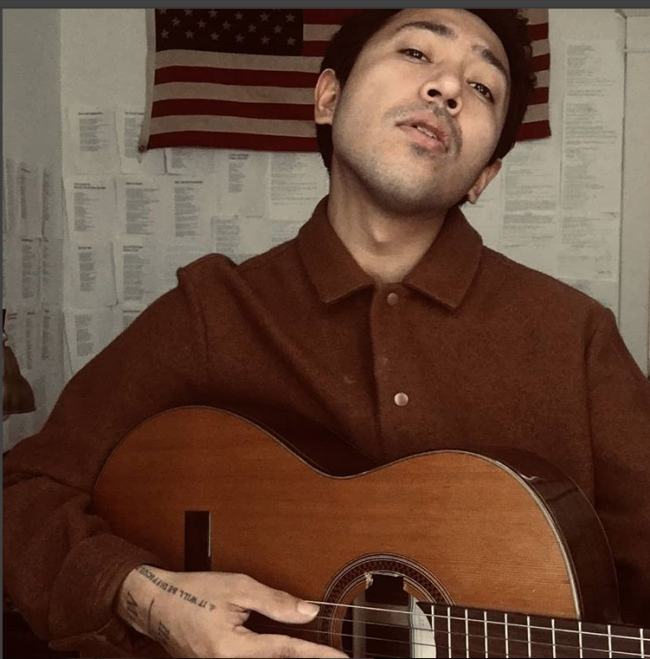
“You live / You Love / You Learn / And You Lose.” A pretty cynical observation about the nature of life, this, but these words were in fact an impetus for the man who wrote them to change his life going forward. So states the Chicago-based singer-songwriter and musician who goes by the moniker “The American Man”. Like a lot of musicians who choose to identify themselves with an artistic moniker rather than their given names, he desired to disappear behind the name and have his songs speak for themselves.
He’s a massive Bob Dylan fan, and as such his music and sound is heavily influenced by Dylan, both musically and lyrically. His music consists only of his acoustic guitar and harmonica, and his lyrics are poetic, honest and heartfelt. And what’s more, his vocals sound alarmingly similar to Dylan’s, right down to their raspy texture and pitch.
In November 2019, he released his marvelous debut album Life & Times, featuring eight tracks that touch on aspects of life, love and loss identified in the opening words of this post. On February 14 he appropriately dropped his latest single “The Last Valentine“, an understated, yet magnificent song which I’m pleased to feature today. He explained the song’s background:
“The song was written four years ago this very week. Trump wasn’t yet in office, mass shootings were taking place, tension was in the air, and I was waking up in the middle of Chicago on Valentines day on the street. It was 15 degrees or so, and I walked across the city in the cold. My wallet was stolen and my phone was stolen and I was bleeding down my head. Halfway home I laid down in an alley and cried. But I wasn’t jumped; I was in the deep end of my alcohol and drug problems that stretched on relentlessly for five years. And then I got sober, let go of song writing, put this song on the back burner and had to do the hard work work of building my life. I spent three years off the internet, and a few weeks ago it dawned on me that I had this song tucked away. So I dug through several hundred pages of old lyrics over a few hours to find it, set up my iphone and hit record. Then I thought I gotta share it with the world, so I bought a lap top and made this video. I thought that the song was interesting because [even though] it’s four years old, it still holds up.”
“The Last Valentine” is inspired both melodically and lyrically by Bob Dylan’s 1962 song “Let Me Die in My Footsteps”, which Dylan wrote after he watched construction workers building a bomb shelter one day. He was struck by the insanity of peoples’ upside-down reasoning during the Cold War – that instead of us learning how to live, we were learning how to die. In that same vein, The American Man explores the similar irrational, hateful and destructive thinking occurring in America today:
I met a young boy who was free in his soul
They beat him so bad and left him dead on the road
But he stood up and walked led by his mind
He stumbles on home as the last Valentine
As he wars through the ruse
You live, you love, you learn and you lose
I watched all the red-blooded American folk Swallow their leader and violently choke And neath their red eyes was a heart filled with hate If you do not act soon it might be too late There a war without truce You live, you love, you learn and you lose
Outside the Trump rally Within the great wall A homeless man fell to all that he saw And with his stained shirt he wipes his watery eyes Some are learning to live, some are learning to die Oh young boy here’s old news You live, you love, you learn and you lose
All incredibly powerful and brilliantly-written words that deeply resonate with me! For the compelling and provocative video, he used footage of actual events and scenes and images from popular films and music videos (some of which may result in removal due to copyright infringement, though I certainly hope not). Take a look and have a listen:
Given the current political upheaval in the U.S., much of Europe and elsewhere in the world, I’ve been thinking about protest songs and the impact they’ve had on spurring conversation and action. There are so many great ones that it was difficult to choose only ten, but I’ve whittled them down to what I think are the ten best protest songs. Many were inspired by either the Vietnam War or racism.
1. WHAT’S GOING ON – Marvin Gaye (1971)
One of the most beautiful and compelling songs of protest ever recorded, Marvin Gaye’s “What’s Going On” is a masterpiece. Recorded in 1971 as one of many tracks for his brilliant album of the same name, the song was originally inspired by a police brutality incident during an anti-war protest in Berkeley, California’s People’s Park, witnessed by Renaldo “Obie” Benson, a member of the Motown group The Four Tops. Gaye had likewise been inspired by events such as the 1965 Watts riots and Vietnam War, which made him question how he could keep writing and singing love songs when the world seemed to be exploding around him. The song was composed by Benson, Al Cleveland and Gaye, and produced by Gaye after Motown exec Berry Gordy was set against recording such a song (and album). Rolling Stone named “What’s Going On” the fourth-greatest song of all time. Sadly, most of the issues Gaye sang about are still thorny in 2017.
2. MASTERS OF WAR – Bob Dylan (1962)
The week Bob Dylan arrived in New York City, Dwight Eisenhower, in his final address as President, warned of the dangers of the “military-industrial complex.” His words were largely ignored, and just two years later the world was on the verge of nuclear war, while the arms industry was making a fortune and spreading money all over Washington. The situation enraged Dylan, and he funneled this anger into writing “Masters of War.” The lyrics are searing: “I hope you die and your death will come soon. / I’ll follow your casket in the pale afternoon and I’ll watch while you’re lowered to your death bed and I’ll stand over your grave ’til I’m sure that you’re dead.” The song has been covered by scores of musicians, including the Staples Singers, Ed Sheeran and Pearl Jam in this chilling version.
3. WAR – Edwin Starr (1970)
The defiant anti-Vietnam War anthem “War” was written by legendary Motown songwriters Norman Whitfield and Barrett Strong (who penned numerous hits for the Temptations, Four Tops, and Undisputed Truth, among others). It was initially recorded by the Temptations for inclusion on their album Psychedelic Shack but, fearful of alienating their fan base, both the Temptations and Motown executives decided against releasing their version as a single. Motown contract singer Edwin Starr volunteered to record the song, and man did he deliver, his fierce vocals spitting and screaming the scathing lyrics. The music is downright brutal, with raging guitars, savage percussion and screaming brass that match the ferocity of Starr’s vocals. It went all the way to #1 on the Billboard Hot 100, and was later covered by Frankie Goes to Hollywood, Bruce Springsteen and, more recently, Black Stone Cherry.
4. HOLIDAY – Green Day (2005)
From Green Day’s brilliant album American Idiot, “Holiday” is a true protest anthem, inspired by the Bush Administration’s invasion of Iraq. Billie Joe Armstrong emphatically rails against the neo-conservatives who pushed for war and their strategy of pitting one group against another. According to Armstrong, the chorus’s refrain – “This is our lives on holiday” – was intended to reflect the average American’s ambivalence on the issues of the day.
5. OHIO – Crosby, Stills, Nash & Young (1970)
In May 1970, students at Kent State University in Ohio were demonstrating against the Vietnam War when the Ohio National Guard attempted to disperse the crowd. Ultimately, four unarmed students were shot to death and nine others injured, resulting in outrage throughout the nation. A few days afterward, Neil Young saw the now Pulitzer-Prize winning photo of 14-year-old Mary Ann Vecchio kneeling over the dead body of college student Jeffrey Miller. Young was so infuriated that he immediately wrote the song “Ohio” and convinced his fellow band members to record the song with him. “Tin soldiers and Nixon coming / We’re finally on our own / This summer I hear the drumming / Four dead in Ohio.” Interesting bit of trivia: future Pretenders lead singer Chrissie Hynde was then a student at Kent State and witnessed the event.
6. STRANGE FRUIT – Billie Holiday (1939)
Perhaps the most haunting protest song of them all, “Strange Fruit” was first written as a poem, then later set to music, by teacher Abel Meeropol in 1937. It protested American racism and the lynching of African Americans, and ‘strange fruit’ is a metaphor for lynching victims hanging from trees. The most iconic recording of the song was by Billie Holiday, but deeply moving versions have also been recorded by Nina Simone, Diana Ross, Jill Scott and Annie Lennox. Simone called it “the ugliest song she had ever heard.”
7. BLOWIN’ IN THE WIND – Bob Dylan (1962)
Though not originally intended to be a protest song, Bob Dylan’s classic “Blowin’ in the Wind” quickly took on powerful meaning for many people in the ways it spoke to the issues of war, peace and civil rights. Dylan recorded it in 1962 for inclusion on his second album, The Freewheelin’ Bob Dylan, but it was the beautiful cover version by Peter, Paul and Mary in 1963 that made it famous, becoming a #1 hit.
8. AMERICAN IDIOT – Green Day (2005)
Another hard-hitting protest song from Green Day, “American Idiot” was inspired by the American public’s patriotic support of the Bush Administration’s war against Iraq. Band frontman Billie Joe Armstrong believed that mass media orchestrated paranoia and idiocy among the public. Citing cable news coverage of the Iraq War, Armstrong recalled, “They had all these Geraldo-like journalists in the tanks with the soldiers, getting the play-by-play.” He wrote the song after hearing the Lynyrd Skynyrd song “That’s How I Like It” on his car radio. “It was like, ‘I’m proud to be a redneck’ and I was like, ‘Oh my God, why would you be proud of something like that?’ This is exactly what I’m against.”
9. FIGHT THE POWER – Public Enemy (1989)
“Fight the Power” by hip hop/rap group Public Enemy was written for the Spike Lee film Do the Right Thing. The song is a scathing attack on racism and classism, incorporating various samples and references to African-American culture, including civil rights, black church services and the music of James Brown. The website NME observed that “the brilliance of ‘Fight The Power’ is that it recognizes that cultural imperialism can be just as repressive a force as more obvious forms of state authority. Everyone knows about the Elvis lyric – but only Chuck D could tease out the unsettling racial stereotypes reinforced by Bobby McFerrin’s ‘Don’t Worry Be Happy’.”
10. EVE OF DESTRUCTION – Barry McGuire (1965)
“Eve of Destruction” was written by singer/songwriter P.F. Sloan in 1964, when the Vietnam war was still in its infancy, but the Cuban Missile Crisis was a very recent memory and there was widespread fear of nuclear war. The lyrics also address civil rights injustice. Sloan initially presented the song to the Byrds, who rejected it. It was subsequently recorded by the Turtles, Jan and Dean and the Grass Roots, but the version that became most famous was by Barry McGuire. His recording was a rough demo not intended for release, but it somehow got leaked to a DJ who began playing it, and it quickly became a huge hit, going all the way to #1 on the Billboard Hot 100 in 1965.
Honorable Mentions:
Fuck tha Police – N.W.A.
Fortunate Son – Creedence Clearwater Revival
We Shall Overcome – Pete Seeger
Sun City – Artists United Against Apartheid
A Change is Gonna Come – Sam Cooke
The Blacker the Berry – Kendrick Lamar
Killing in the Name – Rage Against the Machine
Inner City Blues (Make Me Wanna Holler) – Marvin Gaye
Sign O the Times – Prince
I-Feel-Like-I’m-Fixin’-To-Die Rag – Country Joe & the Fish
The Times They Are A-Changin’ – Bob Dylan
A Hard Rain’s A-Gonna Fall – Bob Dylan
Hurricane – Bob Dylan
War Pigs – Black Sabbath
For What It’s Worth – Buffalo Springfield
Born in the U.S.A. – Bruce Springsteen
Sunday Bloody Sunday – U2
Mississippi Goddam – Nina Simone
Zombie – The Cranberries
Say It Loud, I’m Black and I’m Proud – James Brown
Revolution – The Beatles
Divisive – Calling All Astronauts


 ECLECTIC MUSIC LOVER