Hailing from Philadelphia is Snap Infraction, a three-piece musical powerhouse comprised of Steve Karsch on vocals, guitar & percussion, Dave Kerr on bass and Tony Iannuzzi on drums. According to their bio, they “distill decades of rock n roll history into a modern sonic journey, crafting songs overflowing with hooks and dynamic instrumentation, echoing The Cars, Joe Jackson, early Fleetwood Mac and The Beatles, crafting a familiar, yet uniquely distinctive sound.” After listening to their considerable music catalog, I say that sounds about right!
From what I can tell, they’ve been around as a band for more than 15 years, and in 2009 released their first single “Try To See It My Way”, a pretty good rocker strongly influenced by the early Beatles sound. After a long hiatus, they released a five-track EP Chin Music in May 2017, then another three years would pass until their follow-up EP Stiff Arm, in May 2020. They were quite active in 2021, releasing several double singles throughout that year, followed by a very nice cover of the Beach Boys Christmas classic “Little Saint Nick” in December 2022, and their own original Christmas song “Christmas In The Islands” in December 2023. Now they return with “Keeping Score“, the lead single from their forthcoming full-length album Eephus, scheduled for release on May 3rd.
Written by Karsch, “Keeping Score” was recorded and engineered by Matt Weber at Gradwell House Studios, mixed by Mike Ian at Eyeball Studios (gotta love the names people come up with for their studios), and mastered by Tom Volpicelli at The Mastering House. The song was inspired by a conversation between Karsch and band drummer Ianuzzi, who yearned for a song channeling The Cars’ iconic sound. Karsch quickly got to work writing the song, placing special emphasis on drums to showcase Ianuzzi’s considerable prowess on his drumkit.
The result is a lively garage rock banger, opening with Ianuzzi’s impressive drumming front and center as he bangs out an aggressive thumping beat that gets our toes tapping and head bopping. He’s soon joined by Kerr’s wonderful buzzing bassline and Karsch’s earnest vocals that sound slightly reminiscent of Ric Ocasek here. As the song progresses, Ianuzzi injects flourishes of crashing cymbals with every chorus and sub-chorus, accompanied by Karsch’s spirited guitars that surprise at every turn while Kerr’s muscular bassline keeps the rhythm on solid footing.
The lyrics describe a man who recognizes his self-destructive ways and knows he needs to change, but just can’t seem to muster the fortitude to do what he must in order to become a better person: “I need to stop myself from becoming who I am./ I can’t help myself, you know I can’t believe my eyes./ What do they say about me? He lies, he cheats to get everything he needs, and maybe more. What will they say about me? I don’t need to know ’cause I’m not keeping score anymore.“
“Keeping Score” is terrific, and I think it’s one of Snap Infraction’s best songs yet. It’s a testament to their strong songwriting and musicianship, and a promising sign of what we can expect with their upcoming album.
It’s been a long while since I last published one of my Fresh New Tracks posts (partly due to the fact I quit writing reviews the last three months of 2023), but with so much new music out, I feel it’s time for a new installment. Today, I’m thrilled to present four excellent recently released songs by, in alphabetic order, British singer-songwriter Ben Gorb, British indie rock band Healer, Long Island, New York alt-rock band Morning Fuzz, and Los Angeles psychedelic indie rock duo The Nanners. I’ve previously written about Healer and Morning Fuzz, whereas Ben Gorb and The Nanners are new to me.
BEN GORB – “Brand New Day”
Photo by Alistair Mac
Ben Gorb is an affable, talented, and very tall singer-songwriter from Manchester, England who, in his early teens, developed a passion for the classic rock of such artists as Jimi Hendrix, The Who and AC/DC that prompted him to take up the guitar. He’s been recording and releasing music since 2014 when he was in his early 20s, and his output since then includes numerous singles, EPs and two albums, Reflections in 2020 and Burning Light in 2021. I like his pleasing, high-energy rock sound, plus he’s also a cat lover, which warms my cat-loving heart! He’s earned quite a following by performing throughout the Northwest and Midlands regions of the UK, both as a solo artist and with his band consisting of Jake Preistley on rhythm guitar, Joseph Shaw on bass and Josh Savage on drums.
He recently reached out to me with his latest single “Brand New Day“, which was released February 20th. He wrote the song, sings lead vocals and plays lead guitar, backed by his aforementioned band members. It’s a rousing kiss-off song addressed to a romantic partner who he tells in no uncertain terms that he’s done with the fights and her putting him down, and that he’s freeing himself of their five-year-long relationship once and for all: “Here I go, I’m on the run. Like a fox from a gun I’ll be gone. I don’t care what you think, I don’t care you say. The future’s mine, it’s the start of a brand new day.” I love the superb guitar work that really channels AC/DC, the tight rhythms, and Ben’s colorful vocals, backed by the guys’ wonderful harmonies.
HEALER is a five-piece alternative indie rock band based in Grimsby, England, comprised of Steve (lead vocals), Kirk (guitar), Dave (guitar), Tony (bass), and Jazz (drums). Formed in 2022, they’ve already built a strong following in the local music scene on the strength of their outstanding songs and riveting live performances, as well as garnering recognition and airplay on BBC Music Introducing and Amazing Radio UK/USA. Since the release of their debut single “Hurricane” in December 2022, the busy guys have followed with six more singles, one of which, “Bones“, I featured in a Fresh New Tracks post last May. The gorgeous song spent three months on my weekly top 30 and ranks #67 on my 100 Best Songs of 2023 list.
Their latest single “Wake Me Up”, released on February 2nd, is an anthemic rock banger, fueled by roiling guitars and driving rhythms. I must say that I love Steve’s distinctive singing voice that make’s HEALER’s songs immediately identifiable as theirs and no one else’s. About the song, the band explains “’Wake Me Up’ is a song about growing up, it’s about realising how much time you have wasted and hoping it’s not too late to stop the free spirit lifestyle and finally wake up. It also references the noise of the internet, visual media and how life can become one big blur and we sometimes need to wake up and smell the roses.” The imaginative video, which was filmed and edited by Misha Warren, shows a young boy played by Cole Ellis, sitting transfixed as he watches a wall of TV and video screens while wearing a spacesuit, juxtaposed with scenes of HEALER performing the song in a garage amid a bunch of vintage portable TVs.
Morning Fuzz is an exceptional band from Long Island, New York formed in 2009, and now comprised of singer/songwriter & guitarist Frank Fussa, bassist Chris Johanidesz, guitarist Michael Cullari and drummer Dan Leonardi. All are outstanding musicians, and together they make highly accessible rock they describe as “fun, bouncy guitar pop, happily shading in the intersections of the Venn diagram where mainstream pop and alternative music meet“, characterized by memorable melodies, ace instrumentation and intelligent lyrics delivered with Fussa’s commanding vocals. Though their musical output has sometimes been sporadic, over the past 15 years they’ve released two EPs, two albums, Chasing Ghosts in 2009 and Wherever We Go (which I reviewed) in 2023, and numerous singles, two of which, “Silent Sun” and “I’ll Be Around” I also reviewed. “Silent Sun” went on to rank #69 on my 100 Best Songs of 2017 list, while “I’ll Be Around” ranks #71 on my 100 Best Songs of 2019 list.
On February 23rd, Morning Fuzz dropped their latest single “New Moon“, the second of two B-Side tracks that didn’t make the final cut of Wherever We Go, but they still wanted to put out into the world. I’m glad they did, as it’s a great song, featuring the band’s signature electrifying guitar work, throbbing bass lines and thumping drumbeats we’ve come to love and expect. I also like that all four band members sing, with Chris, Michael and Dan’s backing harmonies beautifully complementing Frank’s raw, impassioned vocals. The lyrics, which feature quite a bit of earth and celestial metaphors, seem to address a troubled relationship where the singer has checked out emotionally, but chooses to hang on with a remaining thread of hope: “This is the part where I fall, but I just keep hanging on until I can’t feel anymore. I’ll hang around for a while. There’s not a bone to pick; I’ve already gone through the whole pile./ Everyone’s here for the good times, but I stick around for the bad times. Wherever there’s dusk, there’s a sunrise.”
Last, but certainly not least, I bring you The Nanners, the wonderfully zany L.A.-based music project of Nicholas Ewing and Thomas Ferraiuolo. From what I can tell, they officially formed last fall (of 2023), and have this to say about themselves: “Welcome to Banana World, where love, curiosity, angst, and nebulous speculations are explored through the lens of two meek and socially awkward grown men in banana costumes.” And while at first glance they might appear to be some kind of weird novelty act, they are in fact fine musicians and songwriters who also happen to be both hilarious and charming. Their pleasing sound is a happy mix of indie rock, psychedelia and dream pop, and I love it.
The duo released their delightful debut single “Sweet Tooth” in December, for which they had their own signature soft drink created, describing it as “the result of 6 years of food science and rigorous flavor profile testing. The ingredients are rare, illegal, and hardly FDA approved. Because they’re so good!” On February 7th, they dropped their second single “New Pony“, an equally delightful song about relaxing at a magical airbnb in the Mojave Desert with unlimited towels. To a mellow groove overlain with gently strummed jangly guitars and delicate sparkling synths, the guys croon in their soothing harmonies: “We’ll bring you more towels and immortality. Check out when you want, it’s a loose policy. We can help you find anything you need in the folds of time, just like magic. I wanna get pampered with you. Bananas get pampered too.” The farcical but sweet video for the song, showing the guys enjoying life and letting loose, was filmed at an actual airbnb in Joshua Tree, about an hour from where I live in the Coachella Valley. You’re in for a treat!
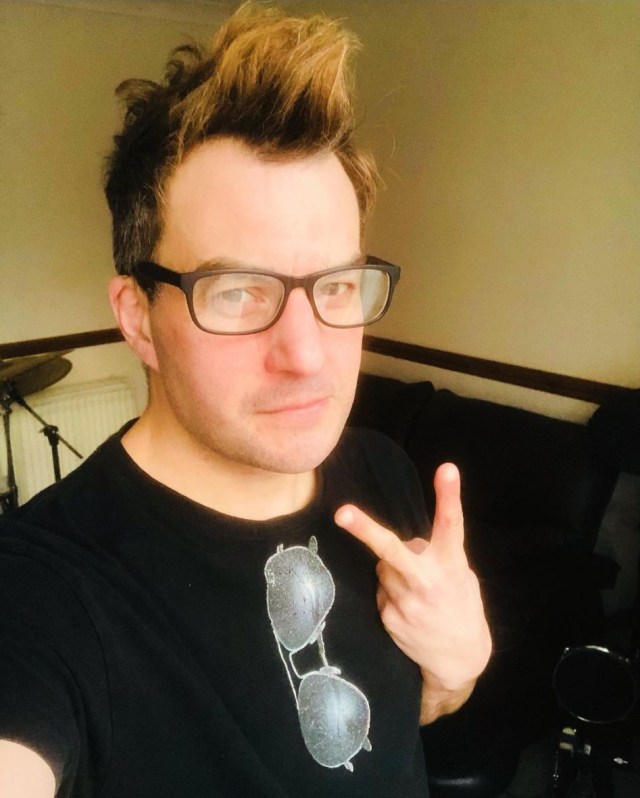
Hailing from the southwest coast of Wales, David Oakes is an imaginative and prolific musician and composer of electronic alternative rock music. Strongly influenced by his love of such acts as Dream Theater, Mastodon, Metallica, Therapy?, Green Day and Smashing Pumpkins, his musical output ranges from gentle synth-driven compositions to aggressive guitar-driven hard rock, though his last several works have trended toward the latter. I really like his music and have featured him on this blog many times over the past eight years (you can read some of those reviews by clicking on the links under “Related” at the end of this post).
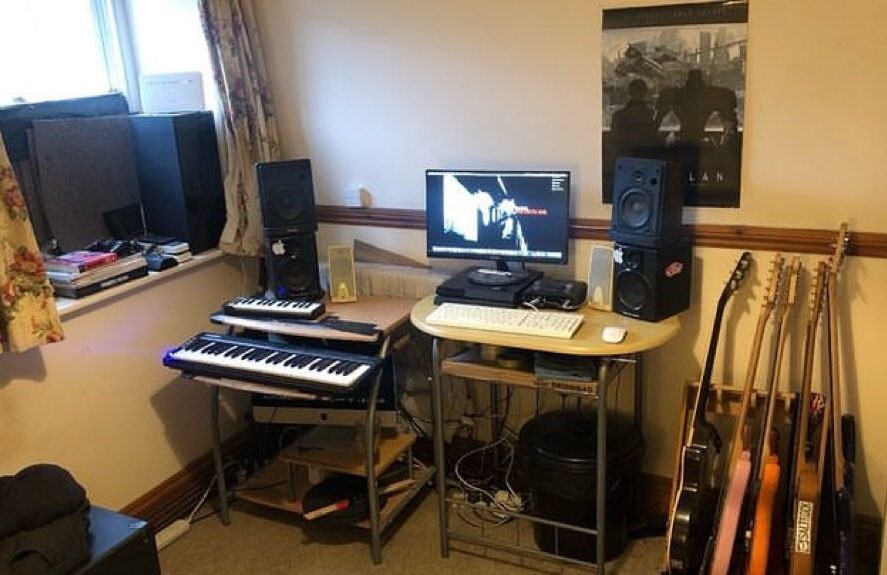
David’s been actively involved in making music since his late teens, when he started playing in various bands. From 2001-06, he and his younger brother were members of the rock band KOTOW, for which he played drums. He went on to study guitar and music theory at the Academy of Contemporary Music in Guildford, England from 2009-12, after which he began composing music as a solo artist, all of which he records and produces himself in his little home studio setup. This drum kit is his pride and joy!
He released his first album The Juggernaut in 2014, and in the years since, has recorded and released an astonishing eleven more albums, the latest of which is Prosthetic Soul, which he released on Bandcamp on February 16th. His first new album in two years, Prosthetic Soul serves up 28 minutes of superb psychedelia-tinged melodic instrumental rock, featuring many of David’s signature electronic and guitar-heavy elements we’ve come to love and expect. But here he’s pushed himself even further, experimenting with new sounds and instrumental techniques, along with what seems to be an even greater emphasis on industrial elements employed by bands like Nine Inch Nails, Rammstein, Dream Theater and Depeche Mode.
Album opener “Minus One” starts off with distant sounds of super-gnarly guitars, which are soon joined by a mix of spooky industrial synths, heavy, razor-sharp percussion and jagged guitar notes layered over an ominous droning synth bass groove. The track immediately segues into “Super Zero”, and we’re off to the races. Though only 1:49 minutes long, the track packs a powerful punch, beginning as a mysterious soundscape of wobbly synths, then exploding into a furious maelstrom of raging grungy guitars and crushing drumbeats.
“The Future Has Begun” is a bit of a musical tour de force, beginning gently with eerie pulsating synths accompanied by a somber piano movement. Forty seconds in, the music abruptly transitions to a rapid barrage of raging guitars and thunderous percussion before calming back down at roughly two and a half minutes to a lovely introspective interlude. Seeming to end at around three minutes, those raging guitars suddenly come roaring back for the next 30 seconds before fading out.
With it’s glitchy sci-fi vibe, infused with both Western and Middle Eastern touches soaked in reverb, the appropriately titled “Dust” would be a perfect fit on the soundtrack for an installment of the Dune film franchise. And David’s skills on guitar and drums are on full display on the marvelous title track “Prosthetic Soul”, as he unleashes a furious onslaught of blistering riffs while beating the hell out of his drum kit. It’s one of my favorite tracks on the album.
“The Dissociation Suite Parts I and II” are a rather intense but melodic couplet, with lots of great keyboards that work quite well with the twangy and grungy guitars that build to a wailing solo toward the end. Living up to its title, “The Reality Bomb” is a glorious little blast of atomic energy, with swirling distorted guitars layered over a grinding bassline, fortified with smashing drumbeats. Halfway into the song, the music calms down to a darkly beautiful interlude of haunting synths, harsh percussion and bewitching stummed guitar notes before exploding into a brief raging torrent in the finale.
“Dirt…” seems to pick back up where “Dust” left off, with more of those mysterious and glitchy sci-fi vibes, only this time accompanied by some really marvelous twangy guitars. The final track is the original version of “The Dissociation Suite Part II”, which David has designated a Bonus Track. To my untrained ear, it sounds fairly similar to the final version, except with a longer lead-in and not quite as many synth flourishes.
Prosthetic Soul is another stellar album by David that ranks among his finest works. It nicely showcases his continued growth as both a composer and musician.
Based in South London, England, Oli Barton is a wildly creative and exceptionally talented singer-songwriter, not to mention a dangerously charismatic charmer. Though I’m sorry to say I’ve never had the pleasure of seeing him perform live (him being in the UK and me 5,500 miles away in Southern California), he’s gained a reputation for his wild, uninhibited live shows that Reyt Good Magazine describes as “straight from indie heaven”. Barton has supported such acts as Kid Kapichi, Baxter Dury and Starsailor.
I’ve been following him for seven years, both as front man of his backing band the Movement, and now as a solo artist, and have featured him many times on this blog. (You can read some of those reviews by clicking on the ‘Related’ links at the end of this post.) His eccentric yet sophisticated style of alternative rock is a colorful mix of post-punk and psychedelia, fortified with touches of funk, grunge and pop, and I can state without exaggeration that I’ve loved every single one of his songs. Five of them have appeared on my Weekly Top 30 charts – the provocative 2017 single “Kinky”, which went all the way to #1, as well as “44”, “Martyr”, “Just Like Always” and, most recently, “Paid Off”, all of which reached the top 5.
It’s always a good day when Barton releases new music, and I’m thrilled to present his latest single “It’s Over Now“, released today via Coke & Dagger Records. For the song’s recording, Barton was joined by Jamal Aggoun on guitar, Marco Fuzz Paone on bass and Josh Needham on drums. Produced by Alex O’ Donovan (Sea Girls) and mixed by Cenzo Townshend (Inhaler), the song is an exuberant piece of indie-pop ear candy, with a lively blend of crunchy and shimmery guitars, fortified by deep thumping bass and propulsive drumbeats layered over a rousing, infectious groove. Or, to put it more simply, this song fucking rocks!
I always love Barton’s distinctive, resonant singing voice and rich accent, which he uses to full effect here as he plaintively implores to a romantic partner, asking if what they once shared is truly over, or if there’s still any chance of reconciliation: “Would you say that it’s over now, or should I wait? Would you say that it’s over now, is it too late?Should I stay?”
About the song, Barton says, “it’s in the whole world of teenage heartbreak and social media; the way that jealousy gets inside us and really makes us into a whole different person and perhaps distorts the decisions we make“, which he nicely articulates in the lyrics “So now I’m spending night times tracking down precise times. I’m addicted to my screen. I see you follow him and you follow her, and it all just seems so clean. But then you drop a like, and well it don’t seem right, and I’ll just sit there green.”
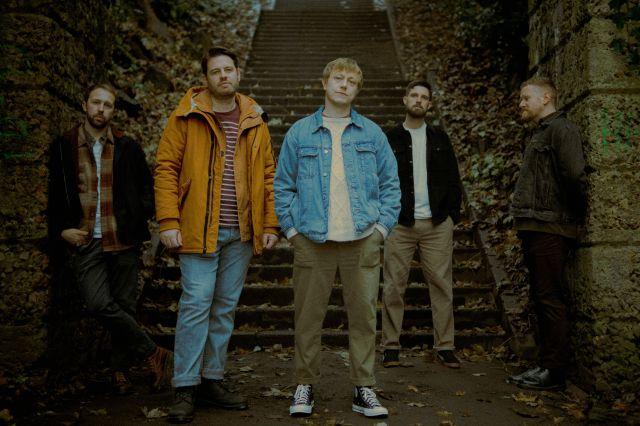
Los Angeles-based alternative electro band MACHINEKIT play a dark and aggressive style of techno-punk music they aptly describe as “an agglomeration of chaos”. Kind of like Nine Inch Nails on steroids. Originally founded as Dharma in 2012 by John Rojas, Dave Cayetano and William Buege, as their sound evolved they changed their name to MACHINEKIT, and in 2017, released their self-produced debut album Dysappearencer. They followed up with two EPs and several singles, and in 2022, dropped their second album I AM JACK’S LONELY HEARTCLUB BAND, a brutally dark yet strangely beautiful and sexy collection of songs Rojas wrote to help articulate his feelings of boredom, loneliness and coming to terms with inner demons that surfaced in response to the Covid lockdown (you can read my review here). After the album’s release, the band experienced a bit of tumult that resulted in some changes in personnel, and their lineup now consists of founding members Rojas and Buege, along with Ryan Janke on drums, Alexander Gillen on guitar and Jeremey Trujeque on bass.
(Also in late 2022, Rojas, who in addition to being a singer-songwriter, is also a sound engineer, producer, multi-instrumentalist and writer, started recording music as a solo artist in order to further explore his love for electronics and composition. Thus far, he’s released instrumental-only music in the form of two EPs, IN THE THICK OF IT, followed by Amongst The Glass Trees, which I also reviewed, and a single “LUSTFUCKIN’BREEDERS”.)
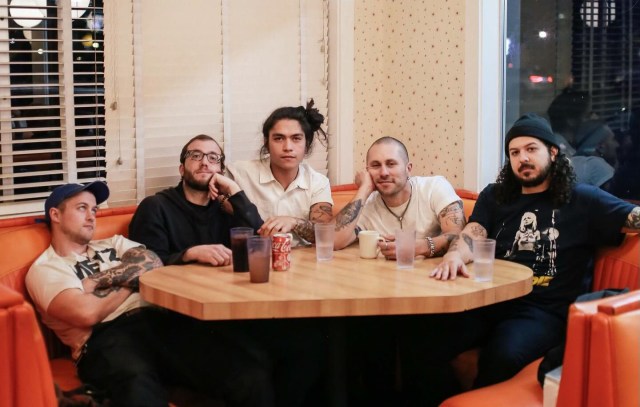
Photo of band taken by Katy Viola at Cindy’s Diner in Eagle Rock, CA
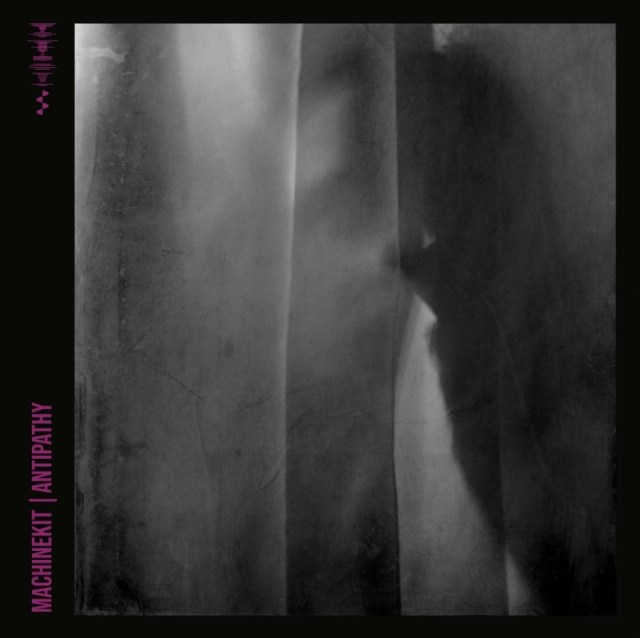
Now MACHINEKIT returns with a new single “ANTIPATHY“, which actually consists of three different versions: an original raw demo written by Rojas and Ryan Janke, and engineered and produced by Rojas at his recording studio MachineHouse Audio, with bass played by Miko Miko; a remix by Matt Miller, which was mastered by Justin Weis at Trakwork Studio; and a final version co-written and mixed with producer Joseph Nova, with both the demo and final track mastered by Sam Berdah at The Wall Studio. Rojas states that this three-part single represents the evolution of the track from inception to final product. The single artwork was created by William and Jaydee Buege at Wire Mark Design, using a photo by 6ri Ramriez.
Band drummer Janke wrote a terrific description of the song for their press release, in greater detail and with more colorful language than I possibly could, so I’ll simply quote his words about “ANTIPATHY”: “Working alongside producer Joseph Nova, Machinekit recalibrates their aggressive electronic-punk sound with fucked-up mood swings and penetrative instrumentation. With the tempo lowered a few notches from the four-on-the-floor stomps or the driving noise-rock outbursts that the band often offers, the emphasis is on a chillingly tense electro groove that percolates through the delicate verses and explodes in the deafening choruses. The vocals croon, coax, swirl, and shout atop a head-nodding concoction of electronics, percussion (both computerized and analog), and a real earworm of a heavy main riff.“
Okay then, now I’ll attempt to describe what I hear with my own meager literary talents. “ANTIPATHY” starts off with heavy and glitchy pulsating industrial synths, creating an unsettling soundscape as Rojas’ sensual croons, tinged with a sinister undercurrent, enter the proceedings. The music gradually builds until, at the one-minute mark, the chorus arrives with a furious barrage of screaming distorted guitars, explosive percussion and tortured synths, Rojas’ vocals now rising to piercing, impassioned wails as he screams “I want you so bad!” From here on out, the song contracts and expands with each verse and chorus, punctuated with all sorts of ominous sounds and textures, resulting in an intensely powerful song filled with tension and unease.
The provocative lyrics describe someone intensely besotted with another who treats him with cruel indifference and apathy – i.e. antipathy, rendering him feeling sexually frustrated and verging on madness.
You think you know me well?
But well enough to keep it raw?
You put me through your hell as you're leaving me in awe

It's not enough to know what's left
You're just like Judas when he was breaking bread
But I still crave your fuckin' company
Regardless of the fact that you will feed on apathy

I want you so bad to be proud
I want you so bad when it's not allowed

I'm poisoned irony
Aren't you the god that asked the serpent to speak to Eve?
And acted so goddamned viciously
I guess it's OK cause you're in the sky and feeling "lonely"

I want you so bad to be proud
I want you so bad when it's not allowed

I can feel you in my head
You're living in my head
You're toying with my head
Goddamn drop dead instead
I can feel you in my fucking head

I want you so bad to be proud
I want you so bad when it's not allowed

Make your bed in my head
The original demo is slightly longer, and to my ears has a somewhat rawer sound, with stronger and more pronounced thumping drumbeats and more overdubbed vocals. Matt Miller’s remix is great, with a sharper, more industrial treatment, while still retaining the overall sinister vibe, thanks to an abundance of screaming distorted guitars and even greater use of Rojas’ fearsome wails. I really like all three versions.
The power of music as a means of persevering through the hardships and challenges that life can throw in our paths is undeniable, and to prove my point I present Ukrainian indie rock band Homeless Radio, and their new single “Submarine“. Despite the fact their country has been waging a valiant defense again their Russian invaders for nearly two years, the band have still managed to keep making music, including recording and releasing a few new songs.
Formed in the city of Kharkiv in 2016, Homeless Radio is comprised of Andrii Yampolskyi (vocals/guitar), Fedir Orlov (guitar), Stepan Tkachuk (bass), Ihor Pankieiev (guitar) and Ivan Orlov (drums), though Ihor is currently away, fighting in the war. (Their original bassist Ivan Trikoza left the band due to the war, and was replaced by Stepan Tkachuk.) Drawing from a mix of garage rock, alternative rock, and pop influences, their music ranges from pleasantly melodic to hard-driving and edgy.
Andrii, Stepan, Ivan & Fedir
From 2017-2019, the band played lots of shows in and around Kharkiv, and in 2018 released two demos “I Don’t Care” and “Cackler” on Soundcloud. Here’s a video of them performing the songs on the streets of Kharkiv in happier times:
In early 2021, Homeless Radio joined the Arizona-based indie label Sunset Alliance, through which they released their debut EP The Truth that May, featuring “I Don’t Care” and three new tracks. Russia invaded Ukraine in February 2022, whereupon the band members became separated across the country for many months. Lead vocalist Andrii found himself living in the occupied town of Izyum for three months without any electricity, gas, water or standard comfort. In a show of support, the band released their beautiful single “About You” on May 3, 2022.
Now, after a long hiatus, the band is back with an exhilarating new single “Submarine”, which they wrote in 2015 but decided to record now. The song was inspired by British comedian, actor, writer and director Richard Ayoade’s 2010 coming-of-age comedy-drama film Submarine, which was itself adapted from the 2008 novel of the same name by Welsh novelist, poet and journalist Joe Dunthorne. (The film’s soundtrack features six original songs written and performed by Arctic Monkeys frontman Alex Turner.) The band calls their single “a lively blend of humor, sarcasm, and unbridled optimism — a musical homage that captures the essence of teenage rebellion, the zest of youth, and the look at those “glory days” through the lens of adulthood.”
Released on January 9th, the single is dedicated to band member Ihor Pankieiev, who joined the Ukrainian army to fight for the resistance. Andrii told me “Ihor remains in the band, but due to participating in the battlefield, he didn’t take a part in the recording of [‘Submarine’]. However, he’s in constant contact with us, and some of his ideas were put on the record. He said he would record his guitar even from the army if he had a chance.”
The song opens with an aggressive jagged guitar lick, then explodes with a barrage of grinding bass, thunderous drums and furious guitars that don’t let up for a second throughout its 2:30-minute run time. Here and there, Andrii and Fedir inject blistering guitar solos that send the proceedings catapulting into the sonic stratosphere, Andrii’s spirited vocals rising and falling with the intensity of the music. The song is a certifiable rock banger, and I love it.
He was born in Swansea, south of Wales Tried to be gentle and kind of these things Oh, Ollie, you are so right Please put yourself in the first side
She’s just an average woman All things you gonna do, well Will be kicked through the prism of her lips And dropped by her hips
Yeah you not Cease, but you’re not worth You’ve got to do a lot of things with high course At the same time with strong confidence In your 38’s it will have no sense
She’s just an average woman All things you gonna do, well Will be kicked through the prism of her lips And dropped by her hips
So, all things you have you will lose Faith in yourself and the tone of boose Will lead you to the Victory And you will meet her near, by the sea
She’s just an average woman All things you gonna do, well Will be kicked through the prism of her lips And dropped by her hips
Unquiet Nights is an outstanding rock band I’ve been following for nearly six years, ever since frontman Luke Mathers reached out to me about their superb single “Promise of You”, which I loved at first listen. Originally started in 2006 as a solo project by Mathers, a talented singer-songwriter and guitarist from Belfast, Northern Ireland, with help by Rodger Firmin on drums, he began recording songs for what would become the first Unquiet Nights album 21st Century Redemption Songs. In 2010, Luke relocated to Italy, where he eventually finished and released the album.
He was later joined by Italian musicians Francesco Piciucchi on bass and keyboards, and drummer Matteo Bussotti for live shows, though Rodger still played drums on their recordings. In 2015 they released their beautiful and compelling second album Postcards in Real Time. One of the tracks from that album, “George Best City”, which was never released as a single but was used in the Federico Buffa Racconta documentary series, landed them several live national appearances on Italian TV stations. Their best known and most successful song, it’s now garnered more than 486,000 streams on Spotify alone. Mathers eventually moved back to Belfast in 2016, where he continues to record and release music with Firmin and Piciucchi as Unquiet Nights.
I’ve written about them three times over the past six years, most recently two years ago this month when I reviewed their excellent single “In Spite of It All”. The song was released in conjunction with, and included on, their compilation album First Ten (2012-2022), a sort of ‘greatest hits so far’ work commemorating the 10-year anniversary of their debut album 21st Century Redemption Songs. Now they’re back with a great new single “Diamond and the Missing Son“, their first new music in two years. The lead single of their forthcoming album Seasons in Exile, to be released on January 19th, the song (and album) was produced by Mathers, and mixed and mastered by Neal Calderwood, who’s also mixed and mastered all previous Unquiet Nights releases.
The song’s a bona fide rock gem, with a strong Tom Petty and the Heartbreakers vibe, courtesy of Mathers’ vibrant soaring guitars. His masterful guitar work never ceases to amaze me, and he doesn’t disappoint here as he delivers spine-tingling riffs that smolder and wail throughout. Meanwhile, Firmin deftly sets the driving rhythm with his muscular drumbeats that propel, but never overpower, the song. And as always, Mather’s vocals are equal parts commanding and pleasing, with just a hint of a rasp to convey the right amount of passion. It’s a marvelous introduction to what promises to be another stellar album by Unquiet Nights.
The song lyrics tell a tale of two characters who find themselves entwined with each other, serving as a kind of first chapter to a much bigger story involving a character named ‘Diamond’, who I’m guessing is a woman, and a man referred to as ‘The Missing Son’. Mathers provides some background to the premise: “Sometimes I force myself to try and write songs that aren’t directly about myself, and to just approach the song like it would be a movie. The back story of these two characters isn’t fully expanded on in ‘Diamond And The Missing Son’ itself, because of the limitations of a three minute single, so I thought if we were going to release it that I would challenge myself to write the whole third album from the point of view of these two characters. This is what our new album ‘Seasons In Exile’ turned into, which was a useful experiment because I’ve ended up getting a lot of songs that definitely wouldn’t have existed without the continuity. The funny thing is that when someone thinks they’re writing fiction, they usually discover it’s the most honest they’ve ever written about themselves. This seems to have happened here.”
Tonight we roll the dice If just to stop and pray for paradise to come through Straight in to the dark Straight into something looking for the spark that we knew
No thinking of tomorrow We only got today
You are the only thing that keeps me hanging on And on and on There’s nothing else could ever come between us ’cause we are The diamond and the missing son
Diamond, you should know Nothing and no one makes me feel anything like you do For all the things you show There’s always something that leaves we wondering and blind and confused
No thinking of tomorrow We only got today
You are the only thing that keeps me hanging on And on and on There’s nothing else could ever come between us ’cause we are The diamond and the missing son
I generally prefer music videos that show the musicians or bands performing their song, so the video for ‘Diamond and the Missing Son” is right up my alley. Filmed in black and white, it shows Mathers and Firmin working their musical magic, while the in-house cat makes its rounds, seeming to express approval of the proceedings.
Terry Gomes is a composer/guitarist from Ottawa, Canada who’s been involved with music his entire life, both as a musician, singer-songwriter and composer of instrumental music, and as a teacher of rock and classical guitar. (He also taught elementary school for 26 years.) He studied classical guitar/composition at the University of Ottawa, where he graduated with honors. Over the years, he’s played in several rock bands and as one half of a flute/classical guitar duo. After writing songs for others, he began recording his own music in 2006, releasing three albums featuring songs in the singer-songwriter/pop/folk-rock genres. He later transitioned toward mostly guitar-based instrumental music, beginning with the release of his album Shh., which featured a more jazz-oriented, easy-listening style. In 2015, he released his Caribbean-influenced EP Blue.Green.Aquamarine, which he followed with The Tropical Dream in 2018, a delightful concept album detailing a tropical vacation written while he recovered from a back injury.
In 2019, Terry released an instrumental single “Rumjaro 360”, in which he combined elements of rumba, jazz and rock, and in 2022, he released two beautiful piano-based singles, “Elegy” and the jazzy “Steen’s Reverie”. Now he returns with “Dark Riders“, a rather unorthodox rock guitar soundtrack he wrote several years ago, accompanied by a quirky animated video. For the recording of the track, Terry played all guitars, bass and organ, and Jeff Asselin played drums and percussion. Mixing was done by Steve Foley at Audio Valley Studios in Ottawa, and mastering by Jason Fee at Conduction Mastering.
“Dark Riders” is a six and a half minute long instrumental track with progressive elements, though Terry’s twangy guitars lend a strong Western vibe to the proceedings. I love his guitar work, and the spooky organ adds some great texture to the track. About the video, Terry says “Encompassing a surreal “dark ride” with Old West imagery, it follows an individual’s unexpected and unusual journey. I think of this project as a cross between David Lynch and Scooby Doo–somewhat creepy and surreal and yet, sort of, fun.” The fun and clever video was made with mostly black and white animation images created by Andres Olmos.
As I wrote last October when I reviewed his brilliant album Friday Night Rockstar (which you can read here), singer-songwriter-musician Lewca is one of the funniest, most creative and irreverent artists I’ve come across, with a deliciously bawdy sense of humour. As he cheekily states in his bio, “Lewca was born in a squat in Brixton, by age nineteen he was living in a squat in Paris, go figure. After studying fine art and dabbling in film, he started making music just before he was too old to die young. His influences range from cheap beer to expensive rum, and also The Clash, The Streets, Sleaford Mods, LCD Soundsystem, Bob Dylan, Eminem, Tom Waits…whoever is making decent music. He currently lives in Normandy, has three kids, a mortgage, and a semi-domesticated hedgehog named ‘Sonic’.”
To reiterate, he’s been making music for years, and after being in a few bands “that fell apart for the usual reasons”, he decided to embark on his own music project as Lewca in 2018. Although he collaborates with lots of different musicians on his projects, his main partner in crime is S.O.A.P. (shorthand for Son of A Pitch), a Parisian composer, producer, drum & bass DJ and beatmaker he met at a gig in 2013. Their partnership grew from a shared love of wonky beats, British soundscapes and a healthy dose of humour, along with an “expectation of absolute world domination and unfathomable wealth, obviously”. Together, they make exciting, zany and eclectic music drawing from a multitude of genres ranging from alternative rock, post-punk and indie pop to hip hop, drum and bass and nu disco.
Now the dynamic duo are back with another uproarious new album Boombap for Boomers, and I’m here for it! Though Lewca is far too young to be a Boomer (the generation I sit squarely in the middle of) and is most likely at the tail end of Generation X, he perfectly articulates the puzzled bewilderment of a middle-aged working stiff and parent coming to terms with the fact he’s not young anymore. As for the word “boombap”, a quick Wikipedia search revealed it to be a subgenre of hip hop that’s “an onomatopoeia representing the sounds used for the bass (kick) drum and snare drum, respectively.” The style was apparently prominent on the East Coast of the U.S. during the golden age of hip hop from the late 1980s to the early 1990s.
Lewca says Boombap for Boomers, the second album to come from the basement sessions with S.O.A.P., “is as laid back as ‘Friday Night Rockstar” was angst ridden“, adding that it’s “about time passing, personal doubts and demons, abuse and dreams that will never come true.” All the lyrics were written by Lewca and the music composed by S.O.A.P., who also mixed the tracks. Mastering was done by Blanka. Besides Lewca and S.O.A.P., additional vocals and/or instrumentals on the album were performed by the artists MC Burnoot (of Scottish band Fire Up The Sun), Mick Swagger, Jamaican dancehall artist Elephant Man, Faya Braz, OrangeG, John Michie, Ian Williamson, Christelle Canot, Cody and Dylan Forsyth, and Luis.
The album kicks off with blaring bagpipes and the voice of Scottish artist MC Burnoot trashing the album right from the get-go on the 32-second long “Fire Up the Intro“: “What the fuck is this? I’ve just finished listening to the new record by Lewca and let me tell ya, it’s pure dogshit. ‘Boombap for Boomers’, what in the fuck is that?” Next up is “Peace of Mind“, a delightful tune about facing yourself after having sold your soul to the Devil to get what you thought you wanted: “Does the Devil now have my number, or have I always been in hell?All I ever wanted, was peace of mind. Bought a brand new soul, with a piece of mine. All those Sunday mornings, behind locked doors. I had all I needed, but I wanted more.” I love the slow, honky tonk piano riff, carnival-like synths and quirky childlike background vocals and sound effects that give the song its zany feel.
Single art by Anoosh from Fivr
Even more delightful is “Roundabout“, where Lewca reminisces about lazy summers spent with friends during his teen years: “Sitting in the middle of a roundabout, smoking weed and wonderin’ what life’s about. Spend a whole summer hanging out, pretending we were free. And I guess we were somehow.” As the song progresses, he sings of how that comaraderie is recaptured when they meet up again as adults with kids of their own, knowing those kids will end up behaving just the same, also viewing him as “a geezer who’s out of touch“. Once again, Lewca and S.O.A.P. employ all sorts of quirky instruments and goofy sound effects to create a lighthearted and playful vibe.
On “I Got it All“, he questions whether material possessions really make us successful, acknowledging with his usual cheeky humour that he’s already satisfied with what he’s got: “Got a beautiful wife that can hardly stand me. We got a nice house, yeah we got a nice family. Car that starts every once in a while. Different colored doors really give it a style./I don’t need shit, mate. King of the world, mate. I got it all!” Listening to Lewca sing, I can’t help but compare his deep, heavily accented vocals to those of Mick Jagger. Conversely, the jazzy hip hop track “Day Job” sees him lamenting about the difficulties of making it in the music industry: “The game’s fucked up, and with the money I make in music, I’ll be giving it up” Guest vocalist Mick Swagger raps in agreement “I guess we do it for the love / Money’s a disease and I’m tryin’ to catch it / Fingers crossed, but ain’t we quittin’ day jobs yet.”
“Quite Like Me” has Lewca and S.O.A.P. teaming up with Jamaican dancehall (a style of reggae known as ragga or dub) legend Elephant Man, who Lewca said they “managed to get by basically cold calling him drunk.” Apparently written as a vehicle for the dream collaboration, the song celebrates the joys of being a totally unique artist with a style like no one else. With call and response lyrics, Elephant man ponders “Why you do what we do?”, to which Lewca replies “There’s nobody quite like me.”
On the madcap drum and bass gem “All Grown Up“, Lewca decries the soul-killing responsibilities of adulthood and how desperately he wants to avoid it: “We’re all grown up, and it fucking sucks! Oh no, I don’t wanna grow. I refuse to be an adult.” Once again, S.O.A.P. draws from his bag of musical tricks to create a playful sense of mayhem with goofy synths, funhouse sound effects, squeaking toys and the child voices of brothers Cody and Dylan Forsyth. All that being said, there are times when Lewca simply must perform his role as an adult in order to get his kids off to school, despite suffering from a hangover, on the wonderful ska song “Monday Morning“.
One of my favorite songs on he album is the superb title track “Boombap for Boomers“, a celebration of the music Lewca and S.O.A.P. make: “I really got nothing to say, just rappin’ some shit, hope it sounds okay / We ain’t got a lot of talent, but we do what we can / We ain’t in it for the money, we’re just booming boombap.” With its propulsive drum and bass beat, wobbly industrial synths and intense scratching, the song is an exhilarating blast from start to finish.
And speaking of exhilarating, “Discoboy” nicely delivers with a wonderful pulsating house dance groove, exuberant piano keys and a colorful blend of gnarly and swirling synths. Featuring some terrific beatbox by French beatboxer and looper Faya Braz, the song encourages us to lose ourselves on the dancefloor while ignoring the haters and judgemental pricks, and practice a live and let live attitude by embracing others’ differences. Lewca frantically raps “Be who you want in life, fuck who you wanna fuck, goddamn, and fuck them haters / Forget the grind, the world outside, let’s lose our minds again.”
Featuring a buoyant retro 80s synthpop vibe, “Internet Recovery” opens with those annoying dial up sounds we all suffered through in the early days of the internet. Lewca cleverly uses a computer reboot as a metaphor for reviving his exhausted and frazzled self “I’m running on fumes, mate. It’s like my system is about to shut down / I need to regroup, get my shit together / Best guess is to erase the whole damn disk, format my mind, I might cease to exist.“
One of the many things I love about Lewca’s songs are the entertaining and humorous stories he weaves. On the autobiographical “Life, innit?“, he tells of his marriage, and how it went to shit: “I met a girl / We had sex, we fell in love, we had more sex / We got married on a beach / We had kids, we left the city / We got a loan, we bought a house / I did it up, but guess what, she threw me out / Love is funny like that, innit mate.” But later in the song, he confesses that his marriage is in fact pretty good: “Full disclosure, I was just kidding. Me and my wife, we’re okay, we’re still winning. I’m so happy we’re still together. But for this song, getting thrown out just worked better.” With a deep drum and bass house groove, lots of glitchy sounds, and guitar played by British singer-songwriter and musician John Michie, it’s a great track.
The closing track “Daydreaming“, a mellow Americana-tinged ska song featuring charming banjo strumming by Pittsburgh artist OrangeG, continues the autobiographical theme with Lewca confessing some of his shortcomings, which aren’t really so serious at the end of the day: “I played a fool / Made believe that I break the rules / My life is one big bluff, but too much is never enough / Daydreaming, wasting my life away / Nothing’s gonna be okay, and that’s okay with me.” It’s a heartwarming end to a fantastic, massively entertaining and thoroughly enjoyable album.
Boombap for Boomers will also be available in a limited edition Halloween Orange 12-inch Vinyl. For purchases within the UK, Lewca advises pre-ordering through the Wax & Beans website shorturl.at/zFKT9, as the postage will be more affordable.
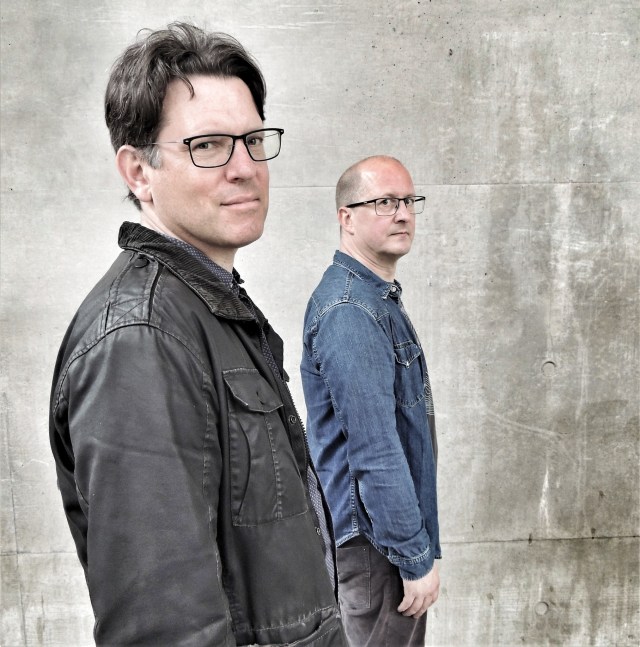
In my eight years as a music blogger, I’ve written about quite a few artists and bands with odd or quirky names, but one of the strangest of them all has to be that of British duo Hats Off Gentlemen It’s Adequate. Based in London and comprised of singer-songwriter, multi-instrumentalist and producer Malcolm Galloway and multi-instrumentalist and co-producer Mark Gatland, with help by Malcolm’s wife Kathryn Thomas on flute and backing vocals, they create their unique brand of progressive alternative rock, infused with experimental and classical elements, minimalist, metal, folk, funk, and electronica. I’m not exaggerating when I say they’re both multi-instrumentalists, as Malcolm plays lead guitar, keyboards/synths, percussion/drums and programming, while Mark plays bass, guitar, slide guitar, keyboards/synths, Chapman Stick (an electric instrument resembling the fretboard of an electric guitar, devised by Emmett Chapman, which has ten or twelve individually tuned strings) and additional percussion/drums.
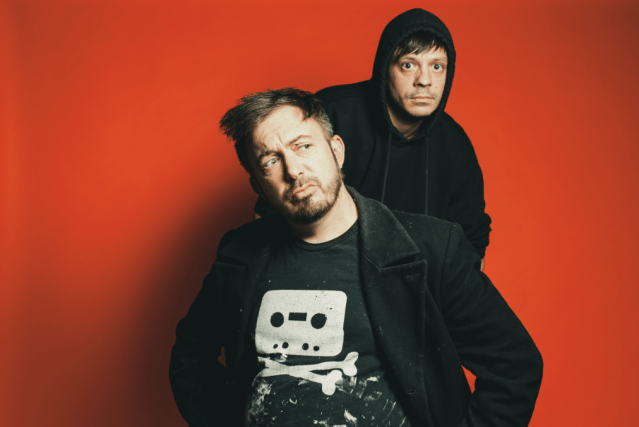
Photo of Malcolm and Mark by Kathryn Thomas
Longtime friends who’ve been playing together since they were in school, Malcolm and Mark’s music often explores scientific and philosophical themes, and they’re strong advocates of social and environmental causes. Accordingly, they’ve organized and supported charity events for Save the Children, Cancer Research UK, Marie Curie Cancer Care, Ehlers-Danlos Support UK, Brain Tumour UK and Prog The Forest, which raises money to protect over 40 acres of threatened habitat. From what I can tell, they’ve released quite a lot of music since 2012, including six albums, three EPs and numerous singles. On September 9th, they’re finally dropping their long-awaited seventh album The Light of Ancient Mistakes.
When they reached out to me about the album in July, I was initially overwhelmed by its size, subject matter and scope, and I admit it’s taken me a while to fully absorb this ambitious and fascinating work. Also, I’m a master procrastinator who always waits until the last minute to write my reviews, a bad habit going back to my college years that I’m afraid I’ll never be able to break. And finally, after reading some superb reviews of the album written by others, I’m now left feeling both intimidated and deflated, wondering how I can ever write a coherent review that does justice to this amazing album. I will give it my best effort.
Although not necessarily a concept album, many of the songs on The Light of Ancient Mistakes are inspired by various books, including works by Adrian Tchaikovsky, Iain M. Banks, David Cornwell (who wrote as John le Carré), Philip K. Dick, and Conservative MP Chris Bryant, as well as issues of personal importance and concern for Malcolm, who wrote all the lyrics. The music was co-written by him and Mark. The album contains 15 tracks, seven of which feature lyrics and vocals, while eight are instrumentals. The Bandcamp version of the album also includes four bonus tracks that are radio edits of four of the original 15.
The album opens with “Sold the Peace” a bitter diatribe against the corporate greed and political cowardice that have essentially negated all the hard-fought gains in the battle against authoritarianism in World War II and the Cold War period that followed, ushering in a new generation of despots, expressed in the lyrics “We risked it all to set the world free. Dead or free, the opportunity cost of the unused bombs. So much invested. We stormed the citadel, then bought the lease. We won the war, we sold the peace.” To drive home their point, the guys start with a grungy bass groove, then layer cinematic industrial synths, noirish piano chords and jagged guitar notes to create an unsettling soundtrack for Malcolm’s exasperated-sounding vocals.
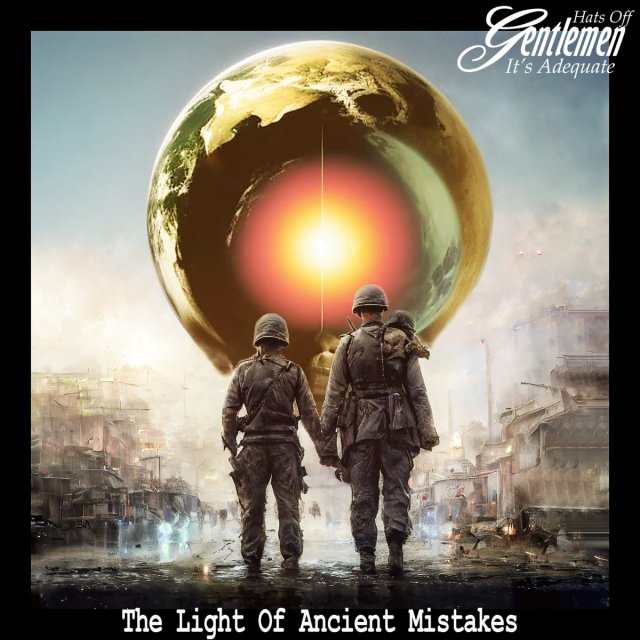
Next up is the hauntingly beautiful six-minute 40-second-long Pink Floyd-esque title track “The Light of Ancient Mistakes“, inspired by science fiction author Iain M. Banks’ novel Look To Windward. Malcolm explained the song to David Edwards of The ProgressiveAspect blog, “It explores the long-lived consequences of an atrocity. The light from a sun-destroying explosion has travelled for 800 years before reaching an orbital where a commemoration for the tragedy is due to take place. The protagonist of the song is an artificial intelligence trying to show the futility of cycles of hatred to someone planning an act of mass destruction.”
This is followed by the electronic instrumental track “Arvana Kern is Made of Ants“, which along with tracks 6 “The Requisitioner and the Wonder” and 8 “Gothi and Gethli“, refer to a character, two spaceships and a pair of crow-like creatures which insistently deny they are sentient in Adrian Tchaikovsky’s Children of Time series. The frantic skittering beats and swirling keyboards on “Arvana Kern is Made of Ants” cleverly evoke the non-stop flurry of activity one would see in a colony of ants, while the somber atmospheric tones of “The Requisitioner and the Wonder”, punctuated by some beautiful guitar notes, convey images of two spaceships traversing the heavens. Mark’s deliciously funky bass and Malcolm’s jazzy piano work make the jaunty “Gothi and Gethli” one of the most upbeat tracks on the album.
Track 4, “The Anxiety Machine Part 1“, is the first of a three-part triptych of darkly beautiful contemporary classical instrumental interludes that serve as connectors within the album, creating unsettling feelings of loneliness, resentment and desolation, in keeping with the overall feel of the album. This immediately segues into the heartbreaking “Sixteen Hugless Years“, a song inspired by the childhood experiences of David Cornwell, better known as John le Carré, namely the abandonment he felt after his mother left him and his family when he was five years old. The 16 years referenced in the song is the time that passed before his mother initiated a reconciliation. Malcolm’s vocals are filled with pain as he bitterly recalls “You packed your Harrod’s suitcase and left. You didn’t even slam the door. I was left with a hole. I didn’t grow up, I just got older. I was only five years old. Sixteen hugless years. Sixteen long, long years. I’ve grown old and I’m cold and hard but I’m told I’m the life and soul but it feels so hollow after 16 hugless years.” The musical highlights for me are Mark’s deep, throbbing bassline and Malcolm’s haunting guitar.
“The Glamour Boys” was inspired by Labour MP Chris Byrant’s book of the same name about the experiences of a group of mostly homosexual or bisexual Conservative MPs who argued against appeasement towards Nazi Germany and Fascist Italy, despite threats from Prime Minister Neville Chamberlain to expose their secrets. Many went on to risk, and in some cases lose their lives in the Second World War. “They call us the glamour boys. The punishment for speaking out. The leaks and smears and telephone taps. The hints the threat the veiled attacks.“
One of my favorite tracks on the album is “imtiredandeverythinghurts“, a chugging, energetic rocker inspired by Malcolm’s experiences with an invisible disability due to Ehlers-Danlos Syndrome (a group of inherited disorders that affect the bodies’ connective tissue, primarily skin, joints and blood vessel walls, resulting in chronic pain), and the challenge of responding honestly to the well-intentioned and seemingly benign question “how are you?” Malcolm elaborated to The ProgressiveAspect blog, “I don’t want to be dishonest with people by pretending to be fine when I’m not, but I also don’t want to drag people into a conversation about chronic pain that they may not be comfortable with. On the other hand, for those of us with conditions that vary from day to day (or hour to hour), it may be important to communicate what our current level of functionality is. I am also aware that there is no negative intention behind the question, and the last thing I want to do is to discourage people from communicating.” He plaintively sings “I keep smiling so you might not notice that I’m falling apart. I’m close to an edge. I need help. If this time you’re really asking, I’m tired and everything hurts.“
The centerpiece of the album is “Walking To Aldebaran“, an epic progressive rock masterpiece inspired by the science fiction novella of the same name by Adrian Tchaikovsky. Clocking in at just under nine minutes, the song features an exciting and eclectic mix of styles and textures, including progressive metal, free-form jazz, contemporary classical and musical theater, as it tells the story of space-ship pilot Garry Rendell who, due to a miscommunication between himself and an old, possibly malfunctioning but well-intentioned machine, is transformed into a monster. The colorful, intricate guitar work, jazzy piano, swirling synths and Kathryn’s lovely flute are all utterly exquisite throughout. Malcolm’s dynamic vocals alternately remind me of David Bowie, Al Stewart and a myriad of male vocalists from such Broadway musicals as Les Misérables and Phantom of the Opera as he forlornly laments “I’ve become what the monsters are scared of. I’ve been changed by the mother machine. I am the thing that used to be me.“
“Goodbye Cassini” is a beautiful instrumental tribute to the NASA probe that spent 13 years exploring Saturn and its moons. When its fuel supply was finally exhausted on September 15th, 2017 it plunged into Saturn’s atmosphere, still returning data right up until its end. The musical highlight of this track is Kathryn’s gorgeous flute. The effervescent instrumental “The Man Who Japed” is named after the 1950s Philip K. Dick novel of the same name, in which a previously obedient government official “japes” – i.e. commits a practical joke – by severing the head of a statue of their dictator in a symbolic act of resistance, thereby putting himself at personal risk. Malcolm created all the artwork for the album using AI assisted art creation software, and the one for this track is particularly good:
The final track “Burn the World” is an hauntingly beautiful and unsettling song about the perils of global warming, sung from the perspective of someone in the future looking back with regret on measures humans could have taken, but didn’t. Malcolm’s melancholy plaintive vocals are drenched in sadness and despair as he laments over lost opportunities that could have helped avert climate disaster: “We could have cared just enough to give ourselves a chance. But it’s easier to fail. We never learned to change. All the things we could have done, and we chose to burn the world.” The track has a strong progressive feel, with a meandering melody overlain by a mix of chiming and wailing guitar notes, ethereal synths, gritty bass and measured percussion. Hats Off Gentlemen It’s Adequate released “Burn the World” as a single in support of Prog The Forest, an environmental fundraising festival that donates to the World Land Trust, which acquires threatened rainforests and other valuable habitats to place them in protective trust in collaboration with local communities. They will be donating all proceeds from sale of the single until at least the end of 2024.
I’ve gone on and on, so will close by simply saying that, in my opinion, The Light of Ancient Mistakes is a certifiable masterpiece. The amount of thought, care, and effort Malcolm and Mark have put into creating this ambitious undertaking is truly astonishing, and they should be very proud of what they’ve accomplished. While the depth and complexity of the music and the rather dark, provocative subject matter of the lyrics may not be everyone’s cup of tea, I think it’s brilliant and worth a listen. If you like excellent progressive rock, you will enjoy this album.











 ECLECTIC MUSIC LOVER