There’s so much great music out now, I have at least 50 songs I’d like to put on my Weekly Top 30. “Seventeen Going Under” by Sam Fender remains at #1 for a second week. Closing in at #2 is Arcade Fire‘s heartwarming ““Unconditional I (Lookout Kid)”, while Lizzo slides into the #3 spot with her funk-pop earworm “About Damn Time”. German alt-rock band Milky Chance enter the top 10 with their cool song “Synchronize”. For some reason I cannot fathom, the song has not been anywhere near as popular as their previous single “Colorado”, even though I think it’s a better song.
Two songs make their debut this week: “Bones” by Imagine Dragons and “Grey” by Welsh rock band Holy Coves. While I’m a fan of Imagine Dragons, I didn’t care for their previous single “Enemy”, a massive hit now in it’s 35th week in the top 40 of the Billboard Alternative Airplay chart, nine of them at #1, but I do like “Bones” a lot. (“Enemy” and “Bones” currently hold the #4 and #5 spots on the Alternative chart.) I’ve resisted putting “Bones” on my chart for the past several weeks, but it’s just too damn infectious! “Grey” is the second song by Holy Coves to appear on my Weekly Top 30; their single “The Hurt Within” spent 11 weeks on my list this past Spring.
SEVENTEEN GOING UNDER – Sam Fender (1)
UNCONDITIONAL I (LOOKOUT KID) – Arcade Fire (3)
ABOUT DAMN TIME – Lizzo (5)
TELL ME THE TRUTH – Two Feet (2)
BELIEVE – Caamp (4)
A LITTLE BIT OF LOVE – Weezer (6)
2am – Foals (9)
AS IT WAS – Harry Styles (8)
MY LOVE – Florence + the Machine (7)
SYNCHRONIZE – Milky Chance (12)
THE FOUNDATIONS OF DECAY – My Chemical Romance (13)
CLOSER – The Frontier (14)
LONELY – Sea Girls (15)
THE FUNERAL – YUNGBLUD (17)
IN THE MIRROR – The Interrupters (18)
WARNING SIGNS – Band of Horses (19)
MISTAKES – Sharon Van Etten (21)
CHASING TRAINS – HULLAH (10) 19th week on list
WILD CHILD – The Black Keys (11)
DESPERATELY WANTING – Brian Lambert & Marc Schuster (22)
LIN MANUEL – Onism E (23)
FAILURE TO COMPLY – MISSIO (25)
BROKEN RECORD – NAVE (27)
BLOODRUSH – The Amazons (16)
UNTIL I FOUND YOU – Stephen Sanchez (29)
SUPERMODEL – Måneskin (30)
BEDS ARE BURNING – AWOLNATION feat. Tim McIlrath (20)
The subject for Day 15 of my 30 Day Song Challenge is “A songfrom the1980s“, and my pick is the glorious “Sledgehammer” by Peter Gabriel. With it’s wildly infectious driving rhythms and wonderfully trippy video, the song became one of the most beloved and popular of the 1980s. Released in April 1986 as the lead single from his critically-acclaimed and commercially successful fifth studio album, So, the song reached #1 in the U.S. and Canada, #2 in Austria, and the top 4 in Australia, Ireland, Norway, New Zealand, South Africa, Switzerland and the UK. The song was also nominated for three Grammy Awards for Best Male Rock Vocal Performance, Record of the Year and Song of the Year.
One of the things – among many – that make the song so uniquely fascinating was the use of a synthesized shakuhachi flute (a Japanese and ancient Chinese longitudinal, end-blown flute made of bamboo), generated with an E-mu Emulator II sampler. Gabriel said that the “cheap organ sound” was created from an expensive Prophet-5 synth, which he called “an old warhorse” sound tool. (Wikipedia) The great backing vocals were sung by P. P. Arnold, Coral “Chyna Whyne” Gordon, and Dee Lewis, who also sang backup on “Big Time”.
Ironically, “Sledgehammer” (which was Gabriel’s only song to reach #1 in the U.S.) replaced “Invisible Touch”, by his former band Genesis, at the #1 spot on the Billboard Hot 100 (which was their only #1 hit in the U.S. as well). In a 2014 interview with The Guardian, Phil Collins remarked “I read recently that Peter Gabriel knocked us off the #1 spot with ‘Sledgehammer’. We weren’t aware of that at the time. If we had been, we’d probably have sent him a telegram saying: ‘Congratulations – bastard.'”
You could have a steam train
If you'd just lay down your tracks
You could have an aeroplane flying
If you bring your blue sky back
All you do is call me
I'll be anything you needYou could have a big dipper
Going up and down, all around the bends
You could have a bumper car, bumping
This amusement never endsI want to be - your sledgehammer
Why don't you call my name
Oh let me be your sledgehammer
This will be my testimony
Show me round your fruitcage
'Cos I will be your honey bee
Open up your fruitcage
Where the fruit is as sweet as can beI want to be - your sledgehammer
Why don't you call my name
You'd better call the sledgehammer
Put your mind at rest
I'm going to be - the sledgehammer
This can be my testimony
I'm your sledgehammer
Let there be no doubt about itSledge Sledge Sledgehammer
I've kicked the habit, shed my skin
This is the new stuff, I go dancing in, we go dancing inOh won't you show for me and I will show for you
Show for me, I will show for you
Yeah, yeah, yeah, yeah, yeah, I do mean you, only you
You've been coming through
Going to build that power
Build, build up that power, hey
I've been feeding the rhythm
I've been feeding the rhythm
Going to feel that power build in youCome on, come on, help me do
Come on, come on, help me do
Yeh, yeh, yeh, yeh, yeh, yeh , yeh, yeh, you
I've been feeding the rhythm
I've been feeding the rhythm
It's what we're doing, doing
All day and night
The brilliant video for “Sledgehammer”, directed by Stephen R. Johnson and produced by Adam Whittaker, featured marvelous claymation, pixilation, and stop motion animation created by Aardman Animations and the Brothers Quay. For the video’s production, Gabriel had to lay under a sheet of glass for 16 hours while the video was filmed one frame at a time. In a 1986 interview with Philadelphia radio station WMMR, Gabriel commented “It took a lot of hard work. I was thinking at the time, ‘If anyone wants to try and copy this video, good luck to them.’” All that hard work paid off, as the video won an astonishing nine MTV Video Music Awards in 1987, more than any other video has ever won, as well as Best British Video at the 1987 Brit Awards.
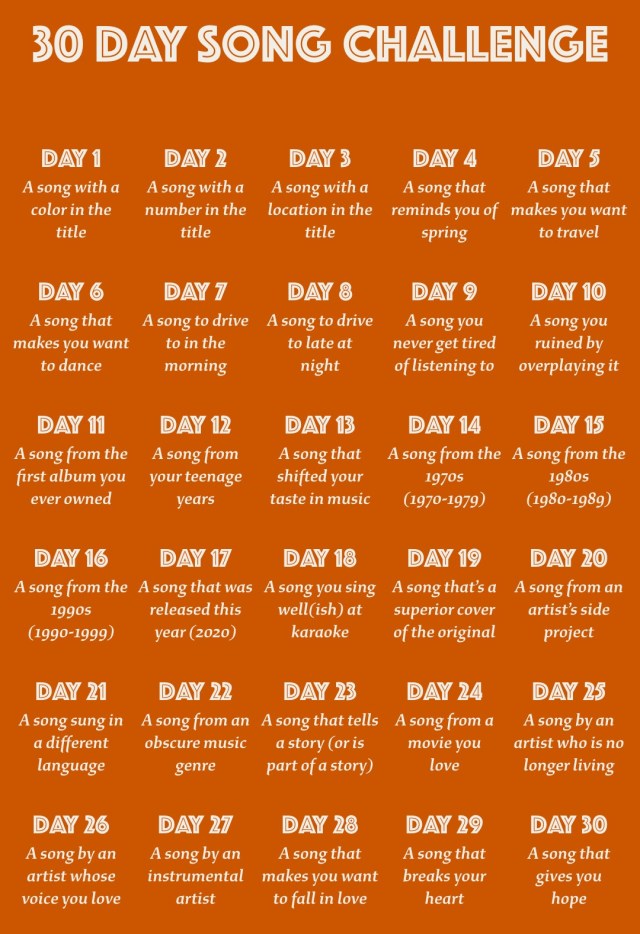
The subject for Day 14 of my 30 Day Song Challenge is “A songfrom the 1970s“, and my pick is “Year of the Cat” by Scottish singer-songwriter Al Stewart. The lead single from Stewart’s album of the same name, the song was released in July 1976 in the UK, and October 1976 in the U.S. It peaked at #8 on the Billboard Hot 100 and Adult Contemporary charts in early 1977, and was also a top 10 hit in Canada, Italy, Belgium and the Netherlands. Surprisingly, it would be Stewart’s only song to chart in his native UK, where it peaked at a disappointing #31. The album peaked at #5 on the Billboard 200 Album chart.
I was going through a break-up at the time the song came out, and though I was only 22, I felt anxious and confused about the direction my life was taking, almost like I was having a mid-life crisis. Consequently, the songs that really resonated with me in the early months of 1977 were Fleetwood Mac’s “Go Your Own Way” and “Dreams”, and Stewart’s “Year of the Cat”. I loved the song’s hauntingly beautiful melody, gorgeous arrangement, lush instrumentation, enchanting lyrics, and Stewart’s beguiling vocals. “Dreams” and “Year of the Cat” are my two favorite songs of 1977.
The song has kind of an interesting back story I discovered researching for this post. Stewart took the melody for “Year of the Cat” from “Foot of the Stage”, an unreleased song he wrote in 1966 after seeing a performance by comedian Tony Hancock, who joked about being a complete loser who might as well end it all right here (and sadly, later committed suicide). Nine years later, while touring the southern U.S. with Linda Ronstadt in 1975 (which according to a review by Katherine Hernandez of a concert Stewart gave in Edmonds, Washington in November 2017, was not a happy experience), he heard the tour pianist Peter Wood repeatedly playing a catchy chord progression during soundchecks that sounded somewhat similar to his original melody for “Foot of the Stage”. Stewart asked Wood if he could incorporate his piano notes into a song, and ended up giving Wood writing credit for “Year of the Cat”.
The song was recorded at Abbey Road Studios in January 1976, under the direction of engineer/musician Alan Parsons, who produced the track. In addition to Stewart, who sang vocals and played guitar and keyboards, Tim Renwick played both lead acoustic and electric guitars, George Ford played bass, Peter Wood and Don Lobster played additional keyboards, Stuart Elliot played drums and percussion, Andrew Powell played string arrangements, Bobby Bruce played violin, Marion Driscoll played triangle, and Phil Kenzie played alto saxophone. His marvelous sax solos transformed the song’s original folk concept into the jazz-influenced ballad that made it a big hit. Surprisingly, Stewart told Dallas radio program In the Studio with Redbeard that he didn’t like those sax solos at first but eventually grew to like them. (Wikipedia)
The song’s lyrics describe a male tourist who encounters a mysterious silk-clad woman while visiting a market in an exotic country. She promptly carries him off to a romantic adventure, which he willingly participates in, captivated by her charms. Upon waking the next day beside her, he discovers that his tour bus has left without him, and decides to stay where he is for now, in the year of the cat. The lyrics also make references to Humphrey Bogart and Peter Lorre, which Stewart was inspired to include after watching the film Casablanca. As for the song’s title, in the Vietnamese zodiac, the Cat is one of the twelve signs, and corresponds to the Rabbit sign in the Chinese zodiac. At the time of the song’s release, the most recent Year of the Rabbit had been February 11, 1975 to January 30, 1976, thus, the song was written and recorded in the Vietnamese Year of the Cat. (Songfacts)
On a morning from a Bogart movie
In a country where they turn back time
You go strolling through the crowd like Peter Lorre
Contemplating a crime
She comes out of the sun in a silk dress running
Like a watercolor in the rain
Don't bother asking for explanations
She'll just tell you that she came
In the year of the catShe doesn't give you time for questions
As she locks up your arm in hers
And you follow 'till your sense of which direction
Completely disappears
By the blue tiled walls near the market stalls
There's a hidden door she leads you to
These days, she says, I feel my life
Just like a river running through
The year of the catWhile she looks at you so cooly
And her eyes shine like the moon in the sea
She comes in incense and patchouli
So you take her, to find what's waiting inside
The year of the catWell morning comes and you're still with her
And the bus and the tourists are gone
And you've thrown away your choice you've lost your ticket
So you have to stay on
But the drum-beat strains of the night remain
In the rhythm of the newborn day
You know sometime you're bound to leave her
But for now you're going to stay
In the year of the cat
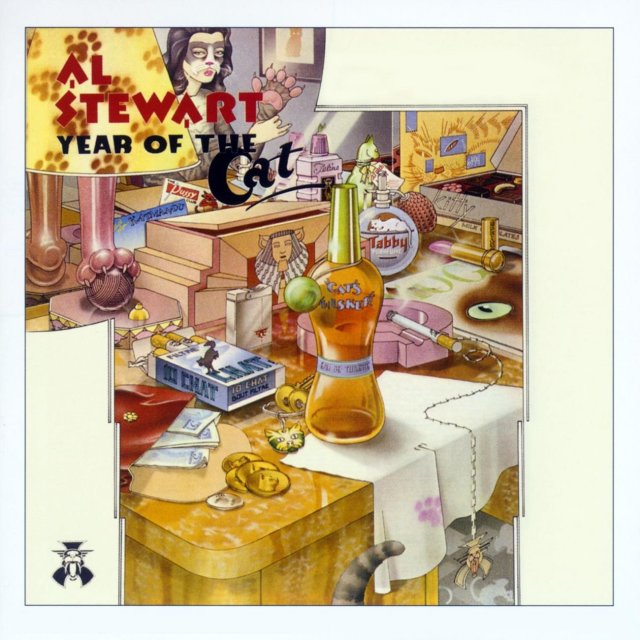
The album’s beautiful and whimsical cover art, designed by Hipgnosis and illustrator Colin Elgie, depicts a woman with an apparent obsession with cats reflected in a mirror as she dresses up as a cat, possibly for a costume party. The assortment of items displayed on her dresser all have cat motifs, and her cat’s tail is visible at the bottom.
Here’s a wonderful performance of the song by Stewart and fellow musicians at Daryl Hall’s home studio in upstate New York this past April.
The subject for Day 13 of my 30 Day Song Challenge is “A song that shifted your taste in music“. This was another difficult one for me, as I can’t really say that one song shifted my overall taste in music. My music tastes have always been pretty eclectic. My earliest music memories are hearing my much older brother (16 years older than me) play his Elvis Presley, Fats Domino, Little Richard and the Everly Brothers records in the late 50s, and my parents play their Frank Sinatra, Dean Martin, Ella Fitzgerald, Ray Charles, Steve Lawrence & Eydie Gorme albums. By the mid-60s, I was heavily into pop and R&B, especially music by the Beatles, Supremes, Four Tops, Righteous Brothers, Petula Clark and Mamas & Papas.
Looking back, there are some songs from genres I didn’t previously care for that made a very strong impression on me at the time. The first that comes to mind is Led Zeppelin’s “Whole Lotta Love” in 1969, which was harder and heavier than anything I’d heard before. I hated it at first, as I found it quite repellent, but eventually grew to love it. Although it made me a fan of Led Zeppelin, it didn’t necessarily make me a fan of hard rock or heavy metal, as I never cared to listen to the music of their contemporaries like Black Sabbath, AC/DC, KISS and Judas Priest. So no great shift in music taste there.
Another song would be Eminem’s “Lose Yourself”. When it came out in late 2001, I still hated rap music, and hated the song the first time I heard it. But after a couple more listens, I fell in love with it, so much so that it ended up becoming my second-favorite song of the 2000s (after “Clocks” by Coldplay). But once again, even though I loved the song, which also made me a fan of Eminem, it did not turn me into much of a fan of rap music, because I still dislike most rap.
After I started writing reviews at the request of artists and bands, I gradually became more receptive to different styles and genres of music beyond my normal comfort zone. One of those was metalcore/death metal, with its often very dark themes and harsh screamo vocals. And though I gained a newfound appreciation for that type of music and vocal style – even writing positive reviews of several singles and albums – I can’t say it ‘shifted’ my overall taste in music either.
After that long-winded discussion, I’m left with only one plausible choice, and that would be the magnificent “Rhapsody in Blue” by George Gershwin. Though my parents also had a few classical albums in their collection, I’d never formed an appreciation for classical music until one day in 1974. I was in a huge record store in San Jose with my dad and stepmom, when I heard some incredible music being played over their sound system. I asked my dad what it was, and he said it was “Rhapsody in Blue”. I was so taken with it that, right then and there, I bought an album featuring the piece, along with Gershwin’s other great composition “An American in Paris”, performed by The Boston Pops, and conducted by the renowned Arthur Fiedler.
George Gershwin was a brilliant American pianist and composer who tragically died far too young from a brain tumor at the age of only 38. Over his rather brief career, his compositions spanned both classical and popular – namely jazz – genres. He wrote “Rhapsody in Blue” in 1924 for solo piano and jazz band on a commission by bandleader Paul Whiteman for his special concert program entitled “An Experiment in Modern Music”. The rhapsody was then arranged for orchestra by Whiteman’s arranger Ferde Grofé, a composer and pianist who wrote the tone poem “Grand Canyon Suite” in 1931.
“Rhapsody in Blue” premiered at the concert held in Aeolian Hall on February 12, 1924 in New York City, with Whiteman’s band the Palais Royal Orchestra performing the rhapsody and Gershwin playing piano. The much-anticipated concert, which was intended to showcase modern musical trends, drew a large and excited audience consisting of vaudevillians, composers, symphony and opera stars, concert managers, Tin Pan Alley acolytes and flappers. The program was lengthy, with 26 separate musical movements, divided into two parts and eleven sections, with Gershwin’s rhapsody to be performed second-to-last before the final piece, Elgar’s “Pomp and Circumstance March No. 1”.
The audience was reportedly underwhelmed by many of the earlier numbers in the program which, combined with the malfunctioning ventilation system in the concert hall, caused those in attendance to become irritable and restless. Some were already heading for the exits by the time Gershwin appeared on stage to perform his rhapsody. But once they heard Ross Gorman’s haunting clarinet glissando (a continuous slide upward or downward from one pitch to another) that opened “Rhapsody in Blue”, they were mesmerized. That distinctive glissando was created almost as a joke. During rehearsals, clarinetist Gorman played the opening measure with a noticeable glissando, ‘stretching’ the notes out and adding what he considered a jazzy, humorous touch to the passage. Gershwin loved it, and asked him to perform the opening measure that way, and to add as much of a ‘wail’ as possible. (Wikipedia)
Upon the conclusion of the rhapsody, the crowd erupted in joyous applause. In contrast to the warm reception by concert audiences, however, professional music critics gave the piece decidedly mixed reviews. One opinionated music critic, Lawrence Gilman – a Richard Wagner enthusiast who would later write a devastating review of Gershwin’s Porgy and Bess – harshly criticized the rhapsody as “so derivative, so stale, so inexpressive” in a review for the New York Tribune.
Other reviewers were more positive. Samuel Chotzinoff, music critic of the New York World, conceded that Gershwin’s composition had “made an honest woman out of jazz,” while Henrietta Strauss of TheNation opined that Gershwin had “added a new chapter to our musical history.” Olin Downes, reviewing the concert in The New York Times, wrote: “This composition shows extraordinary talent, as it shows a young composer with aims that go far beyond those of his ilk, struggling with a form of which he is far from being master…. In spite of all this, he has expressed himself in a significant and, on the whole, highly original form.” (Wikipedia)
On the whole, “Rhapsody in Blue” has stood the test of time, and remains one of George Gershwin’s most recognizable creations and an important composition that helped define the Jazz Age. The piece inaugurated a new era in American musical history, established Gershwin’s reputation as an eminent composer, and eventually became one of the most popular of all concert works. It’s among my favorite classical pieces, and was the most instrumental in my coming to love and appreciate classical music.
My original 45 single of “It’s Too Late/I Feel the Earth Move”
The subject for Day 12 of my 30 Day Song Challenge is “A song from your teenage years“, and my pick is the poignant break-up song “It’s Too Late” by Carole King. I was 16 years old when the song came out in April 1971, and remember thinking that it had a more mature feel, both lyrically and musically, than most of the other songs I’d heard up to that point in my young life. Though I’d not yet been involved in a romantic relationship, the song’s bittersweet lyrics about the end of a love affair really resonated with me. I also loved the song’s simple, yet sophisticated, arrangement and King’s earnest vocals that beautifully expressed a sense of sad resignation, without being too maudlin.
The song was co-written by King, who composed the music, and Toni Stern, who wrote the lyrics. Stern later told author Sheila Weller for her 2009 book Girls Like Us: Carole King, Joni Mitchell, Carly Simon – and the Journey of a Generation, that she wrote the lyrics in a single day, after her love affair with James Taylor ended. For the recording of the song, King played piano and sang vocals, Danny Kortchmar played guitar and conga, Curtis Amy played the haunting saxophone, Charles Larkey played bass, Joel O’Brien played drums, and Ralph Schuckett played electric piano.
The lead single from her hugely successful and critically-acclaimed masterpiece album Tapestry, “It’s Too Late” was a massive hit, spending five weeks at #1 on both the Billboard Hot 100 and Adult Contemporary charts in the summer of 1971, and is my favorite song of that year. The single’s B-side “I Feel the Earth Move” also charted, peaking at #12. “It’s Too Late” was awarded a Grammy for Record of the Year in 1972.
Stayed in bed all mornin' just to pass the time
There's somethin' wrong here, there can be no denyin'
One of us is changin', or maybe we've just stopped tryin'

And it's too late, baby, now it's too late
Though we really did try to make it
Somethin' inside has died
And I can't hide and I just can't fake it
Oh, no, no, no, no, no
(No, no, no, no)

It used to be so easy, livin' here with you
You were light and breezy, and I knew just what to do
Now you look so unhappy and I feel like a fool

And it's too late, baby, now it's too late
Though we really did try to make it (we can't make it)
Somethin' inside has died
And I can't hide and I just can't fake it
Oh, no, no

There'll be good times again for me and you
But we just can't stay together, don't you feel it, too?
Still I'm glad for what we had and how I once loved you

But it's too late, baby, now it's too late
Though we really did try to make it (we can't make it)
Somethin' inside has died
And I can't hide and I just can't fake it
Oh, no, no, no, no

It's too late, baby
It's too late now, darling
It's too late
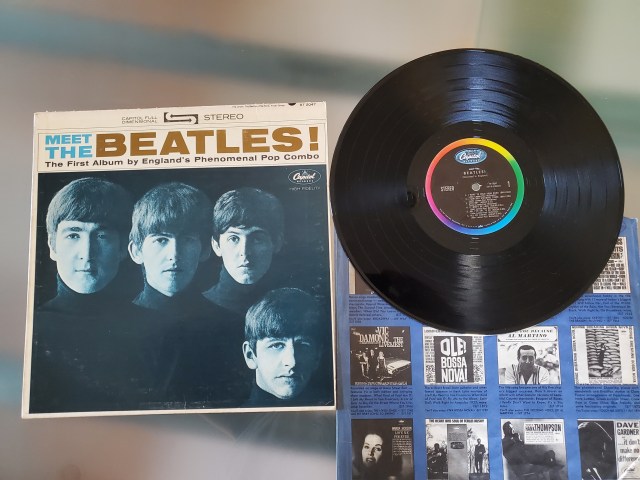
The subject for Day 11 of my 30 Day Song Challenge is “A song from the first album you ever owned“. This will reveal how ancient I am, but the first album I ever owned was Meet the Beatles!, which I bought in 1964 when I was nine years old. My copy, pictured above, is still in mint condition. The song I’ve chosen from the album is “I Want to Hold Your Hand“, which was my introduction to the Beatles, and their first Top 40 hit in the U.S. (The version of the album released in the UK was titled With the Beatles, and featured a different list of tracks, none of which was “I Want to Hold Your Hand”.)
The Beatles recorded “I Want to Hold Your Hand” at EMI Studios in London on October 17, 1963, along with “This Boy”, which became the B-side of the 45 single released in the UK. The two songs were recorded on the same day, and required seventeen takes to complete. The single was released on November 29, 1963 in the UK, and December 26, 1963 in the U.S., although the version released in the U.S. featured “I Saw Her Standing There” as the B-side.
The song entered the Billboard Hot 100 chart at #45 on January 18, 1964, which music historians mark as the beginning of the ‘British Invasion’ of the American music industry. It reached #1 on February 1st, and stayed there for seven weeks before being replaced by “She Loves You”, which had actually been released in September 1963, but shockingly, failed to catch on in the U.S. at the time. Despite receiving a positive review in Billboard, “She Loves You” garnered very little radio airplay, sold only about 1,000 copies, and completely failed to chart on Billboard (I previously featured “She Loves You” for another song challenge in 2020, which you can read here).
After the poor reception for “She Loves You” in the U.S., Capitol Records (the Beatles’ label for the distribution of their music in the U.S.) resisted releasing any more of their music, despite protestations by Beatles’ producer George Martin and manager Brian Epstein. Capitol finally released “I Want to Hold Your Hand” the day after Christmas 1963.
Though the song was quickly embraced by raving fans on both sides of the Atlantic, it was dismissed by some stodgy critics as nothing more than another fad song that would not hold up to the test of time. Proving them wrong, “I Want to Hold Your Hand” went on to become the Beatles’ best-selling single worldwide, selling more than 12 million copies, and in 2018, Billboard named it the 48th biggest hit of all time on its Hot 100. In the UK, it was the second highest selling single of the 1960s, behind “She Loves You”.
Here’s their famous performance on the Ed Sullivan Show on February 9, 1964.
Well, I somehow managed to skip over the correct Day 9 subject of the 30-day song challenge and mistakenly went directly to Day 10 for Saturday’s post. So, for today’s Day 10 post I’m going to tackle “A song you never get tired of listening to“. And once again, this was a tough call, as there are hundreds of songs I love that I never tire of hearing. But pick one I must, and to make my selection a little easier, I’ve chosen a beloved song I’ve not previously written about. My pick is “For All We Know” by the Carpenters. (I have previously written about the Carpenters though, when I featured their song “Superstar” in 2019.)
As I wrote in that earlier article, with their successful run of great singles from 1970-75, beginning with their massive hit “(They Long to Be) Close to You”, the Carpenters were one of my favorite acts back then. Their music was beautiful, with the kind of lush orchestration I love, and Karen Carpenter had the voice of an angel. Her distinctive, pitch-perfect contralto singing voice remains one of the finest of any female pop singer ever, in my opinion. I loved their music so much as a teen that I wrote a paper about them for my 11th grade English class (the only time I wrote about music or an artist until becoming a blogger several decades later).
“For All We Know” was written for the hilarious 1970 comedy Lovers and Other Strangers, with music by Fred Karlin and lyrics by Robb Wilson Royer and Arthur James Griffin (both Royer and Griffin were founding members of the soft rock group Bread). (Most of the songs recorded by the Carpenters were written by others, other than their hits “Goodbye to Love” and “Yesterday Once More”, which were co-written by Richard Carpenter and John Bettis, “Only Yesterday” by Carpenter, Bettis and Kōji Makaino, and “I Need to Be in Love” by Carpenter, Bettis and Albert Hammond.) The song was originally sung by Larry Meredith for the film’s soundtrack, and when Richard heard his version while watching Lovers and Other Strangers, he felt the song would be perfect for their style and Karen’s voice.
For the recording of the song, Richard initially wanted Jose Feliciano, who was a big fan of theirs and wanted to play on one of their records, to play guitar on the intro. They went into the studio, where Feliciano came up with an intro on his nylon string acoustic guitar, however, the following day Feliciano’s manager demanded that he be removed from the recording. (Wikipedia) Disappointed but undaunted, Richard removed Feliciano’s guitar intro and replaced it with a beautiful oboe intro by Earle Dumler (an esteemed musician who played on several Carpenters records, as well as with an eclectic range of artists such as Stan Kenton, Tim Buckley, J.D. Souther, Frank Zappa, Helen Reddy, Barbra Streisand, Robert Palmer and Nina Simone, among many others over the years). Though I haven’t heard Feliciano’s guitar intro, I believe Dumler’s sublime oboe intro had to have made the song much better. Besides Dumler’s oboe, the other instruments on “For All We Know” were played by Richard Carpenter (piano, Hammond organ, Wurlitzer electric piano), and Wrecking Crew members Joe Osborn (bass) and Hal Blaine (drums).
“For All We Know” was also recorded by Shirley Bassey at the same time as the Carpenters’ version, where it was a hit in the UK, peaking at #6, and later by Petula Clark and Nicki French. But it was the Carpenters’ recording that’s the best known and most popular, reaching #3 on the Billboard Hot 100 chart and #1 on the Easy Listening chart in 1971. The song also won the Academy Award for Best Original Song.
An interesting bit of trivia I learned in researching the song for this write-up is that the Motion Picture Academy did not previously allow artists to perform a best original song nominee at the Oscars if they had not appeared in a film, which finally explains for me why Anne Reinking sang “Against All Odds” (in a terrible performance that included a bizarre interpretive dance) at the 1985 Oscars instead of Phil Collins, but I digress. Since the Carpenters were not allowed to perform “For All We Know” at the ceremony, they requested that it be performed by their friend Petula Clark. Clark would later perform the song in tribute to Karen Carpenter at her concert at Royal Albert Hall on February 6, 1983, two days after Karen’s untimely and very sad death. Here’s a video of that poignant performance:
A year after it’s release in July 2021, the beautiful “Seventeen Going Under” by the immensely talented English singer-songwriter Sam Fender reaches the pinnacle of my Weekly Top 30. Somewhat of a sleeper hit, the song finally peaked at #3 on the UK Singles Chart this past January, when it also began getting airplay in the U.S. It eventually appeared on various Alternative song charts (where it recently peaked at #10 on the Billboard Triple A chart). Though I actually ranked it #44 on my Top 100 Songs of 2021 list, I felt compelled to add the song to my Weekly Top 30 in May, and it’s quickly climbed my chart ever since. Even though it’s now fallen off most charts, I love it more than ever, and it’s my current favorite song. Those gorgeous jangly guitars, exuberant trumpet and sax, cracking drumbeats and Fender’s arresting tenor vocals are all magnificent.
Written by Fender and released as the lead single from his brilliant and critically acclaimed second album Seventeen Going Under, the album in general, and song in particular, chronicle his life at 17 when his mother was afflicted with fibromyalgia and depressed because she could no longer work after 40 years of service as a nurse. Though she’d never missed a day of work, the Department for Work and Pensions harassed her with letters and treated her unjustly. Fender wanted to help her financially, even considering selling drugs to earn money, but she talked him out of it. In an interview with Rolling Stone, he commented: “That’s when my rose-tinted glasses fell off. 17 is when all the challenges begin: you’re not a baby, but you’re definitely not an adult.” With his striking tenor voice, strong Geordie accent, and heartthrob good looks, it’s hard to believe Fender was bullied for being overweight and unathletic as a child.
I think “Seventeen Going Under” is one of the most perfect songs I’ve heard in a long while, and in May, the song won the Ivor Novello Award for Best Song Musically and Lyrically from the British Academy of Songwriters, Composers, and Authors. Fun fact: Sam Fender also plays Fender guitars.
In other chart highlights, Arcade Fire‘s “Unconditional I (Lookout Kid) leaps 8 spots to #3, and YUNGBLUD‘s “The Funeral” jumps 6 spots to #17. Debuting at #s 29 & 30 are the beautiful “Until I Found You” by Nashville singer-songwriter Stephen Sanchez and “SUPERMODEL” by Italian band Måneskin.
SEVENTEEN GOING UNDER – Sam Fender (2)
TELL ME THE TRUTH – Two Feet (1)
UNCONDITIONAL I (LOOKOUT KID) – Arcade Fire (11)
BELIEVE – Caamp (6)
ABOUT DAMN TIME – Lizzo (7)
A LITTLE BIT OF LOVE – Weezer (8)
MY LOVE – Florence + the Machine (4)
AS IT WAS – Harry Styles (5)
2am – Foals (10)
CHASING TRAINS – HULLAH (3)
WILD CHILD – The Black Keys (9)
SYNCHRONIZE – Milky Chance (13)
THE FOUNDATIONS OF DECAY – My Chemical Romance (15)
CLOSER – The Frontier (16)
LONELY – Sea Girls (17)
BLOODRUSH – The Amazons (12)
THE FUNERAL – YUNGBLUD (23)
IN THE MIRROR – The Interrupters (20)
WARNING SIGNS – Band of Horses (21)
BEDS ARE BURNING – AWOLNATION feat. Tim McIlrath (19)
MISTAKES – Sharon Van Etten (26)
DESPERATELY WANTING – Brian Lambert & Marc Schuster (24)
The subject for Day 9 of my 30 Day Song Challenge is “A song you ruined by overplaying it“. This is my least-favorite item on this song challenge, because 1) it’s negative, and 2) I don’t as a rule ruin songs for myself by overplaying them. Obviously, I only intentionally play songs that I want to hear, and if I’m tired of a song, I won’t play it. However, radio stations have ruined a number of songs for me over the years by playing them over and over until I’m sick to death of them, so I’m tweaking this subject to “A song that was ruined for me by being overplayed“.
I don’t listen to much commercial radio anymore, except occasionally when in the car, but when I was a teenager and young adult, I listened to a lot of radio. When I think back on songs that I’d liked at first, but later grew to detest because they were so grossly overplayed, most were generally from the 70s and 80s. And the one that most quickly comes to my mind is the 1972 classic “American Pie” by Don McLean. It was a massive #1 hit and one of the most popular songs of the 1970s, and like all big hits, it was played to death on the radio. To make matters worse, it was so damned long, clocking in at over 8 1/2 minutes, and seemed to go on forever. I liked it at first, but after a few months of non-stop airplay (back in the day when hearing songs on the radio was our main form of listening to music besides playing them on our stereos), I came to loathe it. The moment I’d hear “Long, long time ago…” I’d jab my finger on the radio button to change the station as quickly as possible.
If I never hear “American Pie” again that would be a good thing. And if I had my own radio station, it, along with a several other songs, would not be allowed in the building.
The subject for Day 8 of my 30 Day Song Challenge is “A song to drive to late at night“, and the first song I thought of was “I Drove All Night” by Cyndi Lauper. (A runner-up was the beautiful Cars song “Drive”, but Cyndi Lauper’s 1989 hit is a no-brainer for this subject.) The song was a sizable hit for Lauper, reaching #6 on the Billboard Hot 100, #7 in the UK and #8 in Canada. She had a string of hits from 1984-89, beginning with “Girls Just Want to Have Fun”, and two of them – “Time After Time” and “True Colors” went all the way to #1. “I Drove All Night” was her last single to reach the top 10 in the U.S.
The song was originally written by Billy Steinberg and Tom Kelly for Roy Orbison, who recorded it in 1987, a year before his death, but his version was not released until 1992. Lauper recorded the song and released it as a single in April 1989. She liked the song and wanted to record her version because she liked the idea “of a woman driving, of a woman in control.” I love the strong propulsive rhythms, blasting drumbeats and edgy strings that powerfully convey the passion and urgency of a woman driving all night to get to her lover. And I really like Lauper’s vocals, which have a somewhat more mature quality than on some of her earlier songs.
The song was included on her third studio album A Night to Remember, and considered by nearly everyone to be the highlight of an otherwise disappointing album. A Night to Remember received mixed-to-poor reviews and less commercial success than her two previous albums. Because of its poor reviews and disappointing sales, as well as the problems she experienced with producer and boyfriend David Wolf during the production of the album, Lauper referred to it as “A Night to Forget”. Despite the album’s poor performance, “I Drove All Night” was nominated for a Grammy for Best Female Rock Vocal Performance.
The song was also later covered by Celine Dion in 2003, whose version topped the Canadian Singles Chart and reached #7 on the Billboard Adult Contemporary chart.
Here’s Roy Orbison’s original version, which is also pretty good. The song’s official video features the young and very beautiful actors Jennifer Connelly and Jason Priestly.







 ECLECTIC MUSIC LOVER